Conversions of Energy
Endothermic and Exothermic
Equilibrium
Rate of reaction
Chapter 7
100
The nutrition label reads 8 g of Total Fat. Convert this to Calories.
72 Calories
100
Is this reaction curve Exothermic or Endothermic?
Endothermic
100
Which way does the reaction shift:
Remove NaCl
HCl+NaOH→NaCl+ H2O
Shift to the right
100
If there is less heat/ lower temperature, how does that affect kinetic energy and the speed of the reaction?
If there is less heat, the kinetic energy of the molecules decreases. As a result, particles move more slowly, leading to fewer collisions. This reduction in collisions decreases the reaction rate because there is less energy available for the molecules to overcome the activation energy.
100
What is the temperature (in C) for melting point and boiling point?
Melting Point: 0 C
Boiling Point: 100 C
200
Convert 500 calories to Joules.
2092 J
200
Is this reaction curve Exothermic or Endothermic?
Exothermic
200
Which way does the reaction shift:
Add HCl
HCl+NaOH→NaCl+ H2O
Shift to the right
200
How does increasing the concentration of reactants affect the rate of a chemical reaction
Increasing the concentration of the reactants will lead to a higher number of reactant molecules which cause frequent collisions, resulting in more frequent reactions occurring.
200
If you have a container and compare it to a larger one containing the same number of particles, how does the pressure change?
The pressure would decrease in the larger container since the particles have more space to move around
less collisions = lower pressure
300
Convert 200,000 Joules to Calories. Round to 3 sig figs.
47.8 Cal
300
What is the activation energy?
Draw the graph:
Reactants = 55
Products = 100
Top of curve = 210
Ea = 155
300
Which way does the reaction shift:
Remove heat (endothermic)
HCl+NaOH→NaCl+ H2O
Shift to the left
300
Does a catalyst cause a shift in equilibrium?
No, because it speeds up both the forward and reverse reactions equally. A catalyst just helps a reaction achieve equillibrium faster.
300
What do each of the components of PV=nRT stand for?
P = pressure
V = volume
n = number of moles
R = constant
T = temperature
400
Calculate the Total Calories using grams of Total Carbs, Total Fat, and protein. 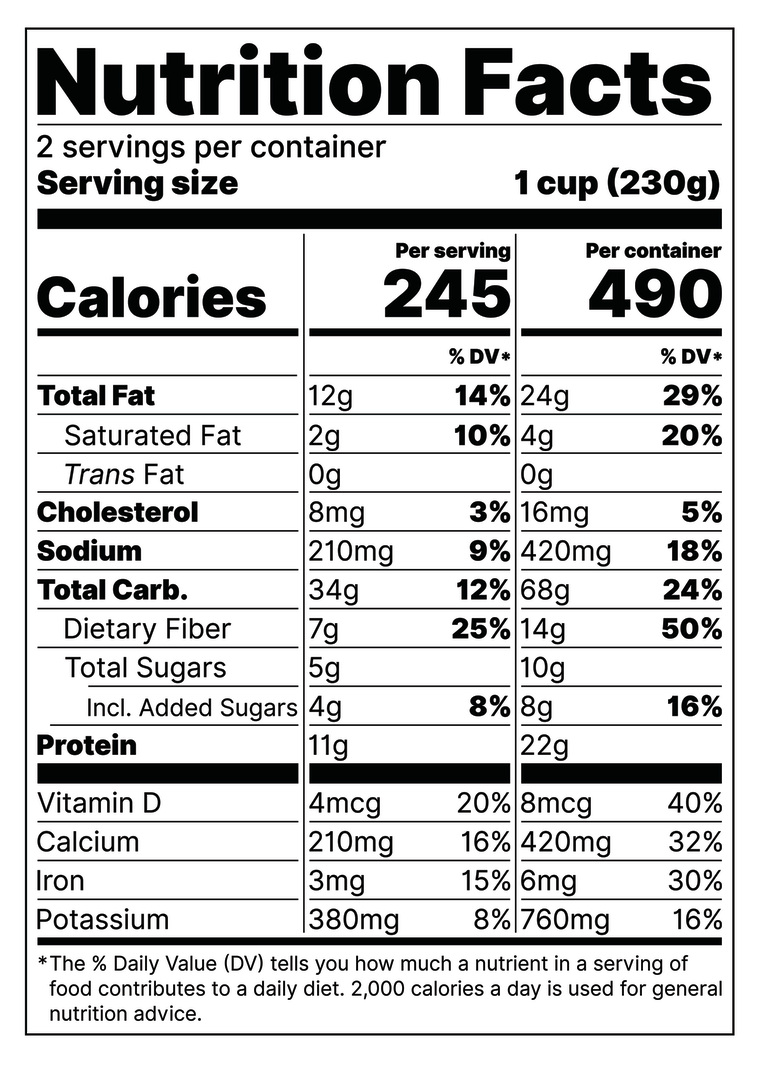
Carbs: 136 Cal
Fat: 108 Cal
Proteins: 44 Cal
Total Calories: 288
400
An Exothermic reaction ________ heat to surroundings.
An Endothermic reaction ________ heat from surroundings.
An Exothermic reaction releases heat to surroundings.
An Endothermic reaction absorbs heat from surroundings
400
Which way does the reaction shift:
Add H2O
HCl+NaOH→NaCl+ H2O
Shift to the left
400
True or false: Equilibrium occurs when the overall concentrations stop changing.
True
400
Container A has a pressure of 1,520 torr, and Container B has a pressure of 1.8 atm.
A) Which container has the higher pressure?
B) What could cause a container to have a higher pressure (think about gas particle collisions, volume, or temperature)?
1atm = 760 torr
Container A: 2.00 atm
Container B: 1.8 atm
Container A has the higher pressure
Higher pressure means gas particles collide more often and with greater force on the walls of the container. This can happen when:
- The volume is smaller --> less space to move
- Temperature is higher --> particles move faster
- There are more gas particles --> more in same space
500
Calculate the Total Calories using grams of Total Carbs, Total fat, and Protein. Then, subtract grams of fiber from the grams of Total Carbs, to get the net carbs. Recalculate the Total Calories and see which Calorie amount is closest to the nutritional label.
Carbs: 104 Cal
Fat: 45 Cal
Proteins: 16 Cal
Total Cal: 165
Net carbs w/ out fiber: 92 Cal
Fat: 45 Cal
Proteins: 16 Cal
Total Cal: 153 (closer to label)
500
Add heat to this chemical equation to make it an Exothermic reaction. Would the heat of reaction be positive or negative?
CH4+2O2 --> CO2+2H2O
CH4+2O2 --> CO2+2H2O + HEAT
The heat of reaction would be negative.
500
Which way does the reaction shift:
Remove NaOH
HCl+NaOH→NaCl+ H2O
Shift to the left
500
Draw an exothermic reaction without a catalyst and one with a catalyst.

500
A container initially holds 3.0 moles of gas at a pressure of 45 atm. If the pressure increases to 65 atm while the volume and temperature remain constant, what is the new number of moles of gas in the container?
4.3 moles