Analyzing Graphs
Continuity and End Behavior
Extrema and Average Rates of Change
Parent Functions and Transformations
Inverse and Composite Functions
100
This is the domain and range of the function seen here:
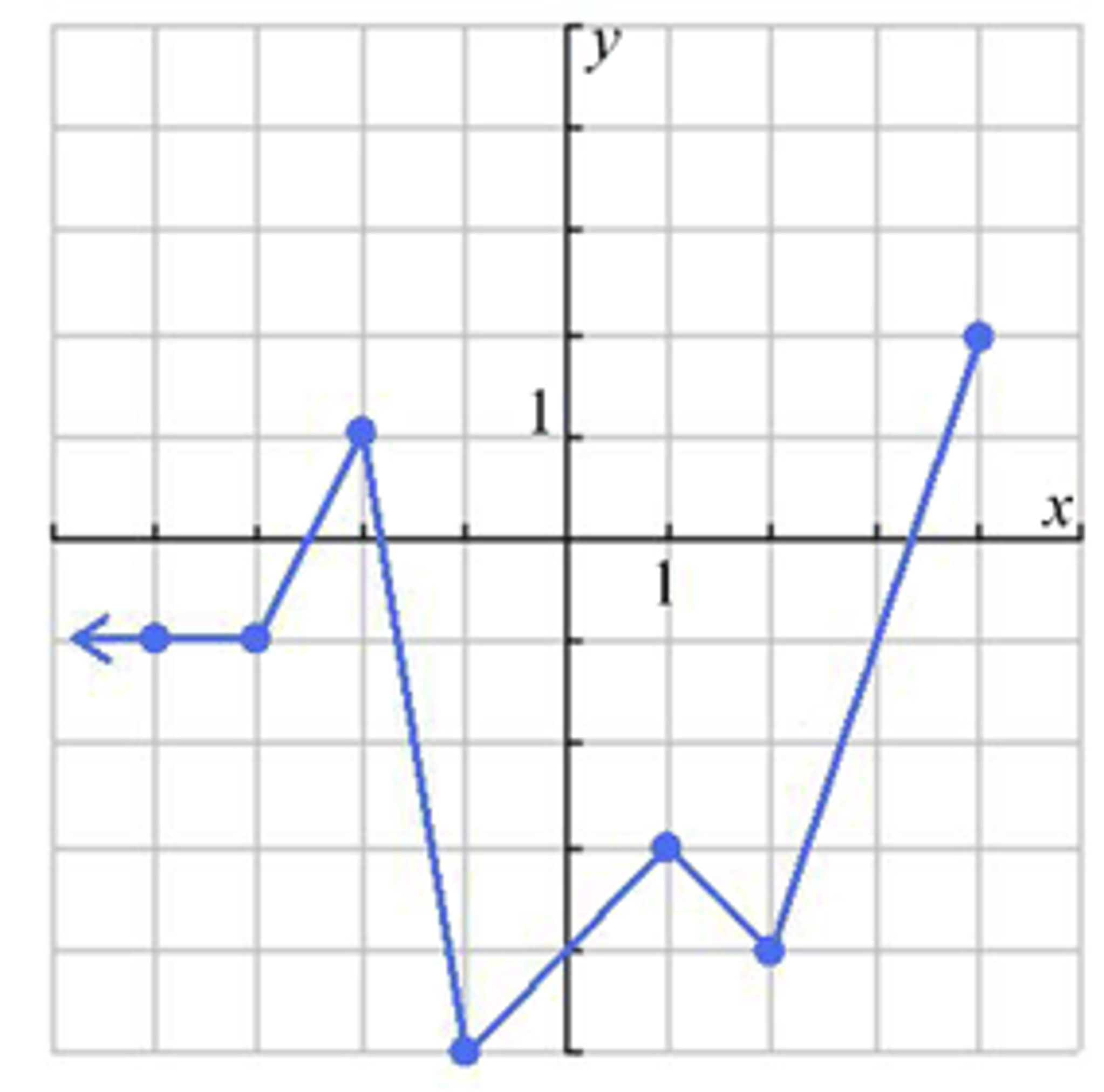
Domain: (-infinity, 4]
Range: [-5,2]
100
Is the function continuous or not at x=7?
y = 1/(x-7)
It is not continuous
100
Estimate the intervals the function is increasing and decreasing on:

Increasing: (- infinity, -0.25) (2.25, infinity)
Decreasing: (-0.25, 2.25)
100
Identify the parent function and transformation on the parent function:
f(x)=2x3-10
cubic function (y=x3)
Vertical Stretch by a factor of 2
Vertical translation down 10
100
Does the function have an inverse? Why or why not?
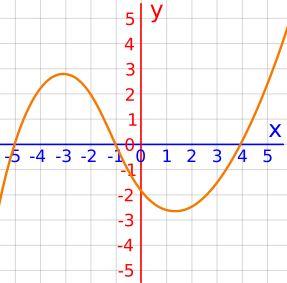
No- it is not one-to-one (Does not pass the horizontal line test)
200
This is the y-intercept of y=x2+6x+10
What is point (0,10)?
200
The position and types of discontinuities seen in the graph below:
x=-2, removable
x=2, jump
200
Based on the following table, name the intervals where the function is increasing and decreasing: x
x y
-1.5 -16
-1 -10
-0.5 2
0 1
0.5 0
1 3
[-0.5,0]
[0.5,1]
200
This is the equation of the reciprocal function translated right 4 and down 7 units
f(x)=1/(x-4) -7
200
Find the inverse of f(x)=3x+6
f-1(x)= x/3 - 2
300
These are the x-intercepts of y=3x3-48x
What are (0,0), (4,0) and (-4,0)?
300
There would be a discontinuity at what x value for this function:
y= 1/(x+9)
x=-9
300
Using your calculator, find the intervals to the nearest hundredth where the function is increasing and decreasing
f(x)= -2x3+4x2+6x
Decreasing: (- infinity, -1.12) (1.79, infinity)
Increasing: (-1.12, 1.79)
300
What is the equation of the quadratic function vertically compressed by a factor of 2, and shifted left 5?
f(x)=1/2(x+2)2
300
Find the inverse of f(x)=x2+9
f-1(x)=sqrt(x-9)
400
Is this function even, odd, or neither?
It is neither one
400
This is how you would describe the end behavior of the following function:

As x approaches - infinity, f(x) approaches infinity
As x approaches infinity, f(x) approaches - infinity
400
Find the average rate of change on the interval [-2,1] of the function f(x)=-6x2+2x-18
8
400
Write the equation of the following function:
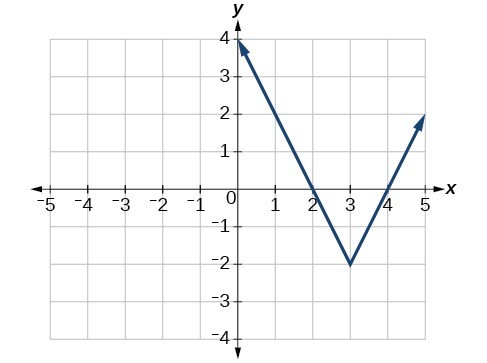
f(x)=2*abs(x-3)-2
400
Find f(g(x)) if f(x)=3x+6 and g(x)=x2-8
f(g(x))=3x2-18
500
This phrase describes the symmetry of the following graph

What is Symmetrical with respect to the origin
500
Based on the following table, zeros of the function are likely to be between these integer intervals:

[-2,-1]
[0,1]
[1,2]
[2,3]
500
Using your calculator, identify the position (to the nearest hundredth) and type of extrema occuring in this function:
f(x)= -3x4+10x3-17x+9
Absolute Max: (-0.67,16.78)
Relative Max: (2.21,7.81)
Relative Min: (0.96, -1.02)
500
Write the equation of a cubic function that is reflected over the x-axis, vertically stretched by a factor of 3, shifted right 2, and shifted down 8.
f(x)= -3(x-2)3-8
500
If f(x)= 2x+5 and g(x)=x2-8, Find g(f(2))
g(f(2))=39