Earth Movement
Eclipses
Tides
Moon Phases
Lucky Dips
100
How long does it take for the Earth to complete a full rotation on its axis?
24 hours
100
Name the order of the three celestial bodies that are in play during a Lunar eclipse.
The three celestial bodies that are in play during a Lunar eclipse are the Sun, Earth and Moon, in that order.
100
How many high and low tides are experienced in one location during a 24 hour period?
2 high and 2 low tides
100
How long does it take for the Moon to do a full rotation on its axis, and how long does it take to revolve the Earth?
It takes 29 and a half days to complete both rotation and revolution.
100
What direction do the stars and planets appear to move across the night sky?
The stars and planets appear to move from East to West across the sky, due to the Earth's rotation.
200
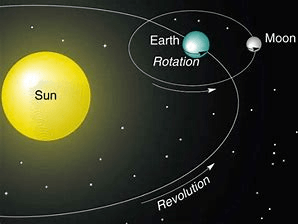
Describe how the Earth moves around the sun.
The Earth revolves around the sun in a circular pattern while rotating on its own axis.
200
List the two shadow components that shadow the Earth during a solar eclipse.
The two shadow components are the umbral and the penumbral shadows.
200
Explain how high and low tides occur.
Primarily it is the Moon's gravitational pull causes the tides.
200
Name the Moon phase after a waxing gibbous, and state how many days into the lunar month it is expected to occur.
The phase after the waxing gibbous is a Full Moon, and would normally occur approximately 14 days
200
Which season experiences the longest day and what is this day called?
The longest day - as in the longest period of daylight - occurs in summer and is referred to as the Summer Solstice.
300
Distinguish what direction the Earth rotates on its axis and what way the Earth moves around the sun.
The Earth rotates on its axis counter clockwise (East to West from the top), and it revolves the Sun in the same direction.
300
Illustrate a Solar Eclipse
Must include labels

300
Illustrate a diagram showing where the Moon is positioned during a Neap tide, including the moon phases.

300
Explain why a quarter moon is called a quarter moon.
A quarter moon is called a quarter moon because even though half of the Moon is illuminated, only a quarter of the Moon's surface is visible to us on Earth during that phase. Also, the moon is a quarter (or 3/4s) of the way through its revolution.
300
Explain how and why Blue moons occur.
Blue Moon is the name given to a second full moon which takes place in the one calendar month. They occur usually in the months with more days than a normal lunar month - where the full moon occurred within the first few days of the month.
400
Explain why the Earth's tilted axis is relevant to the seasons.
The tilt is important to the seasons because the Northern and Southern hemispheres will be exposed to more or less direct sunlight, which impacts the season they experience.
400
Outline in detail what is needed for a Solar eclipse to occur, and how is it experienced on Earth.
A total solar eclipse is when the Moon fully blocks the Sun and this can only happen when the Sun, Moon and Earth are exactly aligned. This creates a shadow on the Earth, and this is experienced by a specific area on the surface for a small period of time.
400
Interpret what would need to happen for the frequency of tides to increase per day.
The Earth would need to spin at a faster rate for the Moon to have a more frequent impact on the tides, as the Earth's rotation would mean it would align with the Moon in shorter timeframes.
400
Differentiate between a waxing and a waning moon.
A waning moon has the moon illuminated on the left whereas the waxing moon has the moon illuminated on the right. The waxing moon phases occurs as the moon moves from new moon to full moon, whereas waning relates to the stages as it moves from full moon to new.
400
Explain why solar and lunar eclipses don't occur during every new moon or full moon.
Solar and Lunar eclipses don't occur every new and full moon because the Moon's orbit is slightly slanted (by approximately 5 degrees) and the three celestial bodies need to be aligned perfectly for the eclipses to occur.
500
What is the angle of the Earth's axis, and what would you anticipate would happen if the angle was either larger or smaller than it is now?
Example answer:
The angle of the Earth's axis is 23.5 degrees. Because seasons are caused by the changing angles that sunlight strikes the Earth, a decrease in tilt would mean less extreme seasons. Spring and fall are not affected by tilt because they are at the point in orbit where sunlight is hitting the earth evenly. However, less tilt would mean less of a change in angle around the orbit and therefore cooler summers and warmer winters. If the angle was larger, seasons would be more extreme. Some places on Earth would be in night for weeks or months and others would be in perpetual light for as long.
500
Predict what would happen during a total solar eclipse if the Moon was larger in size.
It would be expected that you would see a larger shadow cast on the surface, creater a larger Umbra and Penumbra - meaning more opportunity for people to be within the umbral shadow.
500
If the Moon was to move 2 times the distance away from the Earth, would it impact the tides? Explain why.
Yes, this is because the further away the Moon is, the less gravitational pull it has causing it to have a lesser impact on the tides.
500
Predict what would happen to the Moon phases id the Moon's revolution around the Earth was faster.
It would be expected that the moon phases would be shorter individually if the Moon revolved the Earth more quickly, and the lunar month would also be shorter.
500
Speculate what the world would be like without the Moon.
There would be less tidal change, no lunar or solar eclipses and nothing would brighten the night sky. It is also possible the Earth's rotation may slow.