Photography
Injuries
100
To provide a record of the findings at the time of the exam
What is the purpose of photo documentation? (page 198)
100
Redness caused by capillary dilation
What is erythema? (page 100)
200
This item is used to provide reference for injury size
What is a standard/measuring device/L-ruler? (page 199)
200
A complete injury description for this image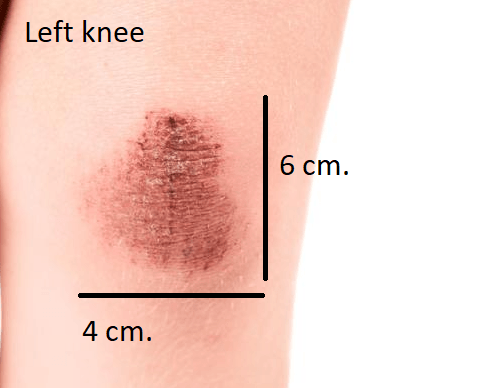
A 4cm. by 6cm. irregular scabbed red abrasion midline left knee (page 215)
300
this item resembles a pair of binoculars and is used to examine external genitalia
What is a colposcope? (page 200)
300
this occurs from a tear in the skin when the stretching of fibers is exceeded due to the impact of blunt force trauma
What is a laceration? (page 102)
400
An imperative practice used to review examination findings as a means of ensuring accuracy and quality
What is peer review? (page 201)
400
Extravasation (leakage) of blood into tissue
What is ecchymosis? (page 102)
*how is bruising different?
500
The patient is uncomfortable with photos being taken, the patient has religious or cultural objections, or the patient doesn't tolerate photo-documentation
What are reasons that photography should be discontinued/not used during the medical forensic exam? (page 202)
500
Cardiac arrhythmia provoked by pressure on the carotid artery nerve ganglion causing cardiac arrest
Pressure obstruction of the carotid arteries prevents blood flow to the brain
Pressure on the jugular veins prevents venous blood flow from the brain, backing up blood in the brain and leading to unconsciousness, depressed respirations, and asphyxia
Pressure obstruction of larynx cuts off airflow, producing asphyxia
What are the four mechanisms of death by strangulation? (page 109)