Coordinate Rules
Reflections
Translations
Rotations
Compositions
100
What is the coordinate rule for a reflection over the x-axis?
(x,y)--->(x,-y)
100
A reflection changes the orientation of the figure, TRUE OR FALSE
True
100
What does this translation vector tell us to do?
<2,-3>
Right 2
Down 3
100
What is the image of A(2, 5) after a rotation of 180 degrees?
A'(-2, -5)
100
This is what we call a transformation that consists of 2 or more transformations performed one after the other
composition
200
What is the coordinate rule of reflecting over the line y=x?
(x,y)--->(y,x)
200
Find the new coordinates of (3,-2) after you reflect the point over the x-axis.
(3,2)
200
What happened in the situation (x+2,y-4)?
Right 2 units and down 4
200
What is the image of V(4, 5) after a rotation of 90 degrees counterclockwise?
(-5, 4)
200
The first translation maps J to J' and the second maps J' to J". This is the translation that maps J to J". Translation 1: (x, y) -> (x+7, y-2) Translation 2: (x, y) -> (x-1, y+3) Translation: (x, y) -> (____? , _____?)
(x+6, y+1)
300
What is the coordinate rule for a 90 degree rotation counter clockwise about the origin?
(x,y)--->(-y,x)
300
What is the new location of our point Z(-2,-4) when reflected over the line y=x?
(-4,-2)
300
Find the new coordinates of (10,12) if you translate the point 3 units left and 4 units up.
(7,16)
300
C(4, 9) is rotated about the origin and becomes C'(9, -4). Write a rule for this rotation.
90 counterclockwise
300
The point T(-3, -7) is rotated 90 degrees about the origin, then reflected over y-axis. These are the coordinates of T'.
(7, 3)
400
What is the coordinate rule of a rotation 180 degrees counter clockwise about the origin?
(x,y)--->(-x,-y)
400
Rectangle with the points of D(5,5) E(5,8) F(8,8) G(8,5) is reflected over the y-axis. Label the new points
D'(-5,5), E'(-5,8), F'(-8,8), G'(-8,5)
400
Write the vector <x,y> after it moves 3 spots to the left and 7 spots up.
<-3,7>
400
What does rotating 360 degrees do?
Puts image exactly on top of the preimage.
400
The composition of a translation followed by a reflection in a line parallel to the translation vector.
Glide Reflection
500
What is the coordinate rule of a rotation 270 degrees counter clockwise about the origin?
(x,y)--->(y,-x)
500
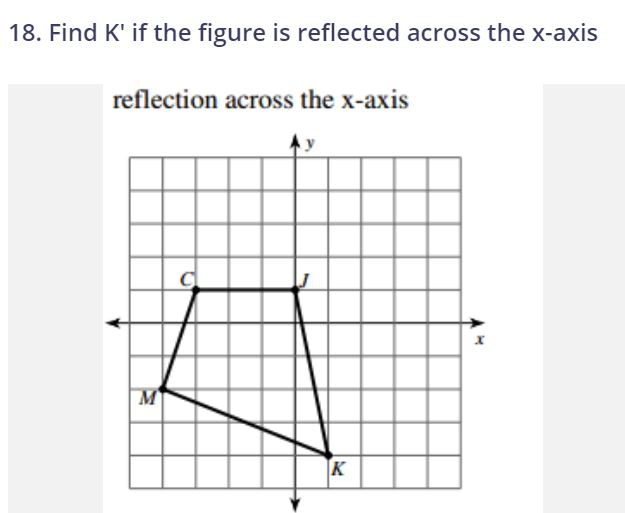
k' (1,4)
500
What are the new points of ∆LMN after a translation of 6 units to the right and 4 units down. L(0,3) M(6,4) N(3,9).
Label all 3 points
L'(6,-1), M'(12,0), N'(9,5)
500
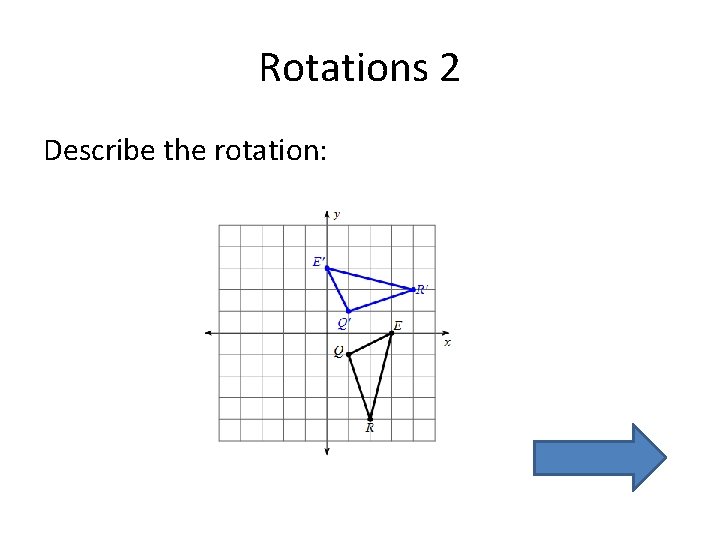
90° counterclockwise about the origin
500
Find the coordinates of B" when A(5, 0), B(5, 5), and C(2,4) undergo the following composition: translate (x, y)-->(x+6, y-5), then rotate counterclockwise 270 degrees.
B"(0, -11)