Any And Everything
BioHazard
Be Kind Rewind
100
Known as the synthesis of a drug or analog from a natural product
What is semi-synthesis?
100
The genetic modification of microbial cells such that they produce produce compounds that they would not normally produce
What is synthetic biology?
Synthetic biology involves genetically modifying microbial cells such that they produce compounds that are not produced by the native cells. Genetic modifications provide the blueprint for enzymes that are not present in the native cell and these enzymes catalyse the reactions required to produce the desired compounds. genetic modifications are also carried out to block or enhance other biosynthetic pathways within the cell.
100
Cyclohexenes are characteristic of this pericyclic concerted reaction between a diene and a dienophile
What is a Diels Alder?
200
Which of the following statements is true regarding the possible binding interactions of a secondary amide?
a) It can only participate in hydrogen bonding as a hydrogen bond donor.
b) It can only participate in hydrogen bonding as a hydrogen bond acceptor.
c) It can participate in hydrogen bonding both as a hydrogen bond donor and a hydrogen bond acceptor.
d) It cannot participate in hydrogen bonding at all.
What is C?
The secondary amide (RNHCOR) has a carbonyl oxygen that can act as a hydrogen bond acceptor. There is also a hydrogen attached to nitrogen which could act as a hydrogen bond donor. The nitrogen itself does not act as a hydrogen bond acceptor since its lone pair interacts with the carbonyl group.
200
Which of the following is an example of a super enzyme?
a) Non-ribosomal peptide synthases.
b) Esterases
c) Kinases
d) Proteases
What is A?
Non-ribosomal peptide synthases are examples of super enzymes containing a series of catalytic sites. The other named enzymes have an active site that catalyses a single reaction.
200
This hypothetical unit within a target molecule represents a potential starting reagent in the retroactive synthesis of that target molecule
What is a synthon?
300
meta-Chloroperbenzoic acid (mcpba) ia preferred over simpler peroxides for carrying out the Baeyer-Villiger reaction on large scale. Which of the following statements is not a justification for this choice?
a) It is a cheaper reagent
b) It is a safer reagent
c) It has a higher decomposition temperature
d) It is readily available
What is A?
meta-Chloroperbenzoic acid is more expensive than simpler peroxides and so it is not preferred because of cost. The reagent is preferred because it is safer to use.
300
Macrolides bind to the 50S subunit of the ribosome: inhibiting translocation of the growing peptide chain. Which of these are examples of macrolides?
A.) Erythromycin, azithromycin, clarithromycin
B.) Amoxicillin
C.) Streptomycin, gentamycin
D.) Vancomycin
What is A?
300
Which reaction in the following reaction sequence is regioselective?
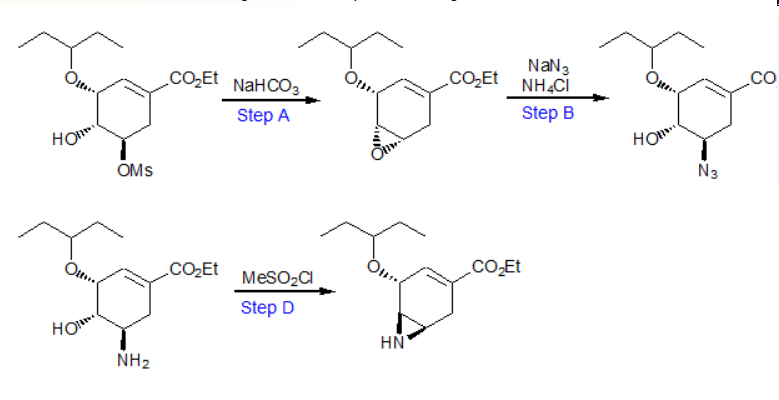
What is step B?
Step B is regioselective since the incoming nucleophile (the azide ion) reacts with one of the epoxide carbon atoms rather than the other. Steps A, C and D are functional group transformations.
400
What product is formed from the catalytic hydrogenation of chlorotetracycline?
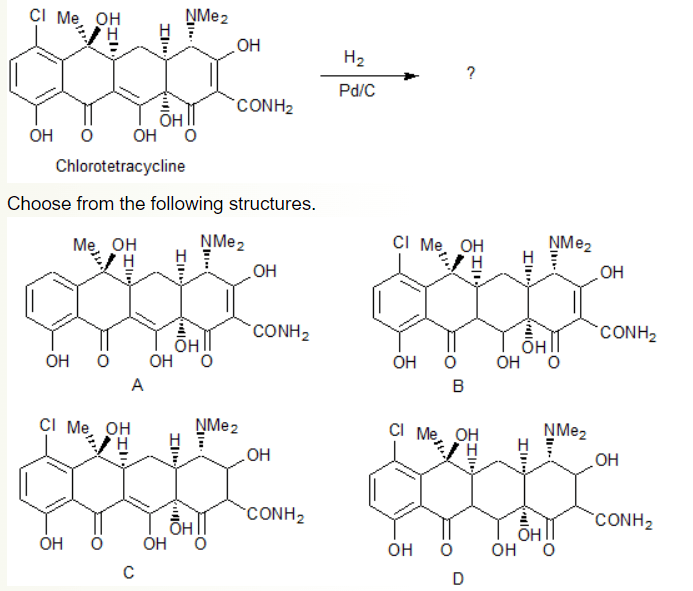
What is A?
400
This type of antibiotics work by affecting cell wall synthesis
What are beta-lactams?
400
This reagent would be least likely to be useful in the retrosynthetic analysis of ropivacaine
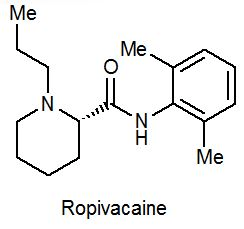
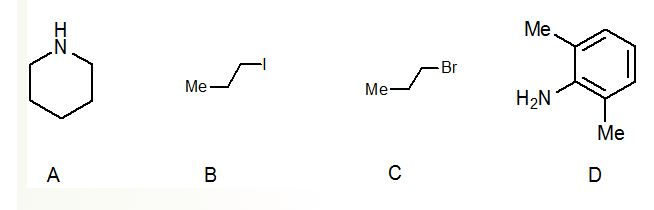
What is A (Piperidine)?
500
The semi-synthetic preparation of azithromycin involves a Beckmann rearrangement of the following intermediate. The rearrangement involves the oxime and one other functional group in the structure. Which functional group is involved?
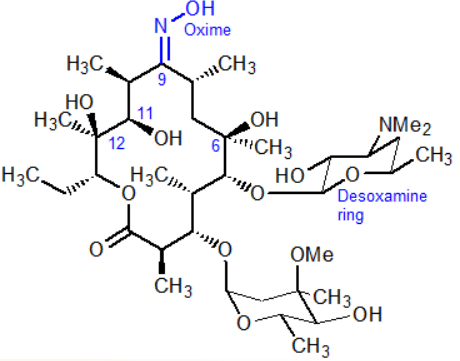
What is B?
The alcohol at position 6 is crucial in the rearrangement reaction as shown below.
500
Which of these is not a gram-negative bacteria?
A.) Haemophilus influenzae
B.) Salmonella
C.) Streptococcus pneumonia
D.) Escherichia coli (E. coli)
What is Streptococcus pneumonia?
500
The synthesis of clinafloxacin includes the following reaction.
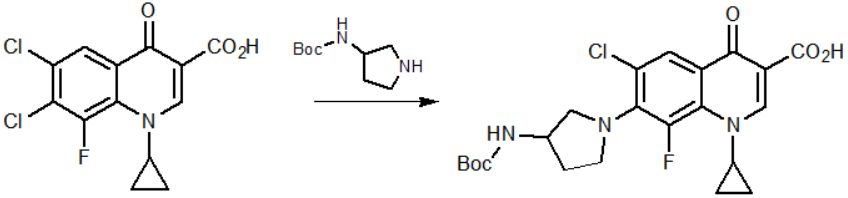
Which of the substituents present in the starting material is likely to have the greatest influence over the regioselectiivity of the reaction?
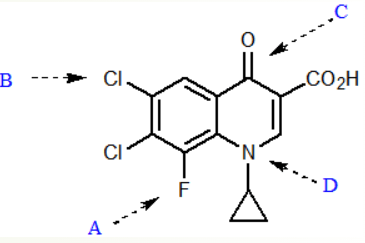
a) The fluorine substituent (A)
b) The chlorine substituent (B)
c) The carbonyl group (C)
d) The nitrogen atom (D)
What is C?
The carbonyl group is the group most likely to influence the regioselectivity. The reaction involves nucleophilic substitution of a chlorine group, and the reaction can be aided by the carbonyl group as shown.