Stars
Universe
Galaxies
Bonus
100
The Sun is a yellow star that's both average in brightness and temperature and is classified as
A) Super giants
B) Giants
C)Main sequence
D)White dwarf
C ) Main Sequence
100
What does a blue shift tell us?
A) An object is getting colder
B) An object is quickly moving
toward us
C) An object is moving quickly
away from us
D) An object is becoming greater in
mass
B) An object is quickly moving
toward us
100
What is a cloud of dust and gas?
A) Star
B) Nebula
C) Solar material
D) constellations
B) Nebula
100
A light year is a measurement
of:
A)Time
B)Distance
C)Temperature
D)Star brightness
B) Distance
200
Which color stars have the highest surface temperature?
A)Red
B)Blue
C)Green
D)yellow
B) Blue
200
What force keeps the planets
and moon in orbit?
A)Magnetism
B)Ionization
C)Pressure
D)Gravity
D) Gravity
200
Which of the following objects is the largest?
A) Star
B) Galaxy
C) nebula
D) planet
B) Galaxy
200
What type of galaxy is the
Milky Way?
A) Elliptical
B) Spiral
C) Irregular
D) Regular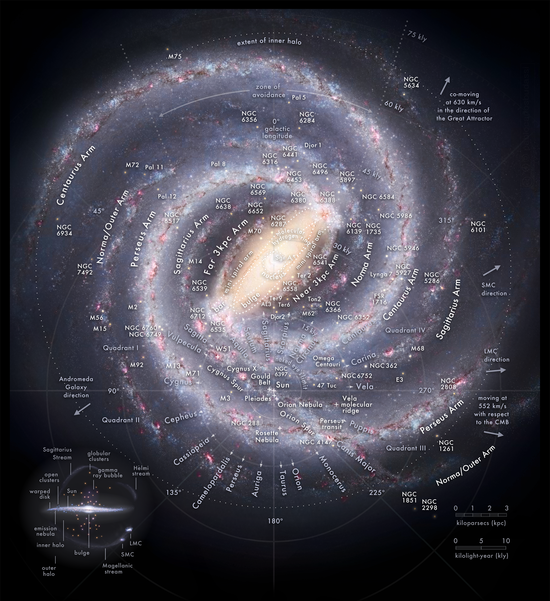
B) Spiral
300
On a traditional Hertzsprung-Russell Diagram,
the stars shown on the left side are blue and
very hot while the---
A) The stars are the right are red and are
cooler
B) The stars on the right are red and are
the hottest
C) The stars on the right are farthest from
the earth
D) The stars on the right red and are the
brightest
A) The stars are the right are red and are
cooler
300
Why does the sun appear to be so large
to us?
A)Because it is super giant
B)It is closer to Earth compared to
other stars
C)Because it has very high luminosity
D)Because of its temperature
B)It is closer to Earth compared to
other stars
300
Which of the following objects is the smallest?
A) Star
B) Galaxy
C) nebula
D) planet
D) Planets
300
A unit of length equal to the distance that light travels through space in on year-
A)Light year
B)Speed of light
C)Galaxy
D)Solar mass
A) Light year
400
After being a Main Sequence Star, what
happens to a star that is a similar size to our sun?
A)Super red giant
B)White dwarf
C)Red giant
D)Black hole
C) Red Giant
400
What is the approximate temperature of the sun?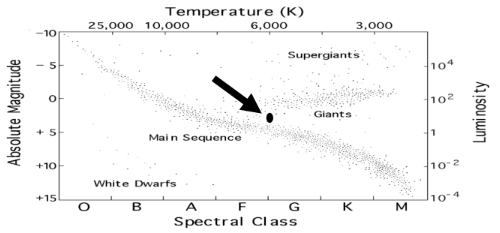
A) 2,300 K
B) 16,000 K
C) 25,000 K
D) 6,000 K
D) 6,000 K
400
How does a star form?
A) A beam of radiation of radiation form a
pulsar passes through a dense
B) Gravity pulls dust and gases into a
sphere
C) The energy of supernova reaches the
dust and gases of new stars
D) Gravity causes neutrons and electrons
to collide and form stars
B) Gravity pulls dust and gases into a
sphere
400
The white Dwarfs are a group of stars that are-
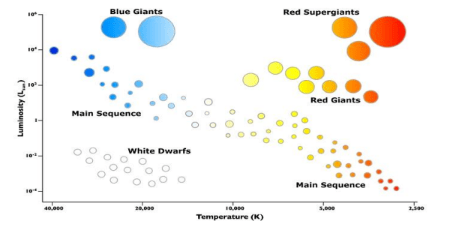
A) Extremely bright and hot
B) Low in brightness but are average to high in temperature
C) Average in brightness but high in temperature
D) Average in brightness and average in temperature
B) Low in brightness but are average to high in temperature
500
What can be formed after a supernova?
A) Black hole
B) Red giant
C) Neutron star
D) Both A and C
D) A+C
500
Would the surface temperature of White Dwarf stars be higher or lower than red super giants?
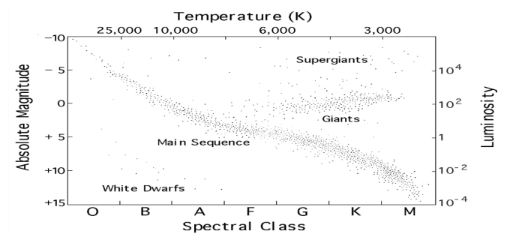
A) Higher
B) Lower
C) The same
D) unknown
A) Higher
500
Which shape does a galaxy not have?
A)Spiral shape
B)Round shape
C)Regular shape
D)Irregular shape
C) Regular Shape
500
How many main types of galaxies are there?
A) 4
B) 2
C) 3
D) 7
A) 4