Tetralogy of Fallot
Other
Other 2
USMLE Rx
AMBOSS
100
Patients with tetralogy of Fallot may [...] in response to cyanotic spells, which decreases right-to-left shunting by increasing systemic vascular resistance (SVR)
squat
Increases venous return.
This prolonged squatting causes pressure to rise in the aorta / LV, resulting in a higher proportion of the RV output to enter the pulmonary circulation
- Increases afterload

100
D-transposition of great vessels is not compatible with life unless a(n) [...] is created
shunt
This defect is not compatible with life unless a ventricular septal defect, patent ductus arteriosus or patent foramen ovale are present
100
D-transposition of the great vessels and VSD are associated with maternal [endocrine]
diabetes
Maternal diabetes is diabetes that existed prior to pregnancy (vs gestational diabetes)
100
A 15-year-old girl is brought to the office by her mother because she has not yet begun menstruating. Her older sisters began menstruating at 13. Her birth history and medical history are normal. Physical examination reveals that the patient is in the 30th percentile for height. Additional findings are shown. Her genitalia and breasts are Tanner stage I. A urine pregnancy test is negative.
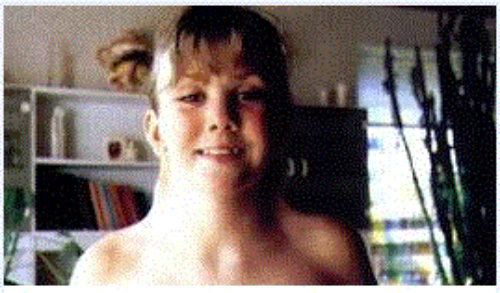
Which of the following additional clinical findings will most likely be present in this patient?
A
Blood pressure in upper extremity greater than that in lower extremity
B
Diastolic heart murmur
C
Kussmaul sign
D
Pulsus paradoxus
E
Supine hypertension and orthostatic hypotension
Blood pressure in upper extremity greater than that in lower extremity
High-Yield Summary
- Turner syndrome is a chromosomal disorder characterized by short stature, primary amenorrhea, and a webbed neck.
- Coarctation of the aorta is associated with Turner syndrome, and it causes hypertension and blood pressure that is greater in the upper extremity than in the lower extremity.
100
A 26-year-old woman comes to the physician for evaluation of nausea and fatigue. Her last menstrual period was 8 weeks ago. She has a history of bipolar disorder controlled by a drug known to sometimes cause hypothyroidism and nephrogenic diabetes insipidus. She does not smoke cigarettes or drink alcohol. A urine pregnancy test is positive. An ultrasound of the pelvis shows a viable intrauterine pregnancy. The fetus is most likely at increased risk for which of the following anomalies?
A
Abnormal placentation
B
Aplasia cutis
C
Atrialization of the right ventricle
D
Microphthalmia
E
Neural tube defects
F
Hypoplastic or absent limb
Atrialization of the right ventricle
200
Tetralogy of Fallot results in a(n) [...]-to-[...] shunt with early central cyanosis
right-to-left shunt

200
[...] is characterized by the pulmonary artery arising from the left ventricle and aorta from the right ventricle
D-transposition of the great vessels (TGV)
- In the normal heart the aorta is posterior and to the right of pulmonary artery
- In D-TGV the aorta forms anterior, and right of pulmonary artery
- In L-TGV, the right ventricle and left ventricle have also been transposed (thus given the moniker "corrected")
200
D-transposition of great vessels results in [...] of the right ventricle and [...] of the left ventricle
hypertrophy, atrophy
200
A 31-year-old woman comes to the clinic reporting urinary frequency and weight gain that began after a psychiatric episode for which she was hospitalized for bipolar disorder 3 months ago. During her hospitalization, she began drug treatment, and her symptoms eventually resolved. She now plans to become pregnant with her partner. Physical examination reveals an enlarged thyroid gland and a mild tremor in her hands.
Which of the following fetal abnormalities would be most likely if this patient became pregnant while taking her current medication?
A
Cleft palate
B
Congenital goiter
C
Ebstein anomaly
D
Neural tube defects
E
Renal dysplasia
Ebstein anomaly
High-Yield Summary
- Lithium is a mood stabilizer used in the treatment of bipolar disorder and acute mania, and may cause tremor, hypothyroidism, and polyuria (nephrogenic diabetes insipidus).
- Lithium is contraindicated during pregnancy because it has been associated with Ebstein anomaly in the fetus.
200
A 2-week-old male newborn is brought to the physician because his mother has noticed her son has occasional bouts of "turning blue in the face" while crying. He also tires easily and sweats while feeding. He weighed 2150 g (4 lb 11 oz) at birth and has gained 200 g (7 oz). The baby appears mildly cyanotic. Examination shows a 3/6 systolic ejection murmur heard over the left upper sternal border. A single S2 is present. An echocardiography confirms the diagnosis. Which of the following factors is the main determinant of the severity of this patient's cyanosis?
A
Right ventricular outflow obstruction
B
Left ventricular outflow obstruction
C
Right ventricular hypertrophy
D
Ventricular septal defect
E
Overriding aorta
F
Atrial septal defect
Right ventricular outflow obstruction
300
Patients with tetralogy of Fallot often experience "[...] spells" which may be caused by crying, fever, and exercise due to exacerbation of RV outflow obstruction
"tet spells"
Children will experience blue skin during crying or feeding
- i.e. crying ↑ pulmonary stenosis and increases pulmonary resistance, so more deoxygenated blood shunted across VSD to aorta, worsening cyanosis
300
Where is a murmur due to pulmonic stenosis the loudest?
left 2nd ICS

300
{....} is the failure of the pulmonic valve orifice to develop
Pulmonary atresia
300
A 4-year-old boy is brought to the pediatrician by his father to establish care. The boy appears well. On examination, cardiac auscultation reveals a harsh, "blowing" 3/6 holosystolic murmur, best heard at the lower left sternal border. Lung auscultation is normal.
Which of the following is the most likely diagnosis?
A
Atrial septal defect
B
Mitral regurgitation
C
Patent ductus arteriosus
D
Patent foramen ovale
E
Tricuspid regurgitation
F
Ventricular septal defect
Ventricular septal defect
High-Yield Summary
- VSDs are the most common congenital cardiac anomaly and produce a harsh or "blowing" holosystolic murmur best heard at the left sternal border.
300
One day after a 4700-g (10-lb 6-oz) male newborn is delivered to a 28-year-old primigravid woman, he has bluish discoloration of his lips and fingernails. Oxygen saturation on room air is 81%. Examination shows central cyanosis. A continuous machine-like murmur is heard over the left upper sternal border. A single S2 heart sound is present. Supplemental oxygen does not improve cyanosis. Echocardiography shows the pulmonary artery arising from the posterior left ventricle and aorta arising from the right ventricle with active blood flow between the right and left ventricles. Further evaluation of the mother is most likely to show which of the following?
A
Prenatal lithium intake
B
Elevated serum TSH
C
Prenatal alcohol use
D
Prenatal phenytoin intake
E
Positive rapid plasma reagin test
F
Elevated fasting blood glucose
Elevated fasting blood glucose
400
Tetralogy of Fallot is characterized by a(n) [...]-shaped heart on CXR
Boot shape due to RV hypertrophy

400
{{...}} is a congenital heart disease characterized by downward displacement of tricuspid leaflets into the right ventricle
Ebstein anomaly
400
{{...}} is the failure of the tricuspid valve orifice to develop
Tricuspid atresia
400
A 1-hour-old newborn boy is evaluated for cyanosis of the fingers and lips that does not change with high-flow oxygen. S1 and S2 are normal on examination. Further studies show that the blood in the pulmonary arteries has higher oxygen content than does the blood in the ascending aorta. Echocardiography shows bifurcating pulmonary artery arising posteriorly from the left ventricle in the parasternal long-axis view.
Which of the following is most likely responsible for this newborn’s condition?
A
Congenital agenesis of tricuspid valve
B
Defect in the septum primum
C
Failure of the aorticopulmonary septum to spiral
D
Failure of the pulmonary veins to connect to the left atrium
E
Patent of the ductal portion of the 6th aortic arch
C
Failure of the aorticopulmonary septum to spiral
High-Yield Summary
- In transposition of the great vessels, the right ventricle empties into the aorta and the left ventricle empties into the pulmonary arteries, causing cyanosis.
- In transposition of the great vessels, the aorticopulmonary septum fails to spiral during development.
400
Several hours after vaginal delivery, a male newborn delivered at full-term develops tachycardia and tachypnea. His blood pressure is within normal limits. Pulse oximetry on room air shows an oxygen saturation of 79% in the right hand and 61% in the left foot. Physical examination shows bluish discoloration of the face and trunk, supraclavicular and intercostal retractions, and a machine-like murmur over the precordium. Bedside echocardiography shows pulmonary and systemic circulation are in parallel rather than in series. What is the most appropriate pharmacotherapy for this patient?
A
Sildenafil
B
Alprostadil
C
Metoprolol
D
Indomethacin
E
Dopamine
Alprostadil
Alprostadil (prostaglandin E1) is used in newborns with congenital heart defects to maintain a patent ductus arteriosus.
500
Tetralogy of Fallot is caused by [...] displacement of the infundibular septum
anterosuperior
Sorry...

500
{...} is a congenital heart disease characterized by a single large vessel arising from both ventricles before eventually splitting
Persistent truncus arteriosus
500
D-transposition of great vessels is due to failure of the [...] to spiral
aorticopulmonary septum
500
A 13-year-old boy is brought to the clinic because of marked shortness of breath that occurs when he sprints in physical education class at school. He feels fine at rest or when walking. His medical history includes surgical repair of a congenital heart defect as an infant. Physical examination reveals decreased lung sounds on the right. An inspiratory x-ray of the chest is shown, and a similar finding was seen after his surgery as an infant.
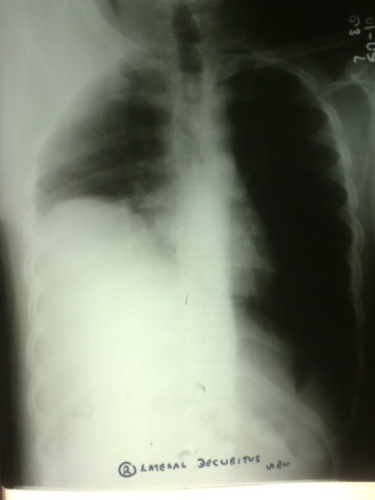
Image © copyright Ratnayake et al; licensee BioMed Central Ltd. 2012
Which of the following best explains the patient’s symptoms?
A
Damaged phrenic nerve
B
Diaphragmatic hernia
C
Eisenmenger syndrome
D
Pleural effusion
E
Pneumonia
Damaged phrenic nerve
High-Yield Summary
- A paralyzed right hemidiaphragm may present as dyspnea with exertion and decreased lung sounds on the right side. On x-ray of the chest, an intact right hemidiaphragm elevated above the left indicates right phrenic nerve damage.
- The phrenic nerve runs along the fibrous pericardium and can be damaged during heart surgery.
500
A 6-month-old girl is brought to the emergency department because her lips turned blue for several minutes earlier during feeding. Her father reports that the patient had similar episodes while playing that resolved quickly. During the examination, she sits calmly in her father's lap. When her ears are examined, the patient begins to cry and her lips and fingers begin to turn blue. Further evaluation of this patient is most likely to show which of the following?
A
Anomalous pulmonary venous return on MR angiography
B
Machine-like hum on auscultation
C
Diminutive left ventricle on echocardiogram
D
Decreased blood pressure in both lower extremities
E
Pulmonary vascular congestion on chest x-ray
F
Right axis deviation on ECG
Right axis deviation on ECG
The thickened myocardium in the right ventricle produces increased electrical activity, which shifts the axis of cardiac depolarization.