Exponential Growth and Decay
Logarithms Exponentials
Transformations
Properties of Logarithms
Solving Functions
Inverse
100
Determine whether the functions are growth or decay:
a. y=(1/12)^x
b. y=(7/2)^x
c. y=(0.8)^x
a. decay
b. growth
c. decay
100
Evaluate the logarithms.
a. log_4(256) b. log_(1/8)1
a. 4
b. 0
100
Describe the transformation of f represented by g. Then sketch each function.
f(x)=6^x
g(x)=g^x+6
The graph of g is a translation 6 units up of the graph of f.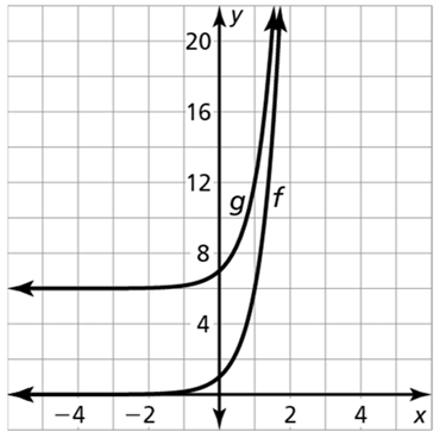
100
Use log_25≈ 2.322 and log_212≈ 3.585 to evaluate the logarithms.
a. log_21/44 b. log_212/25
a. -7.17
b. -1.059
100
Solve for x:
a. 5^(2x+4)=5^(5x-8)
b. (1/5)^(3x-2)=sqrt(25^x )
a. 4
b. 1/2
100
Find the inverse of the functions:
a. y=15^x+10
b. y=ln(2x)-8
a. y=log_15(x+1)
b. y=1/2 e^(x+8)
200
Rewrite the function in the form y=a(1+r)^t or y=a(1-r)^t .
State the growth or decay rate.
a. y=a(3/2)^(t/7)
b. y=a(0.9)^(4t)
a. y=a(1+0.06)^t 6% Growth
b. y=a(1-0.34)^t 34% decay
200
Simplify the expressions.
a. 13^(log_13 6)
b. ln e^(x^3)
a. 6
b. x3
200
Describe the transformation of f represented by g. Then sketch each function.
f(x)=(1/5)^x
g(x)=(1/5)^(-3x)+4
The graph of g is a reflection over the y-axis, horizontal shrink by a factor of 1/3 and a translation 4 units up of the graph of f.
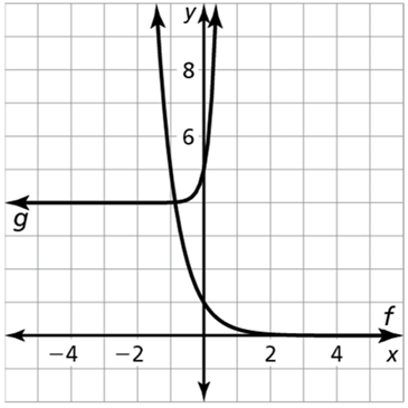
200
Use the change-of-base formula to evaluate the logarithm. Round to the nearest thousandth.
a. log _317
b. log_9294
a. 2.579
b. 2.587
200
Solve for x:
a. 3^2x-8*3x+15=0
b. 4^(2x)+3*4^x-28=0
a. x=1 and x≈1.46
b. x=1
200
Write the equation of each function’s inverse.
a. f(x) = 2^x
b. j(x) = ( 1 / 4 ) ^x + 2
a. f^(-1)(x)=log_2x
b. j^(-1)(x)=log_(1/4)(x-2)
300
You deposit $1250 in an account that pays 1.25% annual interest. Find the balance after 5 years when the interest is compounded daily.
$1330.62
300
Graph the function.
y=(log_(1/2)x)-4
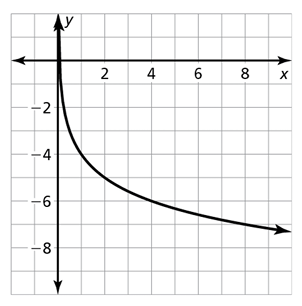
300
Describe the transformation of f represented by g. Then sketch each function.
f(x)=logx
g(x)=-3log(x-2)
The graph of g is a reflection over the x-axis, vertical stretch by a factor of 3 and a translation 2 units right of the graph of f.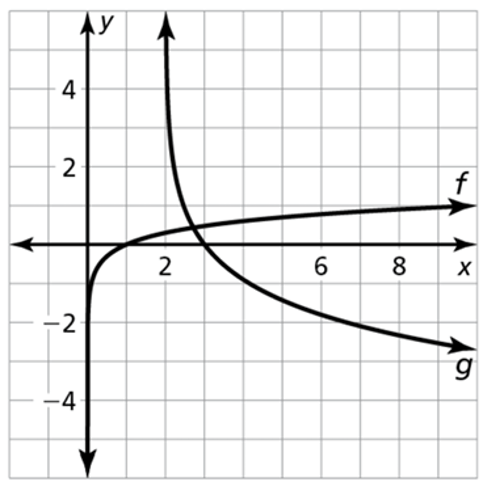
300
Expand the logarithms.
a. ln 2x^6
b. log_3x^4/(3y^3 )
a. ln2+6 lnx
b. 4 log_3x-3 log_3y-1
300
Solve for x. Check your solution(s).
a. 2=log_34x
b. ln(x^2+3)=ln4
a. 9/4
b. ±1
300
Write the equation of each function’s inverse.
a. g(x) = 2^x - 3
b. k(x) = 3^(x + 2) - 1
a. g^(‐1)(x) = log_2 (x + 3)
b. k^(‐1)(x) = log_3 (x + 1) - 2
400
You buy a new smartphone for $700 and sell it 2 years later for $185. Assume that the resale value of the smartphone decays exponentially with time. Write an equation that represents the resale value V (in dollars) of the smartphone as a function of the time t (in years) since it was purchased.
V=700(0.5141)^t
400
Rewrite the equation in logarithmic form.
a. 20^-1=1/20
b. 216^(1/3)=6
a. log_20(1/20)=-1
b. log_216 6=1/3
400
Let the graph of g be a reflection in the y-axis, followed by a translation 5 units down of the graph of f(x) = 8x.
Write a rule for g.
g(x)=8^-x-5
400
Condense the logarithms.
a. log_23+log_28
b. log_54- 2 log_55
a. log_224
b. log_54/25
400
Solve the inequalities:
a. 25^x>1/5
b. logx≤1/2
a. x> -1/2
b. 0<x≤sqrt10
400
Write the equation of each function’s inverse.
a. h(x) = log_2 (x) - 3
b. l(x) = log _ (4/3)(x + 5)
a. h^(‐1)(x)=2^(x + 3)
b. l^(-1)(x) = ‐5 +( 4/3 ) ^ x
500
The number of bacteria y (in thousands) in a culture can be approximated by the model y=100(1.99)^t where t is the number of hours the culture is incubated.
a. Tell whether the model represents exponential growth or exponential decay.
b. Identify the hourly percent increase or decrease in the number of bacteria.
c. Estimate when the number of bacteria will be 100,000.
a. exponential growth
b. 99% increase
c. about 3.35 hrs
500
Rewrite the equation in exponential form.
a. log_(5)1/25=-2
b. log_(1/4)64=-3
a. 5^(-2)=1/25
b. (1/4)^-3=64
500
Let the graph of g be a translation 6 units right and 7 units up of the graph of f(x)=log_(1/4)x .
Write a rule for g.
g(x)=log_(1/4)(x-6)+7
500
Condense the logarithms.
a. 3 ln6x+ln4y
b. log_2625-log_2125+1/3 log_227
a. ln864x^3 y
b. log_215
500
You buy juice for your graduation party and leave it in your hot car. When you take the juice out of the car and move it into the basement, the temperature of the juice is 80°F. When the room temperature of the basement is 60°F, the cooling rate is r = 0.0147. Using Newton’s Law of Cooling, T=(T_0-T_R ) e^(-rt)+T_R to determine how long will it take to cool the juice to 63°F.
About 129.06 min
500
Find the inverse of each function.
a. y = log(-2x)
b. y = log_ (1/4) x^5
a. y = − 10^x /2
b. y = 1/root(5)(4^x)