Population Dynamics
Migration
Structure & Density
Settlements & Hierarchy
Urbanisation & Land Use
100
This term describes the condition where there are too many people in an area relative to the available resources and technology to maintain an adequate standard of living.
Overpopulation
100
What is the term for the movement of people from the countryside to the city?
Rural to urban migration
100
On a population pyramid, a wide base indicates what?
A high birth rate / youthful population
100
Which settlement pattern consists of buildings arranged in a long line, often following a road, river, or valley floor?
Linear
100
What is the 'Central Business District' (CBD)?
The commercial, business, and functional heart of a town or city, typically located at its most accessible central point.
200
Give 2 reasons for high birth rates in many Less Economically Developed Countries (LEDCs).
Any possible answers, such as:
- Lack of access to contraception / family planning
- Needed in the farm for labor
- Traditional values encourage large families
- Etc.
200
Which of the following is considered a 'Push Factor' for a migrant leaving their home country?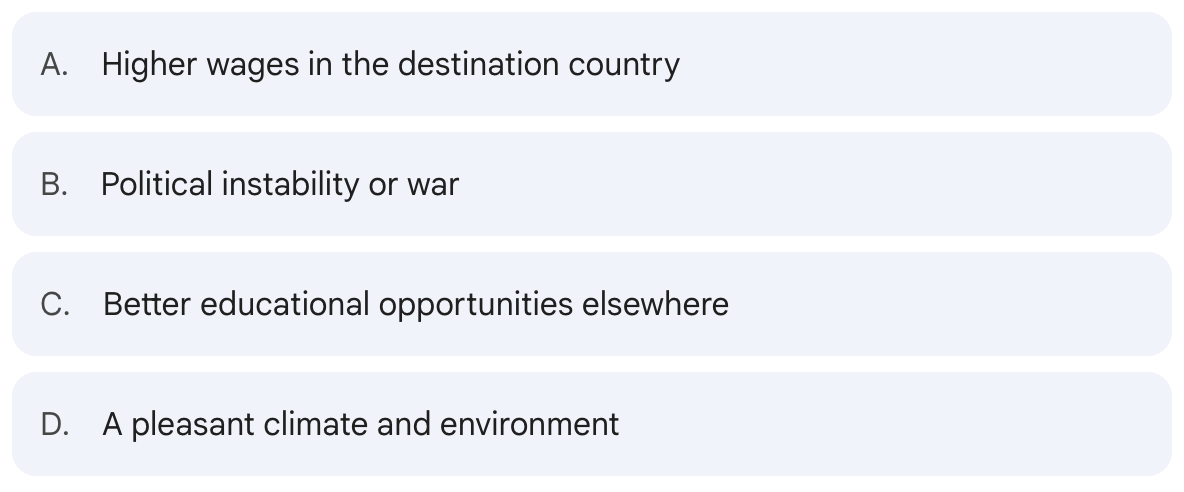
B. Political Instability or War
200
The 'Dependency Ratio' is a measure that compares the number of people in the 'dependent' age groups to which other group?
The economically active (working age) population
200
What is the 'threshold population' of a service?
The minimum number of people needed to make the service profitable.
200
'Urban Sprawl' is best described as which of the following?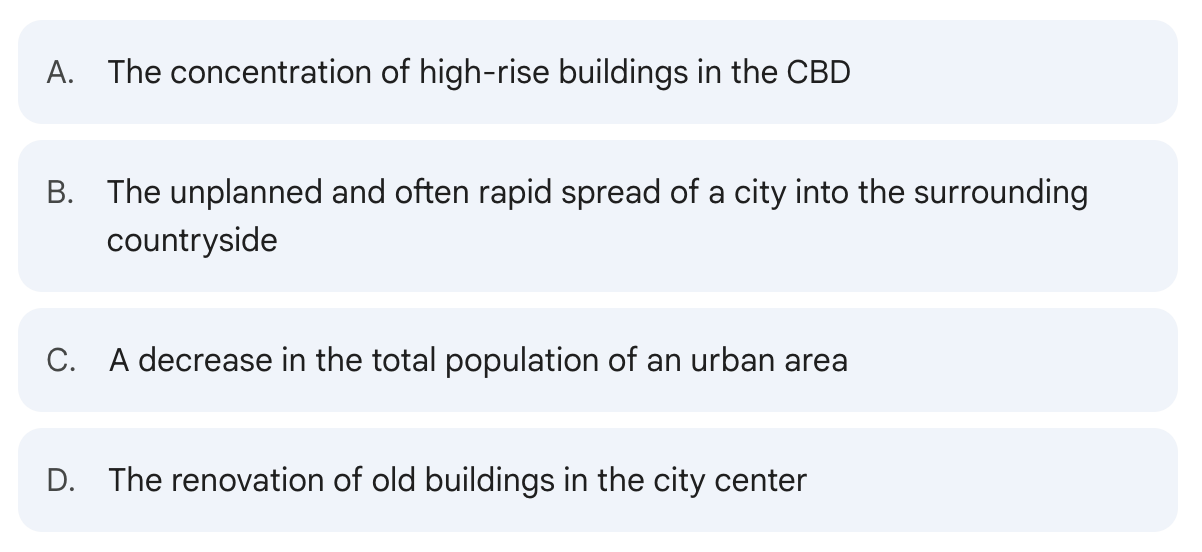
B. The unplanned and often rapid spread of a city into the surrounding countryside.
300
In the context of population change, how does the prevalence of HIV/AIDS specifically impact the death rate of a country?
It increases the death rate, particularly among the working-age population.
300
What are 2 potential negative impacts of migration on the 'origin' country?
- Brain drain
- Demographic and Social Imbalance
- Children and elderly family members may suffer due to the absence of family members
- Etc.
300
Which physical factor would most likely lead to an area being 'densely' populated?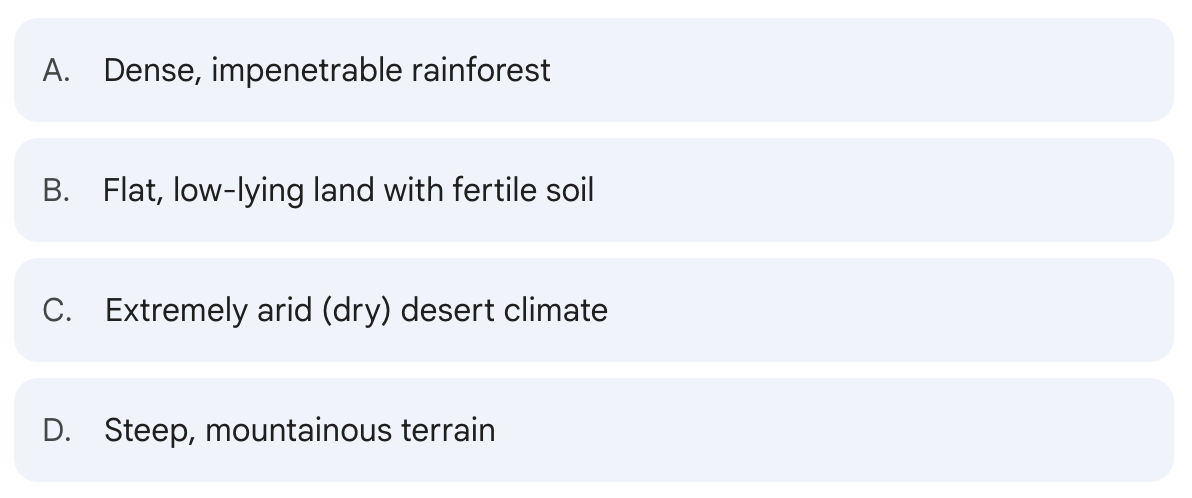
B. Flat, low-lying land with fertile soil
300
In a settlement hierarchy, which of the following is true as you move from a 'village' up to a 'large city'?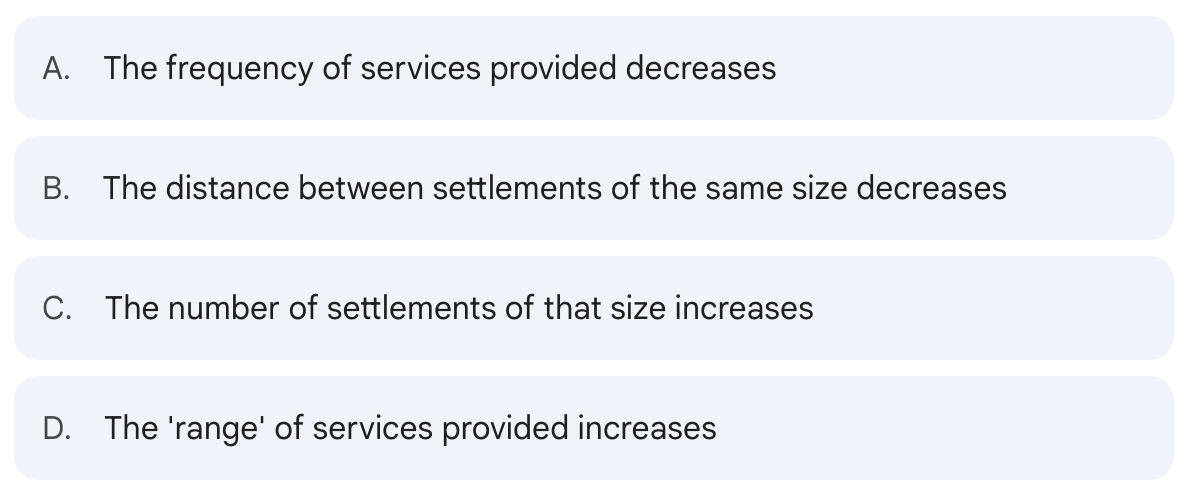
D. The 'range' of services provided increases
300
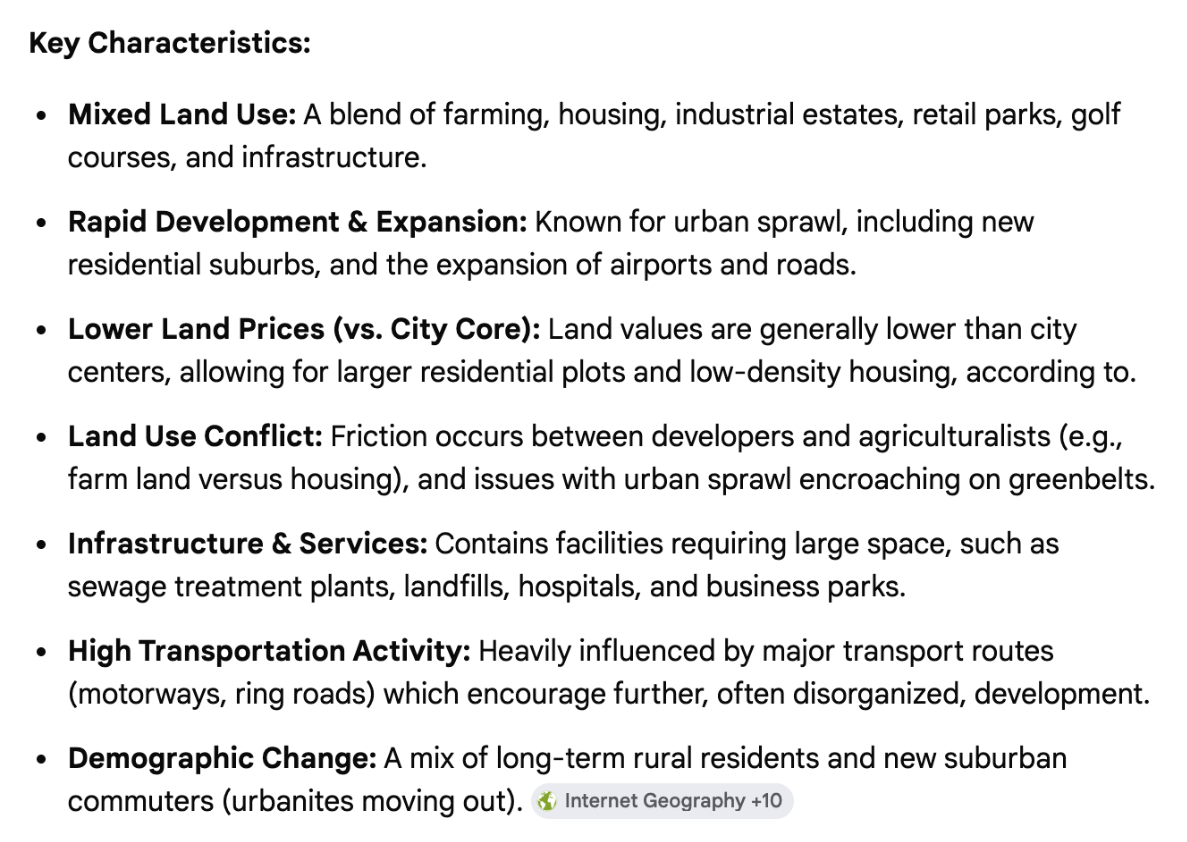
Give 2 common characteristics of the 'Rural-Urban Fringe'.
400
A government policy designed to reduce the birth rate and slow down population growth is known as what?
Anti-natalist policy, e.g. One Child Policy
400
Refugees fleeing from a natural disaster or conflict are examples of what type of migration?
Involuntary / forced
400
A population pyramid that is 'top-heavy' (wider at the top than at the base) indicates that the country has what?
An ageing population
400
Which physical factor refers to the actual land on which a settlement is built?
A. Situation
B. Sphere of Influence
C. Accessibility
D. Site
D. Site
Site factors include physical characteristics like soil quality, relief, and water supply that make the specific spot attractive for building.
400
Why do squatter settlements (shanty towns) often form in rapidly growing cities in LEDCs?
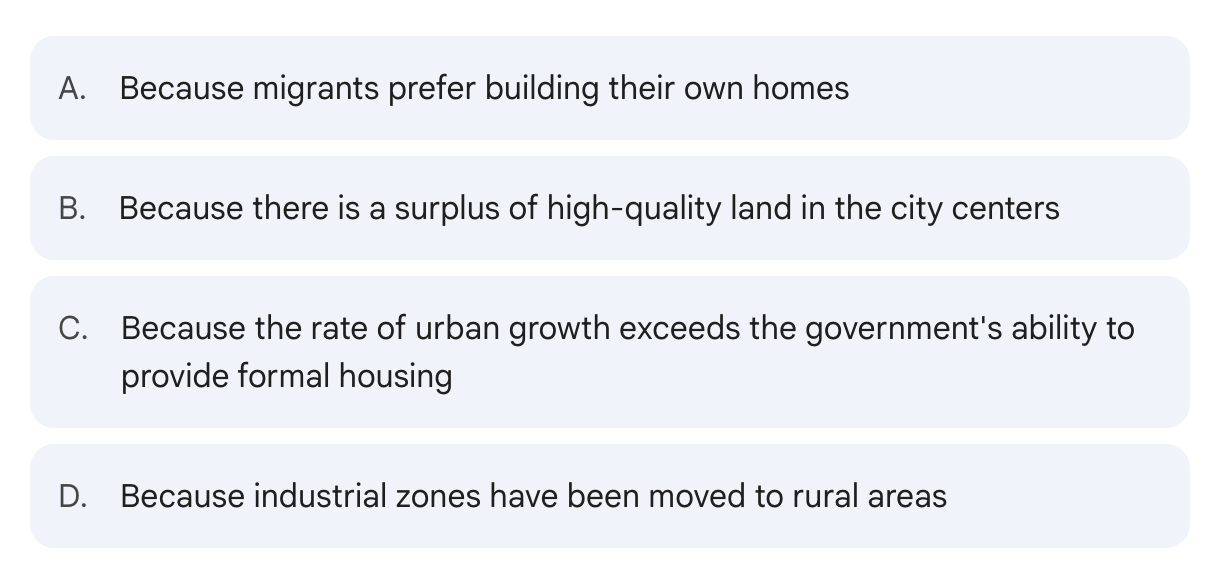
C. Because the rate of urban growth exceeds the government's ability to provide formal housing
500
Which 2 factors are most likely to lead to a country experiencing 'under-population'?
An abundance of natural resources
Small population to exploit these resources
500
What are 'remittances,' and why are they important for a migrant's origin country?
Money sent back home by migrants to support their families.
They are a major source of foreign income for many developing nations and help improve the standard of living for families left behind.
500
How can political factors influence population distribution within a country?
The government can...
- move the capital city to a new location
- develop cities for specific industries or trade
- conflict in certain areas can drive people away
- etc.
500
Which of these best describes a 'high-order' service?
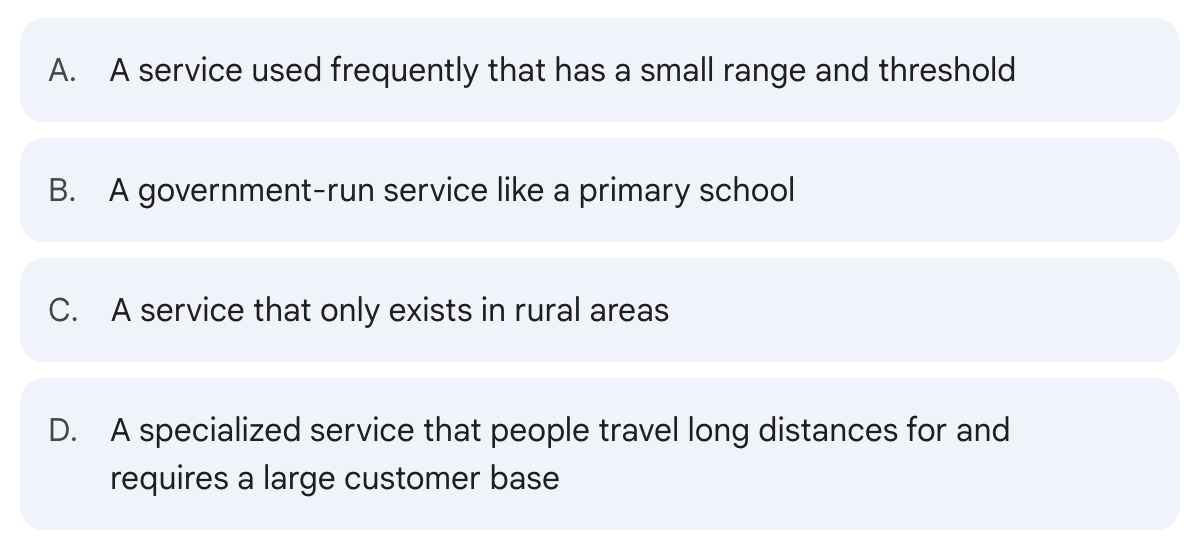
D. A specialized service that people travel long distances for and requires a large customer base
500
Which strategy is often used to manage the negative impacts of urban growth in squatter settlements?
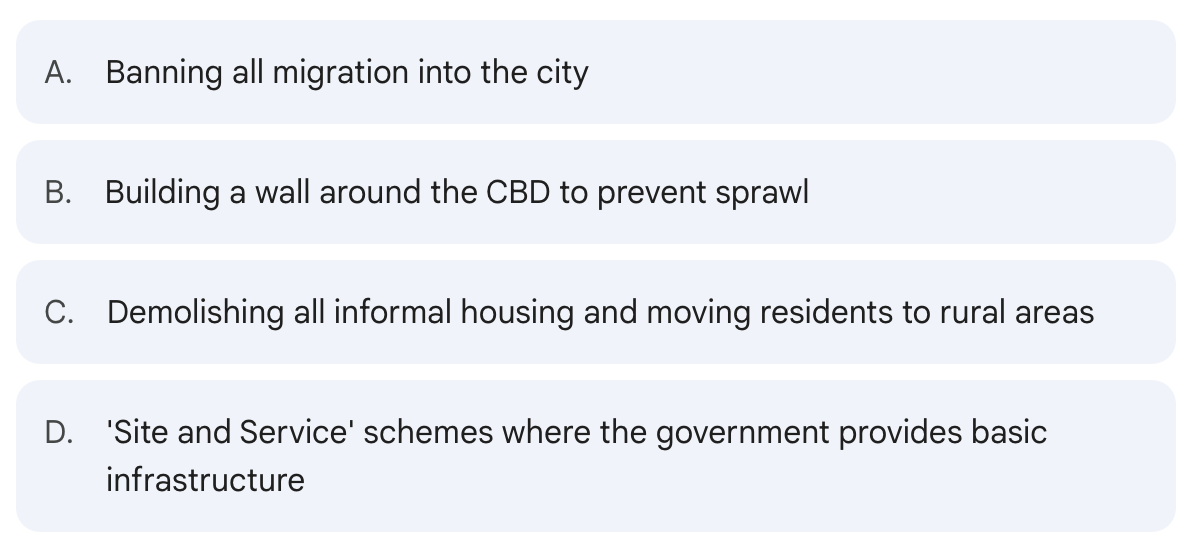
D. 'Site and Service' schemes where the government provides basic infrastructure