Social Detective
Confidence vs. “Look at Me!”
Calm First, Talk Second
Speak Up Skills
Random Brain Breakers
100
What does it mean to “read the room”?
Answer: It means noticing how people are feeling, acting, and responding around you.
100
What is confidence?
Confidence means believing in yourself and acting like yourself, even if no one is watching.
100
What number on this feelings scale means you are calm?
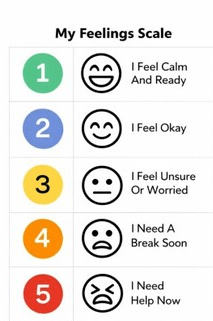
Answer: 1 and 2
100
What does assertive mean?
Saying what you need or feel in a respectful and clear way.
100
Make a face that shows “annoyed” without using words.
Child acts out an annoyed face.
Example: Eye roll, crossed arms, frown, sigh.
200
Name one clue that someone may feel uncomfortable.
They get quiet, look away, cross their arms, stop laughing, move away, or give short answers.
200
Is this confidence or attention-seeking:
“I share my idea even if no one claps for me.”
Confidence.
200
Name one body clue that shows you are getting too excited or upset.
Fast talking, loud voice, tight fists, racing heart, hot face, jumping around, wanting to yell, or not thinking clearly.
200
What is one polite way to say no?
“No thank you.” “I don’t want to.” “I’m not comfortable with that.” “Maybe another time.”
200
Name 3 things you can do when your feelings are at a 7 or higher.
Deep breathing, take space, count to 10, ask for help, drink water, journal, use a calm voice.
300
Why is it helpful to think about how others may feel?
It helps us make kinder choices and understand how our behavior affects people.
300
Is this confidence or attention-seeking:
“I act silly even when others ask me to stop because I want people to laugh.”
Attention-seeking or trying too hard.
300
What can you do before responding when you feel angry?
Pause, breathe, count to 10, take space, drink water, or ask for a break.
300
How can you disagree without being rude?
Use a calm voice and say, “I see it differently,” or “I understand, but I think…”
300
Act out the difference between “confident” and “trying too hard.”
Confident: Calm voice, relaxed body, being yourself. Trying too hard: Acting extra, forcing jokes, doing things only for attention.
400
A friend gets quiet after you make a joke. What could you ask yourself?
“Did my joke hurt their feelings?” “Did I go too far?” “Should I check on them?”
400
What is the difference between being liked and liking yourself?

Being liked depends on what others think. Liking yourself means knowing your worth even if others do not notice you.
400
What should you do if you are at a “10” on the feelings scale?
Stop talking, step away if safe, calm your body first, and wait before solving the problem.
400
What can you say if someone teases you?
“Please stop.” “That’s not funny to me.” “I don’t like that.” “I’m walking away.”
400
You want to say yes to fit in, but your real answer is no. What can you say instead?
“I don’t want to.”
“No thanks.”
“I’m not comfortable with that.”
“I’ll pass this time.”
500
You notice people are laughing, but one person looks hurt. What can you do?
Stop, check on them, apologize if needed, or say, “I didn’t mean to hurt you. Are you okay?”
500
Give an example of quiet confidence.
Trying your best, being kind, saying what you think respectfully, walking away from drama, or being yourself without needing everyone’s attention.
500
Why should emotional regulation come before social skills?
Because when your feelings are too big, it is harder to think clearly, listen, or choose respectful words.
500
How can you walk away from drama without being mean?
Say, “I don’t want to be part of this,” “I need a break,” or “I’m going to step away.”
500
A friend rolls their eyes after you say something. Give 2 possible reasons why — one that is about you and one that may not be about you.
About me: “Maybe my words hurt their feelings.”
Not about me: “Maybe they are having a bad day, tired, or upset about something else.”