Ecology
Energy Transfer
Glycolysis
Krebs Cycle
ETS
100
The branch of biology dealing with interactions among organisms and between organisms and their environment is called
Ecology
100
What percent of energy reaches the next higher trophic level?
10%
100
Glycolysis Occurs in the?
Cytoplasm
100
What stage in cellular respiration is the Krebs cycle?
2nd
100
Where does the ETS occur?
Inside the mitochondria
200
Where does energy in an ecosystem originate from
The sun
200
As energy flows through the ecosystem the majority is lost as?
Heat
200
How many carbons are in Glucose?
6
200
Where does the Krebs cycle occur?
Inside the mitochondria
200
When does it happen?
The 3rd and last stage of cellular respiration
300
A developer wants to build new a new housing development in or around a large city. Which of the following plans would be LEAST harmful to the environment?
A, Clearing a forested area outside of the city to build houses.
B. Building apartments at the site of an abandoned factory in the city.
C. Building a neighborhood in a meadow at the edge of the city.
D. Filling a wetland area and building oceanfront condominiums.
B. Building apartments at the site of an abandoned factory in the city.
300
Which statement best describes the relationship between the products of photosynthesis and the reactants in cellular respiration?
A. The products of photosynthesis serve as the reactants in cellular respiration to provide chemical energy.
B. The products of photosynthesis combine with the reactants in cellular respiration to remove ATP from cells.
C. The products of photosynthesis inhibit the reactants in cellular respiration in the presence of light.
D. The products of photosynthesis change the structure of the reactants in cellular respiration in the presence of light.
A. The products of photosynthesis serve as the reactants in cellular respiration to provide chemical energy.
300
What stage is glycolysis?
1st
300
What are the required reactants for the Krebs Cycle?
2 Pyruvate and O2
300
How much ATP is produced?
32 ATP
400
A small population colonized an isolated island. Over time, the size of the population increased to its carrying capacity, as represented in the graph below. Which of the following conditions will most likely keep the population at its carrying capacity?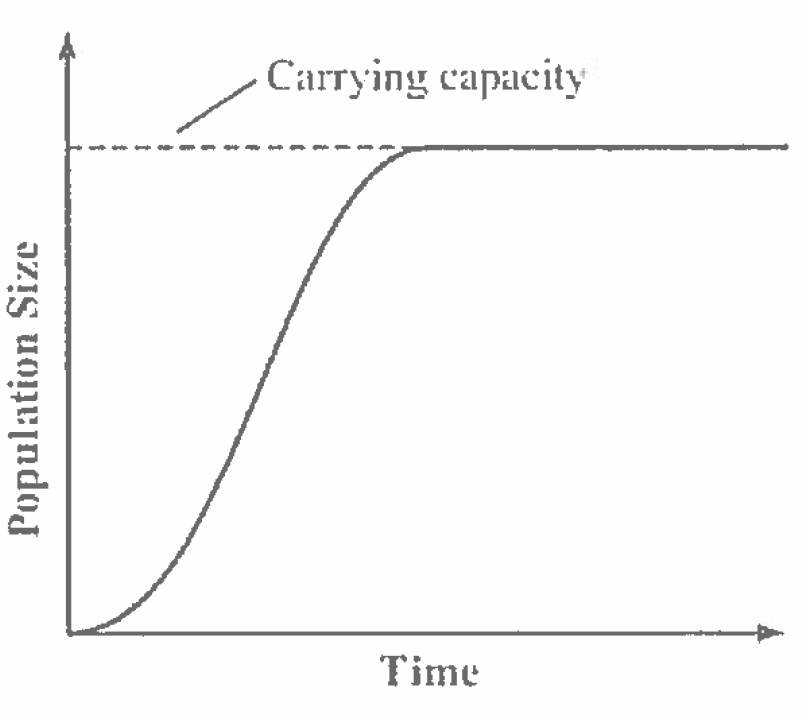 A. a death rate of zero.
B. a death rate that is half the birth rate.
C. a death rate equal to the birth rate.
D. a death rate that is twice the birth rate.
C. a death rate equal to the birth rate.
400
Where does the chemical energy to produce ATP come from?
A. The conversion of ATP to ADP.
B. The use of chemicals from the environment to build sugars.
C. The addition of a phosphate group to ATP.
D. The breakdown of carbon-based molecules into smaller molecules.
D. The breakdown of carbon-based molecules into smaller molecules.
400
What are the products of Glycolysis
How many Carbon molecules are in this substance?
2 Pyruvate
3 Carbons
2 NADH
2 ATP
400
Is the Krebs cycle considered aerobic or anaerobic?
Aerobic it requires oxygen
400
What are the electrons used for?
Energy to convert ADP into ATP
500
Name the 5 types of ecological relationships.
2 Oppositional
3 Symbiotic
Predator & Prey
Competition
Mutualism
Commensalism
Parasitism
500
The table shows the amount of energy stored in each molecule in the photosynthesis reaction. Use the data to answer the question.
6CO2 + 6H2O -> 6O2 + C6H12O6
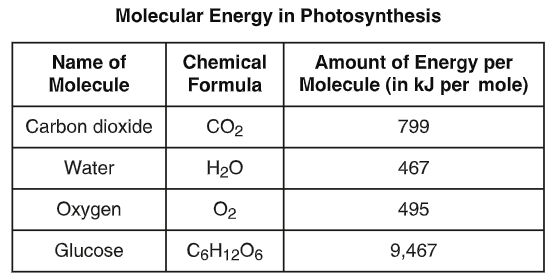
Which statement correctly describes the flow of energy in photosynthesis?
A. Photosynthesis releases energy when the reactants rearrange and form the bonds in the products.
B. Photosynthesis releases energy when carbon dioxide and water combine to form glucose molecules.
C. Photosynthesis stores energy because more energy is stored in glucose than it is in carbon dioxide or water.
D. Photosynthesis stores energy because energy is released when glucose is formed from carbon dioxide and water.
C. Photosynthesis stores energy because more energy is stored in glucose than it is in carbon dioxide or water.
500
Is glycolysis considered aerobic or anaerobic?
Anaerobic it does not require oxygen
500
What are the products of the Krebs cycle?
Electrons/NADH/FADH, CO2 and 2 ATP
500
What are the products of the ETS
32 ATP
6 CO2
6 H2O