Properties & Parts
Types & Examples
Amplitude & Energy
Frequency & Wavelength
Wave Behavior and Interference
100
This is the material (solid, liquid, or gas) that some waves must travel through.
Medium
100
Name the wave type where particle vibrations are parallel to the direction of energy travel (example: sound).
Longitudinal (compressional)
100
True or False: Increasing amplitude increases the energy carried by a wave.
True
100
What describes how many wave cycles pass a point each second?
Frequency
100
What do all waves have in common
They transfer energy (but not matter).
200
The highest point of a transverse wave is called this
Crest
200
Name the wave type where particle vibrations are perpendicular to the direction of energy travel (example: water surface waves).
Transverse
200
If you press a piano key much harder but play the same tone more loudly, which property of the sound wave increases?
Amplitude (louder → greater amplitude and energy)
200
Fill in the blanks: Low-frequency sound waves have a _____ wavelength and a _____ pitch. (two one-word answers)
long; low
200
Why can you see lightning before you hear thunder?
Light travels much faster than sound, so light from lightning reaches you before the sound of thunder.
300
The vertical distance from the equilibrium (rest) position to a crest or trough is called this.
Amplitude
300
Give one mechanical wave example and one electromagnetic wave example from the lesson.
Mechanical example: sound (or water wave, rope/slinky); Electromagnetic example: visible light (or radio, x-ray, EM Spectrum)
300
Using only words, describe what happens to a wave’s energy when its amplitude increases.
Greater amplitude means the wave carries more energy.
300
If a wave graph shows four complete cycles in one second, how would you describe that frequency in simple words?
Four cycles per second (a frequency of four per second)
300
In the diagram where two pulses of a wave—one up and one down—meet and produce a flat line labeled "A+B," what type of interference is shown?
Destructive interference (crest + trough cancel to a flat line).
400
The distance from one crest to the next crest is called this (use the common name).
Wavelength
400
Explain why electromagnetic waves can travel through empty space but mechanical waves generally cannot (one to two sentences).
Electromagnetic waves are oscillations of electric and magnetic fields and do not require matter to move; mechanical waves need particle interactions in a medium, so they cannot travel through a vacuum.
400
Describe how amplitude relates to loudness for sound and brightness for light (one or two sentences).
For sound, larger amplitude = louder; for light, larger amplitude = brighter.
400
Using words, explain the relationship between frequency and wavelength (how one changes when the other increases).
As frequency increases, wavelength decreases; as frequency decreases, wavelength increases — they are inversely related for a given wave speed.
400
n the diagram where two upward pulses overlap and produce a larger upward pulse labeled "A+B," what type of interference is shown?
Constructive interference (crest + crest combine to make a larger crest).
500
Label these parts in words on a blank transverse-wave diagram: crest, trough, amplitude, wavelength
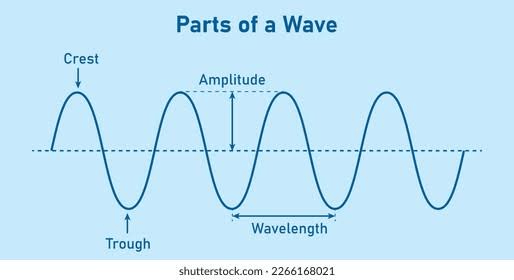
500
Identify two seismic wave types (P-wave and S-wave) and state whether each is longitudinal or transverse, with a one-sentence description of how each moves material.
P-waves: longitudinal/compressional — particles move back and forth along travel direction. S-waves: transverse — particles move perpendicular to travel direction.
500
Two ocean waves have the same wavelength, but Wave X is noticeably taller than Wave Y. In two to three sentences, explain which wave carries more energy and why, using only words. Mention amplitude and how it relates to energy.
Wave X carries more energy because it has the greater amplitude. Amplitude is the measure of how far the medium is displaced from its rest position; larger displacements require and transfer more energy, so higher-amplitude waves carry more energy than lower-amplitude waves even when their wavelengths are the same.
500
If Wave A has fewer cycles across the same length than Wave B, WHich wave has the longer wavelength and why?
Wave A has the longer wavelength because fewer cycles across the same distance means each cycle occupies more space.
500
Explain, in words, how constructive and destructive interference affect sound loudness (one to two sentences).
Constructive interference makes sounds louder (wave amplitudes add); destructive interference makes sounds quieter or can cancel them (wave peaks and troughs reduce net amplitude).