Columbian Exchange
Columbian exchange
Random Q's from the Test
100
Which of these statements best defines the Columbian Exchange?
A: The trade of goods and ideas between Europeans, Africans, and American Indians
B: The passing of germs from Europeans to American Indians that resulted in Epidemics
C: A slave trade between Europeans and Africans that financed Columbus's voyages
D: The passage of European officials across the Atlantic to fill New positions in colonial governments
A: The trade of goods and ideas between Europeans, Africans, and American Indians
100
Which statement displays a negative effect from the Columbian exchange?
A: The trade of crops and livestock from America required people to grow and raise these goods, and this provided jobs for native peoples
B: The trade of sugar grown in America required people to grow it, and this led to plantations and forced labor
C: Europeans traded potatoes and tomatoes to America, which made these foods part of the American Indian diet.
D: Europeans traded pigs, horses, and goats to America, which led to a shortage of these goods in Europe.
B: The trade of sugar grown in America required people to grow it, and this led to plantations and forced labor
100
What was the main goal of Prince Henry's navigation school?
A: To start a colony there
B: to establish the slave trade
C: to build a navy and start a war
D: to find and control trade routes
D: to find and control trade routes
200
Out of the four goods listed: corn, horses, potatoes, and wheat
Which two were traded from the Americas to Europe, and which two were traded from Europe to the Americas?
corn and potatoes were traded from the Americas to Europe
wheat and horses were traded from Europe to the Americas
200
Explain a positive outcome from the Columbian Exchange we can see today.
Cultures were exchanged between different groups. Today, there is greater diversity as a result. Eventually, the flow of goods and people across the ocean led to the large immigration of people that formed the United States.
200
GO TO PAGE 44-45 IN YOUR BOOK:
On the timeline, look at the activity between 1000 and 1500. Which statement about this time period does the timeline support?
A: merchants started trading with India using sea routes after 1419
B: Europeans abandoned sea travel until 1487 because it was too dangerous
C: technology had improved enough by 1487 to make sea travel more common
D: there was little or no development in navigation and sailing technology until 1487.
C: technology had improved enough by 1487 to make sea travel more common
300
Why does Christopher Columbus call the Carribbean Islands "The Indies"?
Columbus sailed west to find riches and a sea route to India. After a long journey, he thought his expedition had reached India. He called the Islands "the Indies" and the people there "Indians." However, he had only reached the Americas. Asia and India were still half a world away.
300
Out of the following, which negative effect of the Columbian Exchange is shown in this image?
War, trade, slavery, or disease?
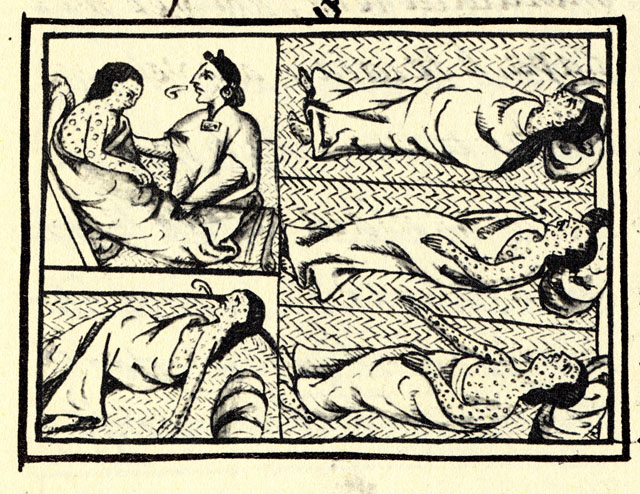
Disease
300
Label the types of Europeans in the order they came to the Americas.
Officials, explorers, conquistadors
1. explorers
2. conquistadors
3. officials
400
From this primary source: "As soon as I arrived in the Indies, on the first island which I found, I took some of the native by force in order that they might learn and might give me information of whatever there is in these parts."
Which part of the excerpt shows the negative treatment of American Indians at the hands of European explorers?
"I took some of the natives by force"
"As soon as I arrived in the Indies, on the first island which I found, I took some of the native by force in order that they might learn and might give me information of whatever there is in these parts."
400
Where did Christopher Columbus sail from and where did he land?
From Spain (Europe) to The Carribbean Sea (Bahamas)
400
CAUSE & EFFECT
If this is the effect, what is the cause
Effect: Spain's rulers agreed to pay for expensive expeditions.
Is the cause:
A: Spain wanted to create jobs
B: Spain needed money to pay for wars
C: Spain wanted to move its government
D: Spain needed to defend itself from American Indians
B: Spain needed money to pay for wars
500
Which trade would reflect the Columbian exchange?
A: peppers for potatoes
B: corn for tomatoes
C: horses for wheat
D: sugar for grapes
D: sugar for grapes
500
How is a colony different than an empire?
A: a colony is made up of a group of smaller empires
B: colonies have stronger governments than empires
C: a colony is a settlement or area far from the country that rules it
D: two colonies become an empire once they agree to trade goods
C: a colony is a settlement or area far from the country that rules it
500
Answer the question by filling in the blank with two of the following words:
time, speed, distance, direction
Sailors used the magnetic compass for _______ and the astrolabe to determine _______.
Sailors used the magnetic compass for DIRECTION and the astrolabe to determine DISTANCE.