Core Vocabulary
Energy Flow & Trophic
Interactions
Cycles & Processes
Ecosystem Changes
100
The term for living and non-living things interacting in one place (an ocean with fish, coral reefs, water, sand, and crustaceans)
Ecosystem
100
The term for a LIVING organism that breaks down dead plants and animals, returning them to the soil
Decomposer (mushrooms and worms)
100
The term for an animal that is hunted and eaten
Prey (a deer being hunted by a wolf)
100
The term for the process plants use to make food from sunlight, water, and CO2
Photosynthesis
100
The term for non-native organisms that harm the ecosystem
Invasive Species (kudzu, honeysuckle, bamboo, stinkbugs, lanternfly)
200
Deer, squirrels, birds, and trees all coexist in a forest as a ______.
Community (all the different populations living together in an area)
200
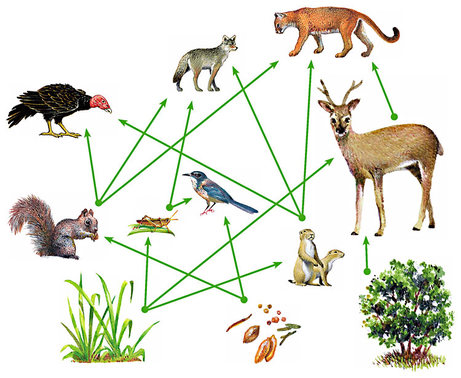
What does this image represent?
Food Web (a diagram showing how many food chains are connected in an ecosystem)
200
When a wolf hunts deer to survive, this would make the wolf a _______.
Predator (an animal that hunts and eats other animals)
200
When a caterpillar turns itself into a cocoon to grow into a butterfly, it undergoes ________.
Metamorphosis (the process of an organism undergoing a physical change in structure, form, or character)
200
A fire breaks out in an ecosystem, killing the grass that the deer eat and destroying the trees where songbirds and squirrels live, the environment has experienced a ________.
(Ecological) Disturbance (an event that changes an ecosystem's structure, community, population, or changes resource availability or the physical environment)
300
Define the term: Biodiversity
The variety of living things on Earth, such as plants, animals, fungi, and microscopic organisms
300
Define the term: Omnivore
An organism that eats both plants AND animals (a brown bear eating fish and berries)
300
Define the term: Symbiosis
A close relationship between two different species (bees and flowers)
300
Define the term: Water Cycle
How water moves through evaporation, condensation, and precipitation
300
Define the term: Carrying Capacity
The largest number of organisms an environment can support (a pond can only support so many fish due to space, food, and familial relationships)
400
Define the word: Niche
The "job" an organism has in its ecosystem: how it gets food, shelter, and interacts with others (bees pollinate flowers to make honey)
400
Define the term: Trophic Level
An organism's position in the food chain (a hawk is a higher trophic level than a mouse)
400
Define the term: Competition
When two or more organisms compete (fight) for the same resource (trees competing for sunlight, deer competing for a mate, wolves competing for pack territory)
400
Define the term: Respiration
The process of breaking down food to release energy (humans breathing oxygen to break down food into energy)
400
Define the term: Limiting Factor
Something that controls how big a population can grow (lack of water in a desert limiting plant growth)
500
Explain the difference between a biome and a habitat and give an example of each.
A biome is a region of the world with similar climate, plants, and animals (grassland); a habitat is where an organism lives and gets what it needs to survive (prairie dog in a burrow)
500
Explain the difference between each term, whether it is living or non-living, and give an example of each: producer, consumer, and decomposer
Producers are LIVING things that make their own food using sunlight (plants); consumers are LIVING things that eat other organisms for energy (animals); decomposers are LIVING things that break down dead plants and return nutrients to the soil (mushrooms/worms)
500
Explain the difference between mutualism and parasitism and give an example of each.
Mutualism is an interaction where both species benefit (clownfish and sea anemones); parasitism is where one species benefits while the other is harmed (ticks feeding on a dog)
500
Explain how an animal begins and ends a life cycle and give an example.
An animal starts as a fertilized egg or seed, grows into a juvenile stage, develops and changes, and then enters the adult stage as it reaches full maturity and reproduces, restarting the cycle when it dies (a wolf pup growing into an adult, reproducing, and then eventually dying)
500
Explain the difference between conservation and sustainability, and give examples of how we can promote both in our environment
Conservation is the act of protecting and saving natural resources (short-term: recycling, planting/replacing trees); sustainability is using resources in a way that keeps them available for the future (long-term: reducing waste, using green transport)