Scientific Method
Lab Safety
Lab Equipment
Metric Conversion& Scientific Notation
Accuracy, Precision, & Errors
100
What is a hypothesis?
A testable explanation.
100
What equipment protects your eyes from chemical splashes?
100: Safety goggles.
100
Which tool measures the mass of an object?
100: A balance.
100
A measurement is composed of a number and a ____.
100: Unit.
100
What does accuracy describe?
100: Closeness to the accepted or actual value.
200
Classify each statement as qualitative or quantitative:
A. “The leaf is green.”
B. “The leaf is 8 cm long.”
100 each:
A. Qualitative.
B. Quantitative.
200
Name the safety equipment used for
A. chemicals splashed on the body or clothes and
B. chemicals splashed into the eyes.
100 each:
A. Safety shower.
B. Eyewash station.
200
Name the tool used to
A. measure liquid volume and
B. magnify objects too small to see clearly.
100 each:
A. Graduated cylinder.
B. Microscope.
200
Name the SI base units of
A. mass and
B. liquid volume.
100 each:
A. Kilogram (kg).
B. Liter (L).
200
A. What does precision describe?
B. What is parallax error?
100 each:
A. Closeness of repeated measurements to one another.
B. Reading a scale from the wrong viewing angle.
300
A. What is an observation?
B. Classify “The plant wilted because it did not receive enough water” as an observation or inference.
C. Classify "The plant has white flowers, each with 5 petals, and a yellow gradient." as an observation or inference.
100 each:
A. Information gathered using senses or tools.
B. Inference.
C. Observation
300
A. What technique should you use when the teacher permits smelling a substance?
B. Describe that technique.
C. Is it okay to assume that a chemical is harmless if it does not have an odor?
100 each:
A. Wafting.
B. Gently fan vapors toward your nose.
C. No, some dangerous chemicals are clear liquids that do not have a smell or odor
300
Scott chooses a graduated cylinder to measure pond-water temperature.
A. What does a graduated cylinder measure?
B. What tool should he use instead?
C. What does that replacement tool measure?
100 each:
A. Liquid volume.
B. Thermometer.
C. Temperature.
300
A. Write 0.00045 in scientific notation.
B. What is its coefficient?
C. What is its exponent?
100 each:
A. 4.5 × 10⁻⁴.
B. 4.5.
C. −4.
300
Daniel looks down at water in a graduated cylinder and reads the top of the meniscus.
A. Identify his viewing-position mistake.
B. Identify his meniscus-reading mistake.
C. Explain how to correct both.
100 each:
A. Looking from above.
B. Reading the top.
C. Read the bottom of the water meniscus at eye level.
400
Malia tests how ramp height affects the distance a toy car travels. She uses the same car, release point, and floor surface.
Identify
A. the independent variable,
B. the dependent variable,
C. one constant, and
D. another constant.
100 each:
A. Ramp height.
B. Distance traveled.
C–D. Any two different constants: car, release point, or floor surface.
400
Jay was using an Erlenmeyer flask to mix a chemical. While he was swirling the mixture, he accidentally hit the back of a ring stand and breaks the Erlenmeyer flask. He picks up broken glass with bare hands. He disposes the broken glass into a regular trash bin.
A. Identify the unsafe cleanup action.
B. Explain its danger.
C. Identify the disposal mistake.
D. Name the proper disposal container.
A. Using bare hands.
B. The glass could cut him.
C. Using regular trash.
D. The designated broken-glass container.
400
Before measuring an apple with a triple-beam balance,
A. what reading should the empty balance show?
B. What quantity does the balance measure?
C. How do you combine the three rider readings?
D. What unit does the exam request?
100 each:
A. Zero.
B. Mass.
C. Add them.
D. Grams (g).
400
A. Convert 3.6 m to cm.
B. Convert 850 mL to L.
200 each:
A. 360 cm.
B. 0.85 L.
400
The accepted mass is 50.0 g.
Carmen records 48.0, 49.0, and 50.0 g. Gerti records 45.6, 45.5, and 45.5 g.
A. Who is more precise?
B. Why?
C. Who is more accurate?
D. Why?
100 each:
A. Gerti.
B. Her readings are closer together.
C. Carmen.
D. Her readings are closer to 50.0 g.
500
Scientists test how hours of light affect bean-plant height.
Identify
A. the independent variable,
B. the dependent variable,
C. one condition to keep constant, and
D. a second condition to keep constant.
E. After the experiment, the scientists conclude that ALL plants would grow taller if they are exposed to more hours of light. Is their conclusion true?
100 each:
A. Hours of light.
B. Plant height.
C–D. Any two: plant type, soil, water, pot size.
E. Other kinds of plants were not tested and may respond differently.
500
Ana was using a beaker to mix a chemical. While she was mixing, a chemical splashes into Ana’s eyes. She rubs them and she feels fine then continues working. If she does not feel well, she is planning to tell the teacher later.
A. Identify the unsafe action involving her eyes.
B. Explain why it is unsafe.
C. Name the equipment she should use immediately.
D. Identify her reporting mistake.
E. State the correct reporting action.
100 each:
A. Rubbing her eyes.
B. It can worsen irritation or injury.
C. Eyewash station.
D. Delaying the report.
E. Notify the teacher immediately.
500
Describe correct measuring procedures:
A. Where should a pencil begin on a ruler? B. What unit does the exam request for pencil length?
C. Where should a graduated cylinder stand?
D. Where should your eyes be when reading it?
E. Which part of the water meniscus should you read?
100 each:
A. At the zero mark.
B. Centimeters (cm).
C. On a level surface.
D. At the level of the meniscus.
E. The bottom.
500
A. Write 7,200,000 in scientific notation.
B. Write 0.00067
C. Write 6.3 × 10³ in standard notation.
A. 7.2 × 10⁶. (200 pts)
B. 6.7 × 10⁻⁴. (200 pts)
C. 6,300. (100 pts)
500
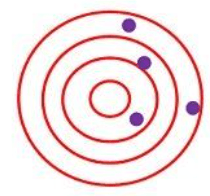 A. Are they accurate?
B. What feature supports that judgment?
C. Are they precise?
D. What feature supports that judgment?
E. Give the complete classification.
100 each:
A. No.
B. They are far from the center.
C. No.
D. They are not close together.
E. Neither accurate or precise.