Treaties
National
Parties
Acts
People
200
Who was the leader of the Miami tribe (NW Territory, Illinois area) who became famous due to his ability to lead Native troops in the Northwest Indian Wars (Little Turtle’s War) against the US?
Hint: He agreed to the Treaty of Greenville.
Little Turtle (Mihšihkinaahkwa)
200
What is National Debt?
National Debt - The amount of money the government owes for borrowing money from various sources (citizens, foreign governments, businesses, etc.)
200
What is the definition of partisan?
Partisan - Person who favors one side of a political issue.
200
What was the Sedition Act?
Sedition Act - Law that made it illegal to criticize the government. Could not “speak, write, or publish false, scandalous, and malicious criticisms of the government.”
200
Who was the 1st Secretary of the Treasury under Washington, Founding Father, and Federalist?
Alexander Hamilton - The 1st Secretary of the Treasury under Washington. Founding Father and Federalist.
300
What was the XYZ Affair?
XYZ Affair- Political crisis with France in which, in response to Jay’s Treaty, France seized a US ship carrying supplies for Great Britain.
300
What is the Bill of Rights?
Bill of Rights - First 10 Amendments to the Constitution that lay out the basic rights of all US citizens.
300
George Washington warned that political parties would ________________________________.
Washington wrote a letter to the people and warned that political parties would divide the nation.
Was he right??
300
What was the Alien Act?
Alien Act - Gave the president/executive branch the power to deport aliens without due process if they were deemed to be a danger to the US.
300
Who was the 1st Vice President of the US under Washington and the 2nd President; Founding Father and Federalist?
John Adams was the 1st Vice President of the US under Washington, the 2nd President, a Founding Father, and a Federalist.
400
What was Jay's Treaty? What did many Americans not like about it?
John Jay, with the help of Alexander Hamilton, negotiated a treaty with Britain to settle issues between the countries that had carried over from the Revolution. Many Americans saw this treaty as favoring the British far too much and called it “dishonorable.” It also did not deal with the issue of impressment, which upset many Americans.
400
What did each of these departments handle?
State Department
War Department
Treasury Department
State Department - Executive branch department in charge of handling relations with other nations.
War Department - Executive branch department in charge of handling the nation’s defenses.
Treasury Department - Executive branch department in charge of handling financial matters.
400
What were political meetings where party’s candidates were selected called?
Caucuses - Political meetings where party’s candidates were selected
In the presidential election of 1796, candidates sought office for the first time as members of a party. To prepare for the election, each party held meetings known as caucuses to help decide on a candidate to represent them. At their caucus, the Federalists chose VP John Adams for president and Charles Pinckney as their VP candidate. The Democratic-Republicans chose former Secretary of State Thomas Jefferson for president and known politician/judge Aaron Burr as VP.
400
What were the Virginia and Kentucky Resolutions of 1798 and 1799?
Virginia and Kentucky Resolutions of 1798 and 1799 - Claimed that the Alien and Sedition Acts were unconstitutional and an overreach of federal power and the states had the right to nullify federal acts they deemed unconstitutional.
An example of States Rights in the new government.
400
Who was the 1st Secretary of War under Washington, a Revolutionary War Hero, Federalist, and longtime friend to Washington?
Henry Knox - The 1st Secretary of War under Washington. Revolutionary War Hero, Federalist, and longtime friend to Washington.
500
What happened between Matthew Lyon and Roger Griswold?
Division between the parties was so high that it broke out into to actual violent conflict in the House of Representatives. In 1798 Roger Griswold (Federalist) insulted Matthew Lyon (Dem-Rep) over his lack of a military record when discussing war policy. Lyon, in turn, spit tobacco in Griswold’s face and a fight broke out in which Griswold attacked Lyon with a cane. Lyon fought back with fireplace tongs. Griswold's supporters sent him large numbers of canes to replace the one he beat Lyon with.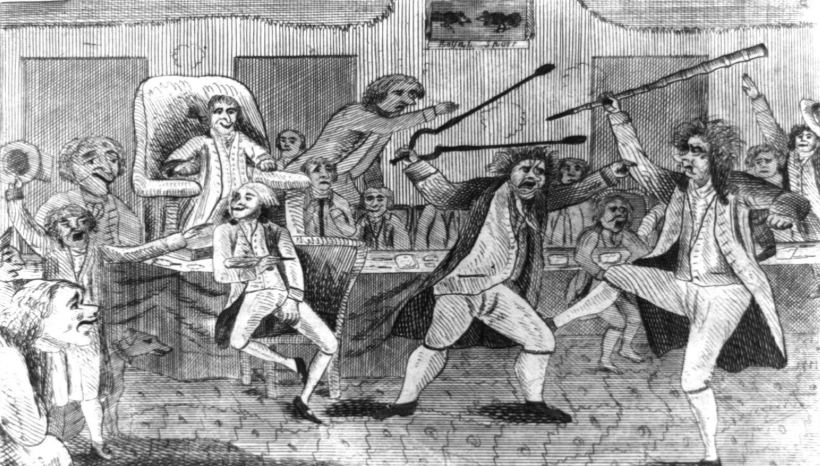
500
What was the Whiskey Rebellion and why was Washington's response to it important?
The Whiskey Rebellion was an armed protest by backcountry farmers who refused to pay a federal tax on whiskey. Many farmers struggled to pay the tax because they often traded goods instead of using cash. When the government began strictly enforcing the tax, angry farmers rebelled.
George Washington responded by sending 13,000 federal troops to stop the rebellion. The farmers quickly dispersed, and the rebellion ended.
Why was Washington's response important?
It proved that the new federal government was strong and could enforce its laws.
It showed that citizens could not use violence to fight against laws they disagreed with.
Washington demonstrated that people should use peaceful, constitutional methods to change laws.
It showed that the new government would not allow another rebellion like Shays' Rebellion to threaten its authority.
Big takeaway to remember: Washington proved that the new government was strong enough to enforce its laws, even when citizens disagreed with them.
500
Describe the differences between the first two political parties.
Federalists:
Wanted a strong national (federal) government and believed states should have less power.
Supported a loose interpretation of the Constitution, meaning the government could use implied powers.
Supported a national bank, protective tariffs, and trade.
Generally supported Britain.
More popular in the Northern states, especially among merchants, bankers, and wealthy plantation owners.
Democratic-Republicans:
Wanted strong state governments and a weaker national government.
Supported a strict interpretation of the Constitution, meaning the government should only have powers specifically listed.
Supported state banks, free trade, and ordinary people's involvement in government.
Generally supported France.
More popular in the Southern states, especially among farmers and workers.
Big takeaway to remember:
Federalists = Federal power! Strong national government, loose interpretation of const, supported Britain.
Democratic-Republicans = State power! Strong state governments, strict interpretation of const, supported France.
500
Explain the Judiciary Act of 1789 and how it would affect state law.
The Judiciary Act of 1789 created the federal court system, including district courts, circuit courts, and the Supreme Court. It made the Supreme Court the highest court, meaning it could overturn state court decisions if they conflicted with federal law.
13 district courts and 3 circuit courts
Each district and circuit court would have 1 Judge and 1 Attorney (defense lawyer)
the Supreme Court which would be the final authority
It would include 1 chief justice and 5 associate judges
All decisions made by the Supreme Court were final
the office of attorney general of the United States as a member of the President’s cabinet
Also, head of the Department of Justice.
that state laws would remain but federal courts could reverse decisions made by the states
500
Who was the 1st Attorney General under Washington. Washington’s aide-de-camp during Rev. War; suggested Virginia Plan; later becomes Sec. of State; represents A. Burr in his treason trial?
Edmund Randolph - The 1st Attorney General under Washington. Washington’s aide-de-camp during Rev. War; suggested Virginia Plan; later becomes Sec. of State; represents A. Burr in his treason trial.