A
B
C
D
E
100
Which statement correctly describes the life cycle of a star?
a.A star originates from a stellar nebula, and its life cycle is determined by its volume.
b.A star originates from a stellar nebula, and its life cycle is determined by its mass.
c.A star originates from a supernova, and its life cycle is determined by its volume.
d.A star originates from a supernova, and its life cycle is determined by its mass.
b.A star originates from a stellar nebula, and its life cycle is determined by its mass.
100
Which statement accurately describes where Earth’s solar system is located?
a. Earth’s solar system is located in the center of the spiral-shaped Milky Way galaxy.
b. Earth’s solar system is located on an outer arm of the spiral-shaped Milky Way galaxy.
c. Earth’s solar system is located in the center of the irregular-shaped Andromeda galaxy.
d. Earth’s solar system is located on an outer arm of the irregular-shaped Andromeda galaxy.
b. Earth’s solar system is located on an outer arm of the spiral-shaped Milky Way galaxy.
100

Earth's solar system is located in a galaxy that contains billions of stars. A model of the galaxy is shown below. Which location best represents the position of Earth's solar system in this galaxy?
Y
100
Which sequence correctly illustrates the stages in the life cycle of a low-mass star?
a. Stellar Nebula  Red giant White dwarf Main sequence Planetary nebula
b. Stellar Nebula Main sequence Red giant Planetary nebula White dwarf
c. Main sequence Red giant Nebula Supernova Stellar nebula
d. Supernova Nebula Red giant White dwarf Main sequence
b. Stellar Nebula Main sequence Red giant Planetary nebula White dwarf
200
The sun’s radiation peaks in the visible range of the electromagnetic spectrum, but the corona, the outermost region of the sun’s atmosphere, is much hotter and emits waves with higher frequencies. To study the corona, scientists use data collected by wave detectors on satellites orbiting Earth. What type of wave detectors must be used to learn more about the corona?
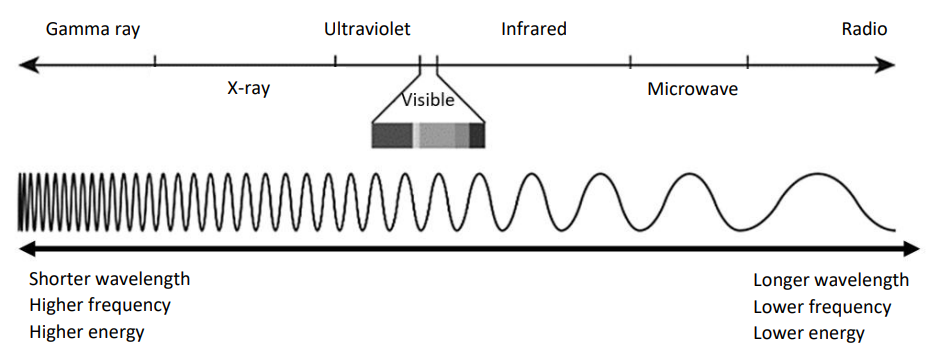
a. Radio wave detectors
b. Microwave detectors
c. X-ray detectors
d. Infrared wave detectors
c. X-ray detectors
200
The diagrams below represent two electromagnetic waves that are traveling at the same speed.
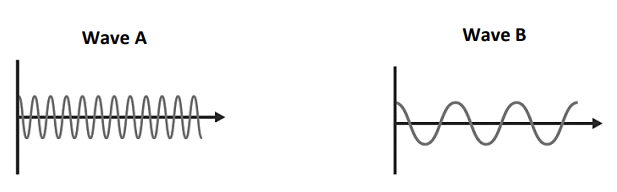
Which statement correctly compares the characteristics of Wave A and Wave B?
a. Wave A has a greater amplitude, while Wave B has a higher frequency.
b. Wave A has a longer wavelength, while Wave B has a lower amplitude.
c. Wave A has a higher frequency, while Wave B has a longer wavelength.
d. Wave A has a lower frequency, while Wave B has a greater amplitude.
c. Wave A has a higher frequency, while Wave B has a longer wavelength.
200
The sun is a star at the center of Earth’s solar system. It provides light and heat that make life possible on Earth. The Hertzsprung-Russell (H-R) diagram below shows the classification of the sun compared to other stars.
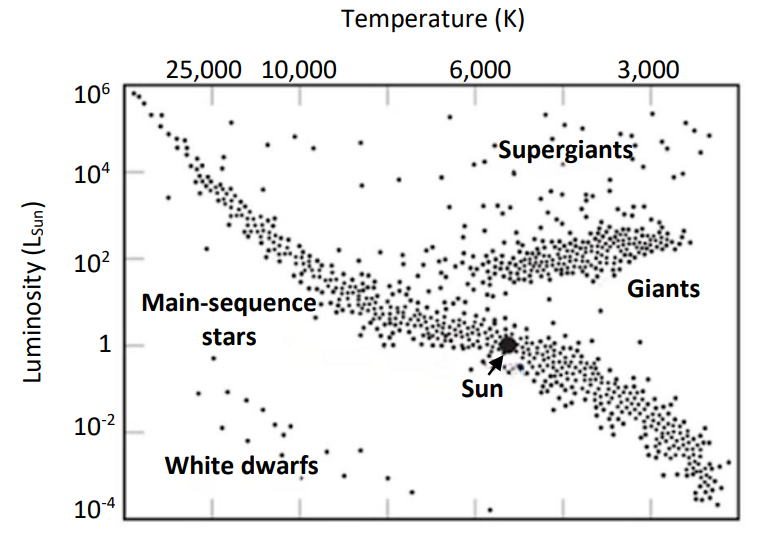
A star that is dimmer than the sun with a surface temperature of 20,000 K would most likely be classified as a -
a. main-sequence star
b. giant
c. white dwarf
d. supergiant
c. white dwarf
200

A student was asked to describe the three main types of galaxies. The descriptions are shown in the table.
Correctly name each of the galaxies listed
A- elliptical
B- irregular
C- spiral
300
Three stars are identified on the Hertzsprung-Russell diagram below.
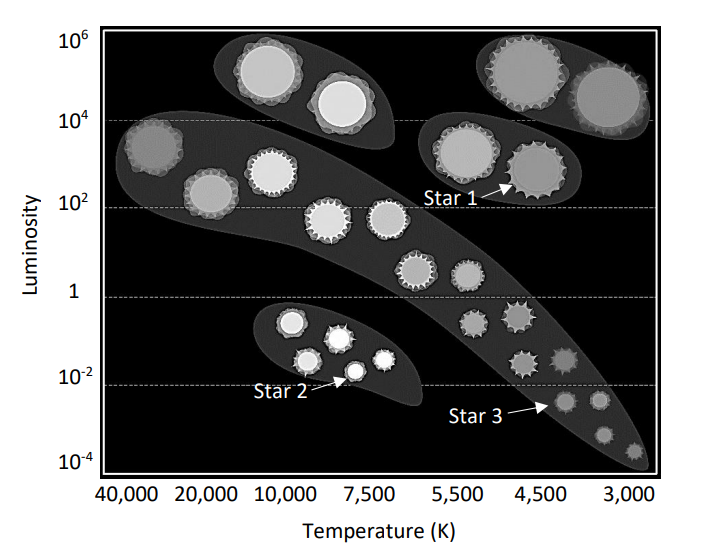
Complete the sentences.
Based on the Hertzsprung-Russell diagram, ______ (Star 1 Star 2 Star 3) began as a low-mass star and is in the middle of its life cycle, while ________ (Star 1 Star 2 Star 3) began as a high-mass star and is near the end of its life cycle.
Star 3
Star 1
300
A Hertzsprung-Russell diagram can be divided into sections to help classify stars based on their luminosity and surface temperature.
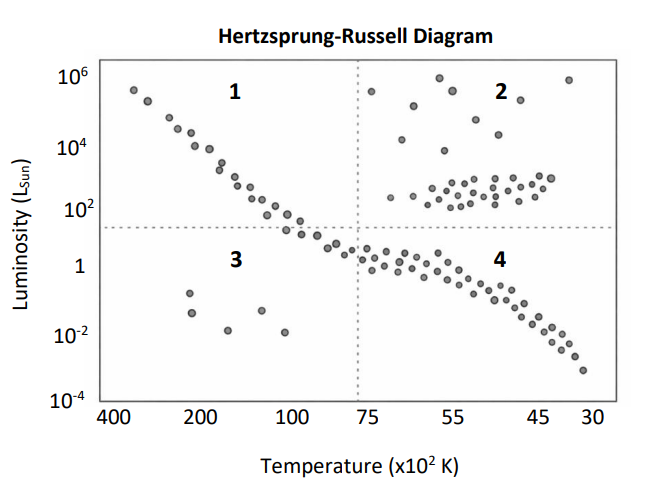
Which section on the diagram includes the brightest and hottest stars?
a. Section 1
b. Section 2
c. Section 3
d. Section 4
Section 1
300
The life cycles of stars are shown in the diagram below.
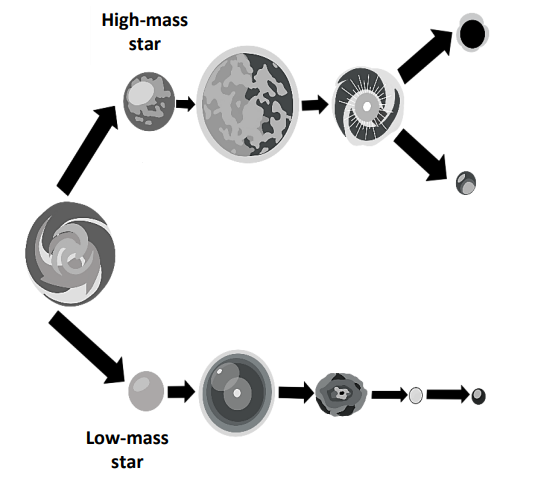
What can a high-mass star become at the end of its life cycle?
a. A supernova or black hole
b. A stellar nebula or red giant
c. A supergiant or neutron star
d. A neutron star or a black hole
d. A neutron star or a black hole
300
Earth's oceans are influenced by the relative positions of the sun, the moon, and Earth. The model below shows one alignment of the sun, the moon, and Earth.
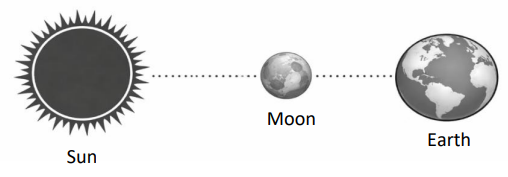
Which statement accurately describes the type of tide this model represents?
a. The model represents a neap tide that results in the least difference between high and low tides.
b. The model represents a spring tide that results in the least difference between high and low tides.
c. The model represents a neap tide that results in the greatest difference between high and low tides.
d. The model represents a spring tide that results in the greatest difference between high and low tides.
d. The model represents a spring tide that results in the greatest difference between high and low tides.
300
Which diagram represents the position of Earth relative to the sun when it is winter in Texas?
a.
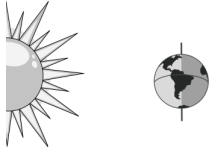
b.
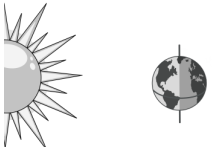
c.
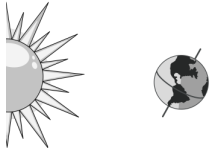
d.
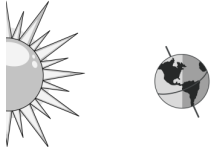
C
400
Most stars belong to one of the four categories shown on the Hertzsprung-Russell diagram.
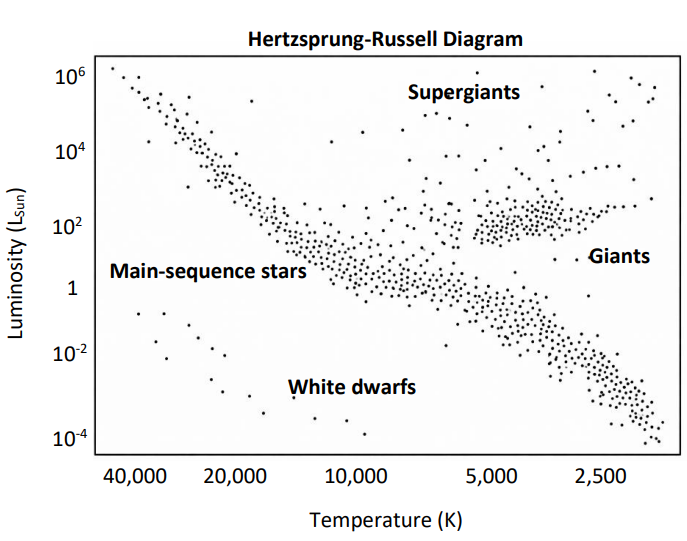
Which statements correctly describe stars on the Hertzsprung-Russell diagram?
Select TWO correct answers.
a. A star with a luminosity of 1 and a surface temperature of 5,500 K is a main-sequence star.
b. In the main sequence, a star’s luminosity decreases as its temperature increases.
c. A star with a luminosity of 106 and a surface temperature of 10,000 K is a white dwarf.
d. In the main sequence, a star’s luminosity increases as its temperature increases.
e. A star with a luminosity of 106 and a surface temperature of 20,000 K is dimmer and hotter than the sun.
a. A star with a luminosity of 1 and a surface temperature of 5,500 K is a main-sequence star.
d. In the main sequence, a star’s luminosity increases as its temperature increases.
400
Two electromagnetic waves are shown. Complete the table by labeling the characteristics of each wave. 
Higher frequency
Lower frequency
Higher amplitude
Lower amplitude
Longer wavelength
Shorter wavelength
Wave 1- Lower, Lower, longer
Wave 2- Higher, Higher, shorter
400

Which student accurately described the theories on the origin of the universe?
a. Student 1
b. Student 2
c. Student 3
d. Student 4
3
400
The diagram shows the positions of Earth as it orbits the sun.
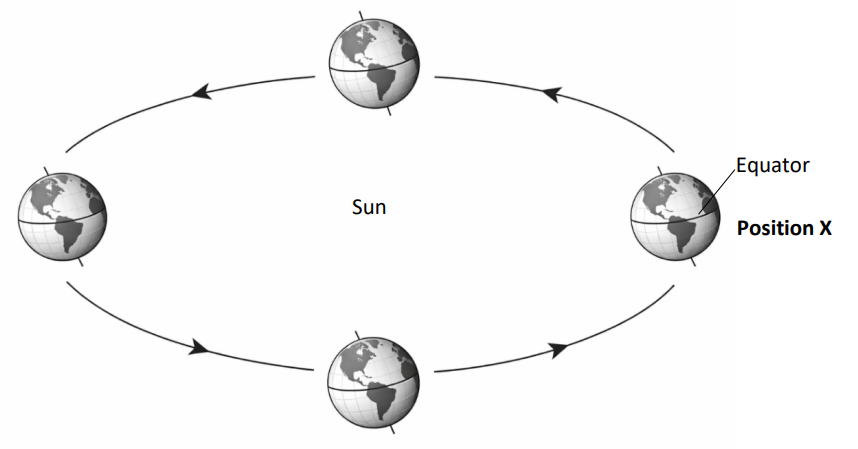
Which statement correctly describes conditions in the Southern Hemisphere at Position X?
a. It experiences more hours of daylight than nighttime because it is tilted toward the sun.
b. It experiences equal hours of daylight and nighttime because it is furthest from the sun in its orbit.
c. It experiences fewer hours of daylight than nighttime because it is tilted away from the sun.
d. It experiences equal hours of daylight and nighttime because it is closest to the sun in its orbit.
c. It experiences fewer hours of daylight than nighttime because it is tilted away from the sun.
400
In the image below, Skater A spins in a circular motion while holding the hand of Skater B. This creates a rotational movement on the ice, where Skater B circles around Skater A in a close, stretched-out position.
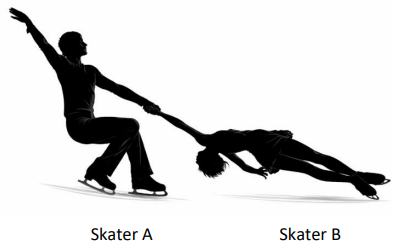
Which phenomenon does the skaters’ movement best represent?
a. Potential energy that is stored in the sun
b. The gravitational attraction between the sun and Earth
c. Electromagnetic energy transferred from one point to another
d. The magnetic attraction between celestial objects
b. The gravitational attraction between the sun and Earth
500
Bacteria are commonly exposed to visible light in their environment. Ultraviolet, or UV, radiation is another type of electromagnetic radiation that can be used for UV sterilization, a process that kills bacteria and other microbes. The table below compares characteristics of visible light and ultraviolet radiation.

Based on this information, which statement correctly compares visible light and UV radiation?
a.Visible light carries more energy and has a shorter wavelength than ultraviolet radiation.
b. Visible light carries less energy and has a shorter wavelength than ultraviolet radiation.
c. Visible light carries more energy and has a longer wavelength than ultraviolet radiation.
d. Visible light carries less energy and has a longer wavelength than ultraviolet radiation.
d. Visible light carries less energy and has a longer wavelength than ultraviolet radiation.
500
A Hertzsprung-Russell diagram is shown below.
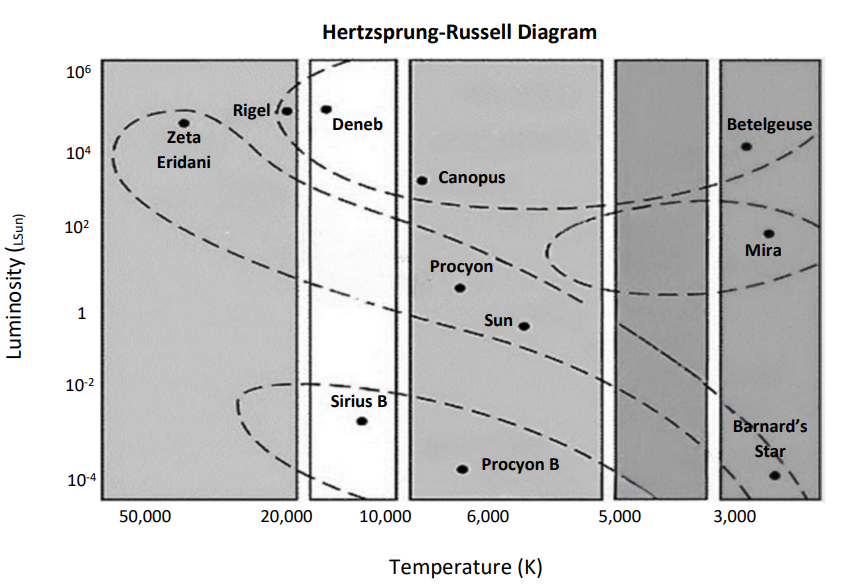
Which star has the hottest surface temperature?
a. Zeta Eridani
b. Betelgeuse
c. Rigel
d. Procyon B
a. Zeta Eridani
500
Which table correctly identifies a device that uses radio waves?

B
500
The diagram below shows how a signal travels through a fiber optic cable using light that reflects along the inside of the cable.
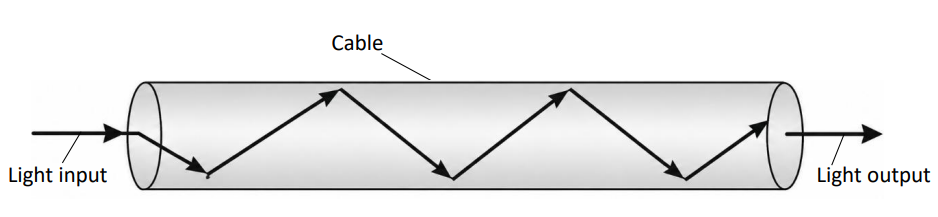
Which type of electromagnetic wave is used in fiber optic communication?
a. Infrared wave
b. Gamma ray
c. Microwave
d. Radio wave
a. Infrared wave
500
Identify the most widely accepted theory on the origin of the universe AND explain how redshift provides evidence for this theory.
Big bang theory
Redshift discusses how the long wavelengths associated with red on the EM spectrum prove that the universe is expanding away from us.