Right Triangle Trig
Standard Position & Coterminal Angles
Unit Circle
Non-right Triangles
Vectors
100
The value of sinθ when θ is opposite a side of 3 and a hypotenuse of 5
What is 3/5?
100
The reference angle for a 30o angle in standard position
What is 30o
100
Convert
pi/3
Radians to degrees
What is 60o?
100
State the Law of Sines formula.
sin(a)/a =sin(b)/b = sin(c)/c
100
A vector v has components ⟨3, 4⟩. Find its magnitude
What is 5?
absv = sqrt(3^2+4^2)
200
The length of an opposite side, rounded to two decimal places, given a right triangle with an angle of 37o is adjacent to a side of 10
What is 7.54?
200
Two coterminal angles for θ = 45o
What are -315o, 415o among others?
200
State the coordinates on the unit circle for angle 0 and for angle π
What are (1,0) and (-1,0)
200
In triangle ABC, A = 30°, a = 10, and b = 15. Use the Law of Sines to find angle B (round to nearest degree). Indicate if ambiguous case arises (More than 1 triangle possible).
1 Triangle.
sinA/a = sinB/b
sinB = b*sinA/a
sinB = 15sin(30^o)10 = 0.75
B = sin^-1(0.75) ~ 48.59^o
200
Write the vector with magnitude 5 and direction 53.13° (to 2 decimal places) in component form (rounded).
components = ⟨5 cos53.13°, 5 sin53.13°⟩ ≈ ⟨3.00,4.00⟩
300
All six trigonometric functions for θ:
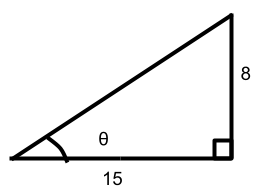
What are: sin = 8/17, cos = 15/17, tan = 8/15, csc = 17/8, sec = 17/15, cot = 15/8
?
300
The quadrant of an angle 210o, and the sign of its sine and cosine (not the values, just the sign)
What are III, negative & negative?
300
What are the exact sine and cosine values for θ = π/4? Give as radicals.
What are
sqrt(2)/2, sqrt(2)/2
300
State the Law of Cosines formula for side a. Then use it: In ΔABC, b = 7, c = 10, and A = 60°. Find a (round to 2 decimal places).
a2=b2+c2−2bc*cosA.
Compute:
a^2=7^2+10^2−2(7)(10)cos60°
a^2 = 49+100−140(0.5)
a = sqrt(79) ~~ 8.89
300
Given u = ⟨2, −1⟩ and v = ⟨−3, 4⟩, find u + v and u − v.
u+v = ⟨−1,3⟩; u−v = ⟨5,−5⟩
400
How high up the wall a ladder 12ft long reaches when leaned against a wall making a 70o angle with the ground.
What is 11.28ft?
400
An angle in standard position has terminal side passing through point (-3, 4). Find the reference angle and name the quadrant.
What is ~53.13o in quadrant II
400
Find the radian measure of an angle that is 135°. Then give the unit-circle coordinates for that angle
135^o = (3pi)/4
(-sqrt(2)/2, sqrt(2)/2)
400
Given triangle with sides a = 8, b = 11, c = 13, find the area using Heron’s formula:
A = sqrt(S(S-a)(S-b)(S-c))
S = (a+b+c)/2
S = (8+11+13)/2 = 16
A = sqrt(16(16-8)(16-11)(16-13)) = sqrt(16*8*5*3)
A = sqrt(1920) ~~ 43.8
400
Compute the dot product of u = ⟨1, 2⟩ and v = ⟨4, −3⟩. Then determine whether the angle between them is acute, obtuse, or right
u*v = 1(4)+2(−3)=4−6=−2
Obtuse angle
500
The angle of elevation to the top of a tower from a point 50m away is 21o. A second observation is made 30m closer to the tower. Find the angle of elevation for the second tower.
tan(21^o) = h/50
h = 50tan(21^o)
h = 19.2m
tan(theta) = 19.2/(50-30)
tan(theta) = 19.2/20 = 0.959
tan-1(0.959) = 43.8o
500
Given θ = −250°, find a positive coterminal angle between 0° and 360°. Then convert that angle to radians (exact form).
−250° + 360° = 110°; in radians:
110^o = (11pi)/18
500
A point on the unit circle has coordinates (−√3/2, 1/2). Find the angle(s) θ in radians between 0 and 2π that correspond to this point. Show your exact answers
What is
(5pi)/6
500
In ΔABC, a = 14, b = 10, and included angle C = 50°. Use the formula for area using two sides and included angle to find area (round to 1 decimal place)
A = 1/2ab*sinC
A = 1/2*14*10*sin(50^o) ~~70*0.766
A ~~53.6
500
Find the angle between vectors a = ⟨5, 2⟩ and b = ⟨−1, 4⟩ in degrees (round to nearest degree). Show work using the dot product formula.
costheta = (a*b)/(absa*absb)
a*b = 5(−1)+2(4)= −5+8=3
absa = sqrt(25+4) = sqrt(29)
absb = sqrt(1+16) = sqrt(17)
costheta = 3/(sqrt(29)sqrt(17))
theta ~~ 73^o