Vocabulary
Arithmetic vs Geometric
Find the Pattern
Recursive vs nth term
Final Jeopardy (with wagers)
100
Which type of sequence adds the same number over and over?
arithmetic
100
Is the sequence 5, 10, 15, 20,... arithmetic or geometric?
arithmetic
100
Find the next term in the sequence: 4, 7, 10, 13,...
16
100
In the recursive formula, f(n)=f(n-1)+4, what does f(n-1) mean?
the previous term
200
Which type of sequence multiplies the same number over and over?
geometric
200
Is the sequence 2, 6, 18, 54,... arithmetic or geometric?
geometric
200
1, 4, 16, 64 has a growth factor of ___
4
200
A sequence is defined recursively by f(1)=5 and f(n)=f(n-1)*2 for n greater than or equal to 2. What are the first three terms of this sequence?
5, 10, 20
300
A formula that tells you how to get the next term using the previous term is called a ________ definition.
recursive
300
A geometric sequence starts 81, 27,...
What is the growth factor?
1/3
300
if h(1)=2 and h(2)=6, what is h(3) if the sequence is arithmetic?
10
300
Write the full recursive definition for a sequence K whose term #0 is 3 and whose growth factor is 2/7.
K(0)=3, K(n)=K(n-1)*2/7, n>=1
400
In an arithmetic sequence, the constant value added to the previous term is called the ....
rate of change
400
A geometric sequence starts 2, 4,...
What is the 5th term? (2 is term #1)
32
400
If a paper strip starts at an area of 36 square units and each cut reduces its area to 1/3 of the previous strip, what is the area after 2 cuts?
4
400
Write the full nth term definition for a sequence G whose term #0 is 2 and whose rate of change is -6.
G(n)=2-6n, n>=0
500
Find M(11).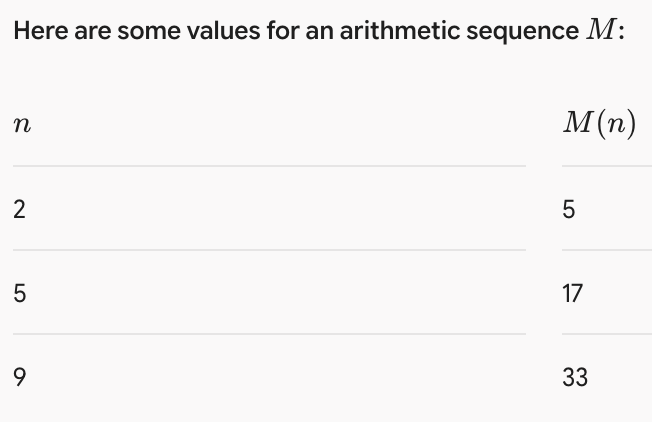
41