Add/Subtract/Multiply
Divide
Basics, Graph & End Behavior
Zeros
100
This is the sum of
( x² + 3x + 5 ) and
( 2x² - 4x -2 )
( x² + 3x + 5 ) and
( 2x² - 4x -2 )
What is 3x² - x + 3
100
This is the product when
( x +3f) and ( x - 3f)
are multiplied
( x +3f) and ( x - 3f)
are multiplied
What is x2 - 9f2
100
This is the degree and leading coefficient of the function
f(x) = -9x5 -2x4 + x3 + 2x2 + 2x + 5
What is d=5 lc= -9
100
This is the root, multiplicity and behavior at the root.
f(x) = (x + 2)2 (x - 5)7
What is
(-2, 0) multiplicity of 2, touches the x-axis
(5, 0) multiplicity of 7, crosses the x-axis
200
This is the result when
(5x4 + 2x2 + 4x -1 )
and ( x5 + 2x4 -x -5 )
are added
(5x4 + 2x2 + 4x -1 )
and ( x5 + 2x4 -x -5 )
are added
What is x5 +7x4 + 2x2 + 3x - 6
200
This is the result when you divide
(3x2+7x-20) by (x+4)
(3x2+7x-20) by (x+4)
What is 3x-5
200
Is the following function even, odd, or neither?
g(x) = -6x9 - 8x5+2x
What is odd.
200
These are the zeros of the function
f(x)= x3 -36x
What are-6, 0, 6
300
( 7x5 - x4 + x3 + 2x2 - 1 )
- (- 2x5 + x4 + 2x - 10 )
- (- 2x5 + x4 + 2x - 10 )
What is ( 9x5 -2x4 + x3 + 2x2 - 2x + 9 )
300
The product of
(w+4) and ( w2 + 6w -1 ) is
(w+4) and ( w2 + 6w -1 ) is
What is w3 +10w2 + 23w - 4
300
Is this an even, odd of neither function?
g(x) = -x6 +5x4-x
what is neither?
300
Identify the roots of the function and their multiplicity.
q(x) = (x-3)4(x+6)3(x+2)3
What is
(3, 0) multiplicity of 4
(-6, 0) multiplicity of 3
(-2, 0) multiplicity of 3
400
This is the result of
(2x -3)3 when expanded.
What is 8x3-36x2 +54x -27
400
The remainder when f(x) is divided by g(x)
f(x) = 3x3 - 4x2 +5 and g(x) = x - 2
What is 13/(x-2)
400
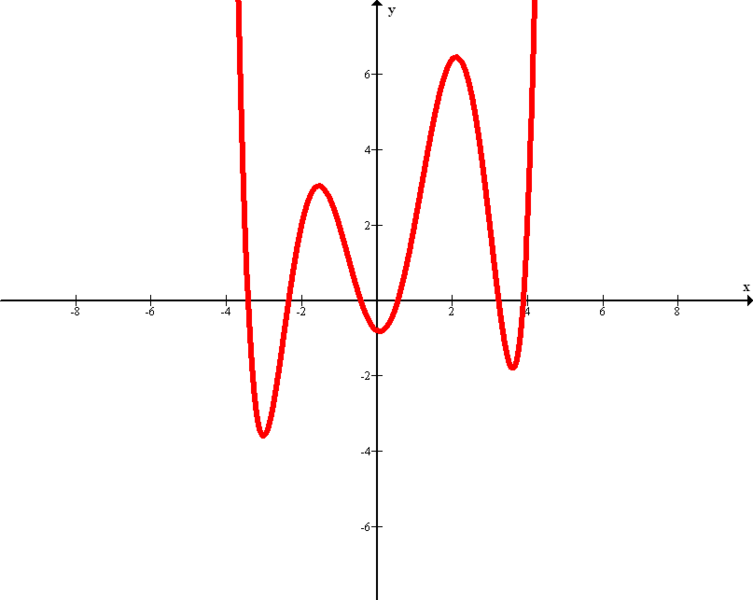
This is the degree( odd/even) and the leading coefficient(positive/negative) of this graph
What is even/positive
400
At what x-intercepts does the graph cross?
q(x) = -(x-4)2(x+5)(x-1)
(-5, 0) and (1, 0)
500
This is the result when
x8 - x7 +x6 - x3 + 2x2
is subtracted from
-x8 - x7 - x6 -x3 -2x2 +1
What is -2x8 -2x6 -4x2 +1
500
This is the remainder when you divide
(3x3 -4x2 + 2x -1 ) by (x + 1)
(3x3 -4x2 + 2x -1 ) by (x + 1)
What is -10
500

This is the degree( odd/even) and the leading coefficient(positive/negative) of this graph
What is odd/positive
500
Find all roots and state the multiplicity of each. Determine whether the graph will bounce or cross at each root.
f(x) = (x3-36x)(x2-4x-12)
(0,0) multiplicity 1, crosses
(-6, 0) multiplicity 1, crosses
(-2, 0) multiplicity 1, crosses
(6,0) multiplicity 2, touches