Graph Attributes
Polynomials
Radical Expressions
Potpourri
Rationals
100
If a rational function has a horizontal asymptote at y=0, what is true about the equation regarding the degrees of the polynomials?
They have the higher degree in the denominator
100
Solve the following:
x2+5x-1=0
x=(-5+sqrt(29))/2
x=(-5-sqrt29)/2
100
Simplify:
sqrt(8y^5 x) sqrt (40y^2)
8y^3sqrt(5xy)
100
Simplify:
(3x5-4x3+3x2-2x-6) - (-2x5-3x3+3x2+4x-8)
5x5-x3-6x+2
100
What is the equation of the horizontal asymptote of the rational parent function?
y = 0
200
If two graphs are inverses, they are symmetric around what line?
y=x
200
Factor Completely: 7x3+42x2-8x-48
(7x2-8)(x+6)
200
Simplify
sqrt(28a^2 b)
2asqrt7b
200
Simplify:
(i -10 )(2i + 16)
-162 - 4i
200
What is 64(2/3)
16
300
What is the end behavior of y=x4+x3+x2+x+2?
Rises on both the left and the right....both sides go to positive infinity.
300
What is the quotient:
(x3-6x2+2x+31)/(x-4)
x^2-2x-6+(7/(x-4))
300
Multiply and simplify:
(sqrt32 -3)(2+sqrt8)
What is
10+2sqrt2
300
Simplify the following:
(x+2)/(2x-2) -(-2x-1)/(x^2 -4x+3)
=(x+4)/(2(x-3))
300
Suppose z varies jointly with x andy and z = -36 when x = -3 and y = -4. What is the constant of variation?
k = -3
400
What is the end behavior of y=-x5-3x2-2x+6
Rises on the left, falls on the right....
As x approaches negative infinity, y approaches positive infinity and x approaches positive infinity, y approaches negative infinity.
400
Solve 10-7x+x2=3(x-3)-2
x = 7 or x = 3
400
Solve the following:
sqrt(29-2x) =sqrt(19 - x)
X = 10
400
Simplify:
(2i-4)/(3-6i)
(-8-6i)/15
400
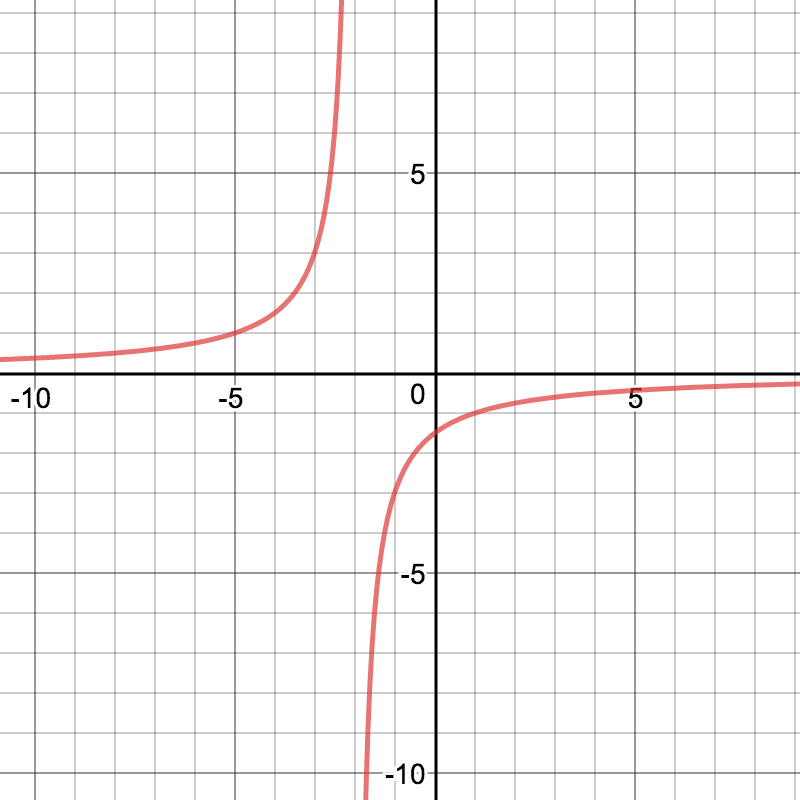
Graph labeling at least four points and all asymptotes.
y=-3/(x+2)
x = -2
y = 0
500
y=(x-2)/((x-3)(x+4))
Name all the asymptotes for the following function
x=3, x=-4, and y=0
500
What is the quotient?
(2x3+5x2+9)/(x+3)
2x^2 -x+3
500
Solve:
8 = (16x)^(3/4)
x = 1
500
Simplify the complex fraction
(5/(x+4))/(1/(x+4) +(2/x)
5x/(3x+8)
500
Simplify:
(7x)/(2x-10)/((x^2-6x)/(x^2-11x+30))
=7/2