Vocabulary
Functions
Graphs
Solving Quadratics
Linear, Exponential, or Quadratic?
100
The point on the graph where the function intersects the y-axis
Y-intercept
100
The name of the 150.
p(x) = 150(3)x
y-intercept
100
The two quadratic functions, f(x) = x2 and g(x) = 2x2 + 3, are shown in the graph. Which parabola is g(x)?
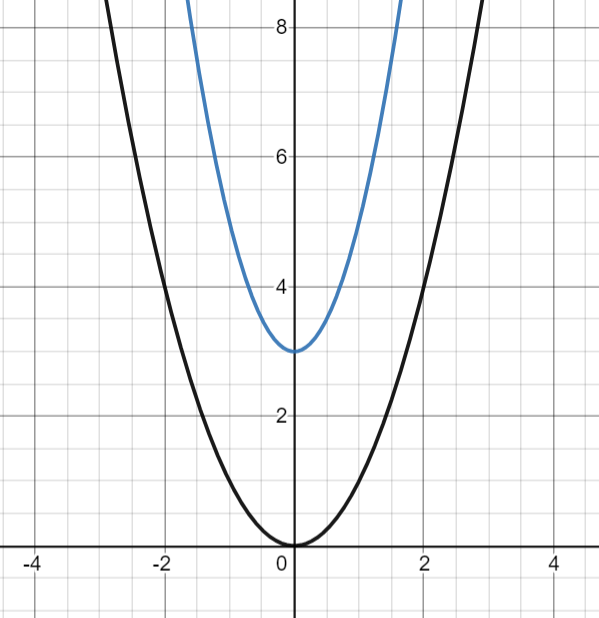
g(x) = 2x2 + 3 is the blue parabola with a vertex of (0,3)
100
What is/are the solutions to
x2 - 4 = 0
x = -2
x = 2
100
Does the graph represent a linear, an exponential, or a quadratic function?
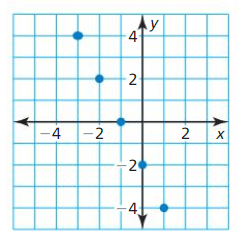
Linear
200
Name of the "r" value.
Correlation coefficient
200
What is the standard form of a quadratic equation?
y = ax2 + bx + c
200
What is the eqatuin of this quadratic function?
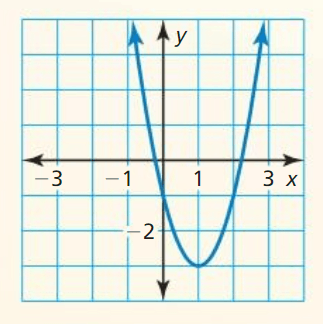
y= 2x2 - 4x -1
200
What is/are the solutions to
2x2 = 128
x = 8
x = -8
200
Does the data in the table represent a linear, an exponential, or a quadratic function?
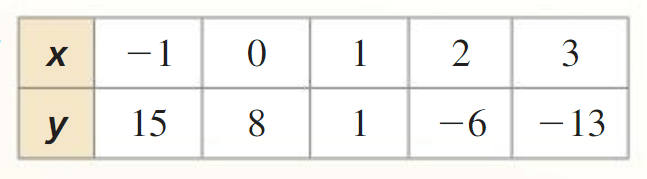
Linear
300
The vertical line that divides the graph of a quadratic function into two symmetric parts
Axis of symmetry
300
Find f(x) = 16 if y = x2 + 4x - 5
x = 3
300
What is the axis of symmetry of the quadratic function graphed below?
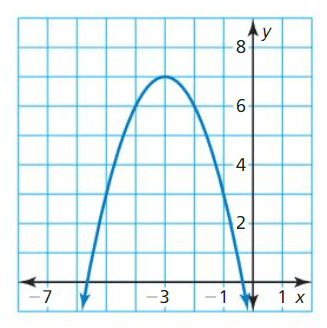
x = -3
300
What is/are the solutions to
9x2 + 10 = 91
x = 3
x = -3
300
The solution to 6 = 2(3)x-1
x = 2
400
The "a" and "b" in y = abx
a: y-intercept b: multiplier
400
Name one similarity and one difference between the graphs of the functions f(x) = x2 and g(x) = -4x2.
Similarities: Both form parabolas. Both have a vertex of (0,0) and an axis of symmetry of x = 0. etc.
Difference: f(x) has a minimum. g(x) has a maximum. The parabola of g(x) opens down and is narrower than f(x). The parabola of f(x) opens up and is wider than g(x). etc.
400
The domain and range of the graph
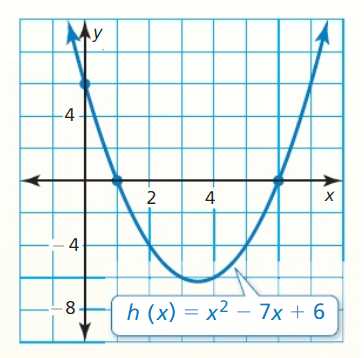
Domain - all real numbers or x = (infinity, infinity)
Range y is greater and or equal to 3.5 or
y= [3.5, infinity)
400
What is/are the solutions to
7x2 = -63
no solution
400
Does the data in the table represent a linear, an exponential, or a quadratic function?
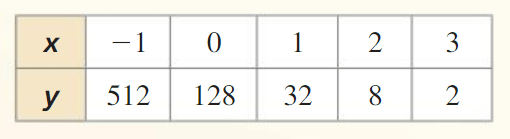
Exponential
500
Two names for the point(s) on the graph where a quadratic function intersects the x-axis
X-intercepts, zeros, roots, and solutions
500
Find the vertex, y-intercept, and x-intercepts of
y = -x2 -6x -10
Vertex: (-3, -1)
Y-intercept: (0, -10)
X-intercepts: None
500
If the quadratic function graphed below is in the form f(x) = ax2 + c, what must be true about a and c?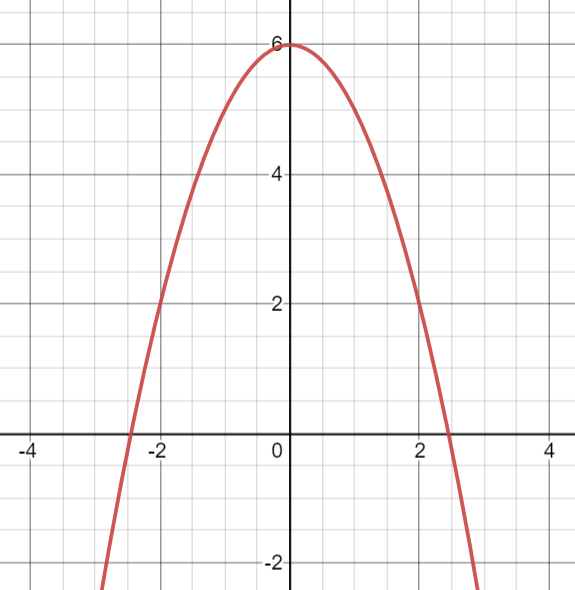
a is a negative and a fraction or decimal 0 to 1
c is 6
500
What is/are the solutions to algebraically
7x2 - 14x + 7 = 0
x = 1
500
Does the data represent a linear, an exponential, or a quadratic function?
(-2,8), (-1,0), (0,-4), (1,-4), (2,0), (3,8)
Quadratic