The ACTS!!!
COLONIST PROTESTS!
Vocab 4 fun
Spark of WAR!!!
Organizing against the machine
100
Increased tax duties colonists had to pay on goods such as coffee, sugar, textiles, indigo, and wine.
A) Sugar Act or B) Navigation Act
SUGAR ACT
100
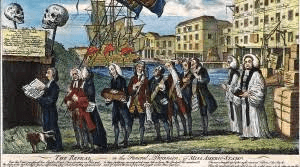
Seen as a symbol of unfair British authority, tax collectors were frequently hung in effigy, or as this colonial era drawing depicts, some tax collectors were even ________ and __________.
A) Tar and Feathered or B) Protest and Tea Party
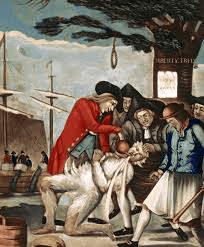
Tar and Feathered
100
This is the act of taxing, or charging people for public and government services.
A) Taxation or B) Restitution
Taxation
100
One of the first people killed in the Boston Massacre. Generally believed to be a runaway slave.
A) William Freeman or B) Crispus Attucks
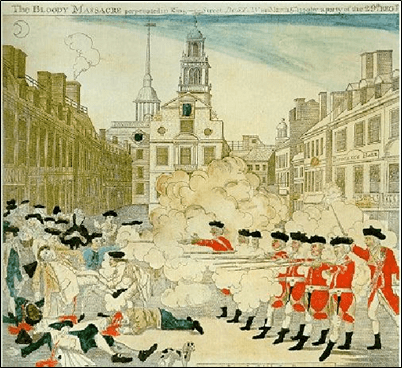
Crispus Attucks
100
Someone who loves his or her own country is a called .........
A) Patriot or B) Zealot
Patriot
200
This was a tax on the American colonies by imposing a stamp duty on newspapers and legal and commercial documents. Such as: Playing cards, Printed sermons, Deeds for transacted property.
A) Sugar Act or B) StamP Act
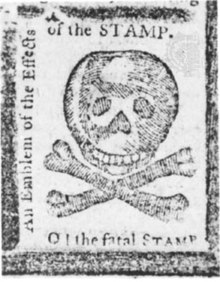
STAMP ACT
200
This group brought together colonist that opposed the Stamp Act. Many members of the group were less educated shopkeepers, artisans, and laborers. Sometimes their protests turned violent.
A) Sons of Liberty or B) Sons of Revolution
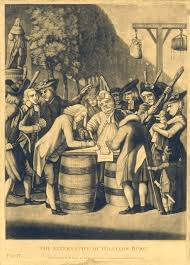
Sons of Liberty
200
To remove something, especially a law.
A) Repeal or B) Replace
Repeal
200
This incident in which 342 chests of tea belonging to the British East India Company were thrown from ships into Boston Harbor by American patriots disguised as Mohawk Indians. The Americans were protesting both a tax on tea (taxation without representation) and the perceived monopoly of the East India Company.
A)Boston Tea Party or B) Boston Tea Masacre
Boston Tea Party
200
This person supposedly rode his horse through towns like Lexington and Concord to warn the Minutemen that the redcoats are coming.
A) Paul Revere or B) Sir Paul George
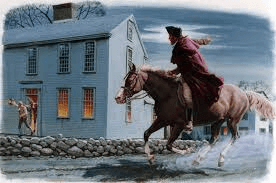
Paul Revere
300
This ordered that all goods traded to and from the North American colonies had to be shipped in either colonial or British ships. TRADE WITH OTHER COUNTRIES WAS NOT ALLOWED!!
A) Trade Act or B) Navigation Act
Navigation Acts
300
It was very difficult to communicate across distances in the 1700s. ___________ of __________ were a communications network set up to keep groups that opposed British policies in touch with one another.
A) Committees of Correspondence
B) Committees of Corrections
Committees of Correspondence
300
To refuse to have a dealing with a person, country or group.
A) Boycott or B) Buying
Boycott
300
This was a group of men trained to be soldiers and who agreed to gather at a minute's notice.
A) Minutemen or B) Militia men
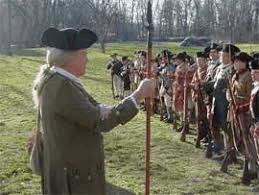
Minutemen
300
After the Boston Tea party, colonists organized into _________ Congress to unite against the British.
A) Continental Congress or B) Congress of Benedict
Hint: This is a type of breakfast
Continental Congress
400
This act was a measure issued by British Parliament asserted its authority to make laws binding the colonists “in all cases whatsoever” including the right to tax.
Declaratory Act
400
These were court orders which allowed customs officials to search locations for “contraband”, items that were being smuggled into the colonies without the proper duties (taxes) being paid. This angered the colonists.
A) Writs of Assistance
B) Commerce Act
Writs of Assistance
400
The act of killing a large number of people in a cruel way.
A) Massacre or B) Marsupial
Massacre
400
This was when a group of British soldiers fired into a crowd of colonists killing several people. Some think that the throwing snowballs caused troops to shoot.
A) Boston Massacre or B) Boston killing
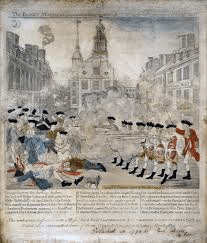
Boston Massacre
400
The British Responded to colonists rebelling by passing the _____________ Acts of 1774. These acts allowed Great Britain to close the post of Boston to all trade, banned town meetings, and housed British troops in peoples homes.
A) Intolerable Acts or B) Incredible Acts
Intolerable Acts
500
They were a series of laws that replaced the Stamp Act. While the acts also taxed the colonists without their consent, they were indirect taxes, and therefore imbedded in the price of the goods purchased.
A) Townshend Acts or B) Revolution Act
Townshend Acts
500
This was the slang term used by the colonists for the British troops.
Hint: It has something to do with the color of the British troops jackets.
A) Red coats or B) Grey Coats
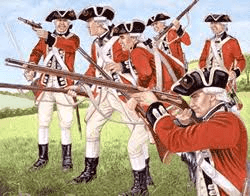
Red coats
500
To join together as a group or a whole.
A) Unify or B) Designate
Unify
500
The colonists despised taxes from the British. There were 2 forms of taxation. What is the form where you are taxed in within the price of an item? This form of tax was often hidden from the colonists.
A) Indirect Taxation or B) Direct Taxation
Indirect Taxation
500
This colonist helped organize resistance to British policies by forming town meetings and committees to discuss complaints about the British. His name was ________________.
A) Paul Adams or B) Sam Adams
Sam Adams