Pompeii & Herculaneum
Sparta
Agrippina the Younger
Julio Claudians
Sources
100
What was the name of the Pompeiian woman who was a wealthy property owner and patron to the Fullers of Pompeii? Bonus Points - What is one source we have about her?
Eumachia - Statue of Eumachia at the Eumachia Building in the Forum
100
Name the 3 main titles for the social classes of Sparta and their role in society.
Spartiates, Spartan citizens, usually soldiers or politicians. Periokoi, dwellers around the villages. Helots - slaves.
100
Explain how Agrippina was connected to Tiberius, Gaius, Claudius and Nero.
Tiberius was her great uncle and adoptive grandfather. Gaius was her brother. Claudius was her uncle and husband. Nero was her only son.
100
Who was Sejanus and what was his role?
Sejanus was a Roman soldier and confidant of the Roman Emperor Tiberius. Of the Equites class by birth, Sejanus rose to power as prefect of the Praetorian Guard, the imperial bodyguard, of which he was commander from AD 14 until his execution for treason in AD 31. Due to senates dislike of one powerful family governing rather than the senate, Tiberius looked for support elsewhere, leading him to Sejanus. He also developed the Delatores (professional informers) = maiestas (treason, bringing the empire and emperor into disrepute)
100
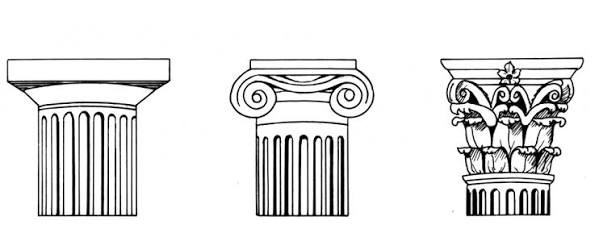
Name these 3 types of columns in order.
Doric, Ionic and Corinthian
200
Name the 4 roles in politics and what they were responsible for.
Duumvirs (2) - Magistrates, Aediles (2) - Public works, Ordo Decurionum (100) - set laws and governed, Comitium - peoples assembly who voted on laws.
200
At approximately what age did Spartan boys leave their families to begin the agōgē, the state education and training system?
7 years old
200
Agrippina appears on coins alongside Claudius in an unusual way. What does this suggest about her public status and political influence?
She was presented prominently alongside the emperor, reinforcing her dynastic importance and public political status.
200
Which Julio-Claudian emperor famously refused the title Pater Patriae at the beginning of his reign, despite the Senate offering it to him? Bonus Point - what does it mean?
Tiberius. Father of the Country
200
What is the significance of this source?
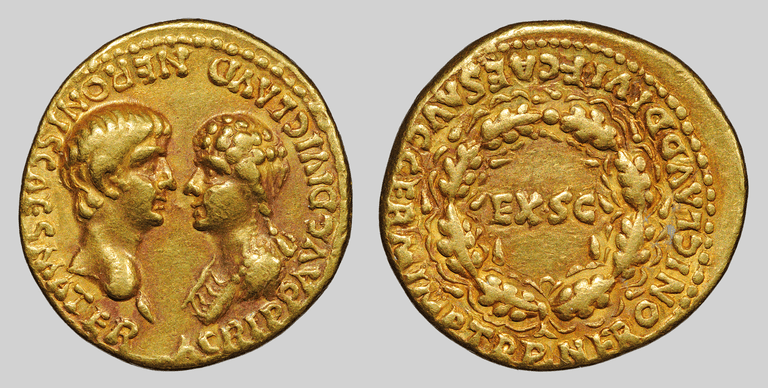
This coinage depicts on the obverse busts of Agrippina and her son, the new emperor. This is the most prominent depiction of Agrippina on imperial coinage, showing her at the height of her power. The use of busts presented Agrippina as her son’s equal and partner in the principate. This was its first use on a Roman coin. This show of equality was a sign of her crucial importance to the dynasty.
300
Name 2 commonly worshipped household Gods and the name of the shrine that most houses had.
Lararium.
Lares - Household gods who protected the family. Usually had a shrine in a cupboard.
Genius - God of the male line of descent. Worshipped on the birthday of the Paterfamilias.
Penates - Gods of the larder or food store.
300
Which Spartan institution consisted of 28 men over the age of 60, plus the two kings, and was responsible for preparing proposals for the assembly?
Gerousia
300
According to Tacitus, what elaborate method was allegedly used in an attempt to assassinate Agrippina at Nero's orders before she was finally killed?
A collapsible/engineered boat was arranged to break apart at sea, intended to make her death appear accidental.
300
After the death of Britannicus, which Roman historian claims that Nero attempted to disguise the murder by arguing that Britannicus had died from an epileptic seizure?
Tacitus
300
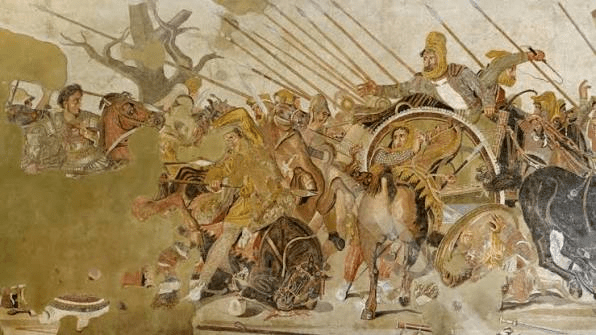
What is this and why is it important? Bonus Point - Where is it found?
The Alexander Mosaic.
It is a copy from a Greek painting depicting a battle between Alexander the Great and Darius of Persia. It is immense in size and detail, and highlights the importance of Greek culture in Pompeii. Found in the House of the Fawn (a copy).
400
What makes the human remains from Herculaneum particularly different from many of those at Pompeii?
The extreme heat of the pyroclastic surges carbonised organic material and bones, while also preserving materials such as wood, food and even scrolls remarkably well.
400
Which ancient historian famously claimed that Spartan women exercised considerable economic power because they could inherit and control property?
Aristotle
400
What did the title Augusta mean?
The title Augusta is the feminine form of the ancient Roman honorific Augustus, meaning "the revered," "venerable," or "majestic one". It carried deep religious and political overtones, signifying a status near divinity, supreme worldly power, and the highest prestige a woman could attain in the Roman Empire
Holders of the title could have their likeness and name minted on official Roman coins. They were granted the right to dress in distinct imperial garments. Many could run their own independent courts, manage their own properties, and build political client networks. Aggy was also given 2 lictors.
400
Which emperor’s reforms included reorganising the imperial administration, expanding the role of the procurators, and admitting provincials into the Senate?
Claudius
400
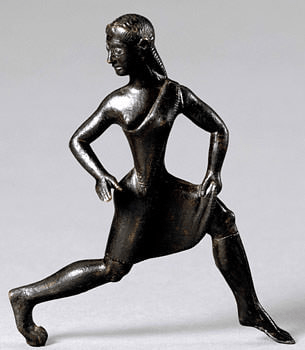
What is this and why is it significant?
The Bronze statuette of an athletic Spartan girl is significant because it provides rare physical proof that ancient Spartan females engaged in public sports. It shows a running girl with a bare shoulder and short tunic (peplos). This challenges the traditional Greek view that they kept women at home.
500
At Pompeii, what type of establishment had a distinctive L-shaped counter with large clay storage jars (dolia) built into it?
Thermopolium - Essentially a Roman fast-food or takeaway establishment where hot food and drinks were served.
500
Which Spartan institution was responsible for electing the five ephors, who could even exercise authority over the kings?
The Apella
500
According to Tacitus, what was Agrippina about to do when the Armenian envoys were presenting their case to Nero — and what did Seneca do to prevent the situation?
Agrippina was about to mount the emperor's tribunal and preside alongside Nero. Seneca prompted Nero to go down and meet his mother, allowing Agrippina to be greeted by him instead. Tacitus presents this as preventing a serious breach of expected imperial protocol.
500
What were the key points of Nero's ascension speech written by Seneca?
In his first speech to the senate he said -
The senate would exercise its traditional functions
No more treason trials
Freedmen and court favourites would be controlled
Model leadership on Augustus
End all secret trials
500
"Tradition says that Tiberius as often as he left the senate house used to exclaim in Greek, 'How ready these men are to be slaves'. Clearly, even he, with his dislike of public freedom, was disgusted at the abject abasement (humiliation) of his creatures"
Where is this source from and what does it signify?
Tacitus, Annuls. This source highlights that the senators were so willing to obey Tiberius and agree with whatever he wanted that they were behaving like slaves rather than independent Roman politicians.
The irony is that Tiberius himself did not particularly support political freedom. Tacitus says that even Tiberius, who disliked the idea of public freedom, was disgusted by how completely the senators humbled themselves before him.