Vocabulary
Locations
Indus River
Religion
Random
100
Another word for Untouchables is:
Dalit
100
What type of landform separates India from the rest of Asia?
mountain ranges
100
Every home had one of these.....
bathroom
100
How long has the religion of Hinduism been around?
4,000 years
100
The Aryans wrote and spoke in a language called ________.
Sanskrit
200
In Hinduism, if a person becomes free from the cycle of life, death, and rebirth and is at the highest level this person has attained:
Moksha
200
Mohenjo-Daro and Harappa were located near the ______.
Indus River
200
What types of seals did the Harappan people use? (which mythical animal)
Unicorn
200
The concept of karma is best described as
a force that decides the form that people will be reborn into in their next lives
200
Which river is considered the "holy" river in India?
Ganges River
300
Within the caste system, warriors were part of the ______.
Kshatriyas
300
The tallest mountain in the world is located in which mountain range?
The Himalayan Mountains
300
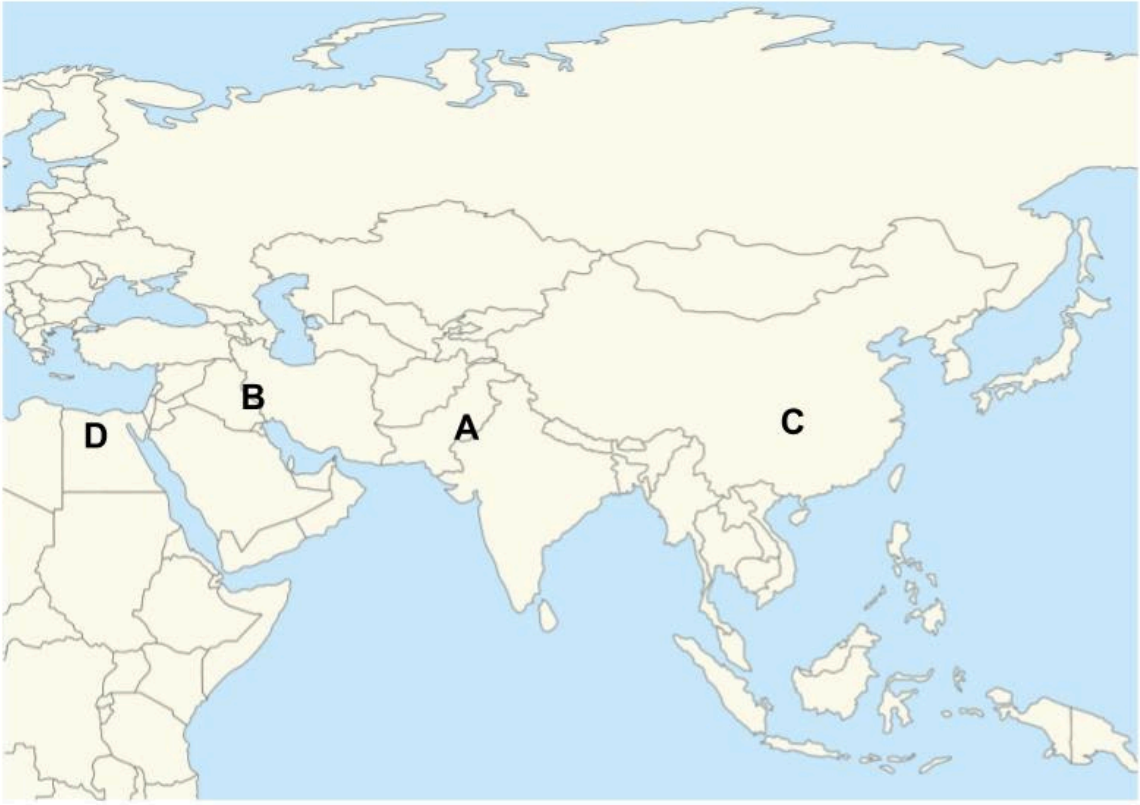
Which letter best represents the location of the earliest Egyptian civilizations?
D
300
Which belief is common to BOTH Hinduism and Buddhism?
reincarnation
300
The Buddha's fourth truth says that people can end suffering by following eight steps called:
Eightfold Path
400
The caste system in India was used for what purpose?
To provide social order according to one's birth
400
Which letter best represents the location of the earliest Chinese civilizations?
C
400
Which letter best represents the location of the earliest Indian civilizations?
A
400
Who was the founder of Buddhism?
Siddhartha Gautama
400
According to the Eightfold Path, a person can be free of reincarnation and be one with the universe. This is called:
Nirvana
500
What order are the varnas in the caste system, from top to bottom?
Brahmins ---> Kshatriyas ---> Vaishyas ---> Sudras
500
Which letter best represents the location of the earliest Mesopotamian civilizations?
B
500
A person's personal duty that is based on their place in society is called ______.
dharma
500
Buddha believed that all people had the ability to achieve ______.
enlightenment
500
Within the caste system, farmers, shopkeepers, merchants, and artisans were part of the ______.
Vaishyas