Andrew Jackson
Removal
Trail
Preservation
*Order*
*Order*
Pot Luck
100
What were the three most significant events of Andrew Jackson's presidency?
1. _______ _______ Act
2. ______ of _______
3. ________ of the _________
Indian Removal Act, Trail of Tears, and Preservation of the Union
100
How did the Indian Removal Act impact Native Americans during the early 1800s?
A. It ended the reservation system forced upon many Native Americans.
B. It prevented Native Americans from serving in the military.
C. It forced many Native Americans to leave their homelands.
D. It allowed Native American businesses to avoid paying taxes.
C. It forced many Native Americans to leave their homelands.
100
The map shows the movement of people in North America.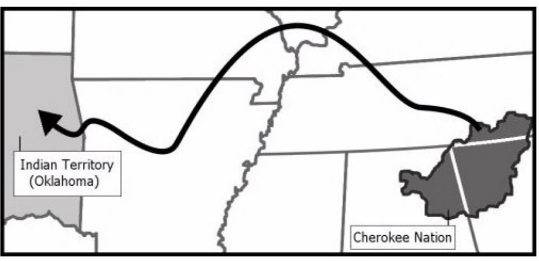 What is the name of this movement of people?
Trail of Tears
100
South Carolina was unhappy with a _______ law that they didn't agree with. This state's leaders believed that South Carolina (and any other state) had the constitutional right to reject any _______ law.
federal
100
Why did white settlers suddenly want to move to Georgia in 1829?
Gold was discovered in Georgia.
200
In what year was Andrew Jackson elected president?
1828
200
How did the Indian Removal Act of 1830 affect Native Americans in the South?
A. It forced them to relocate to areas west of the Mississippi.
B. It let them own land east of the Mississippi.
C. It helped create reservations in Alabama and Mississippi.
D. It let them rent land in the southern United States.
A. It forced them to relocate to areas west of the Mississippi.
200
The Trail of Tears is most closely related to what historical event?
A. the growth of industrialism
B. the relocation of Native American tribes
C. the British retreat from Yorktown, Virginia
D. the international slave trade
B. the relocation of Native American tribes
200
What is the meaning of nullify?
to reject or strike down
200
What was the real purpose of the Indian Removal Act?
A. to set up schools for Native American children
B. to take land from the Native Americans so it could be used by white settlers
C. to force Native Americans to become slaves on cotton plantations
D. to end all fighting with the Native Americans
B. to take land from the Native Americans so it could be used by white settlers
300
Andrew Jackson was the _______ president of the United States.
(1st, 2nd, 3rd, ....)
7th
300
Why did some Native Americans agree to move out of their traditional homelands in 1830?
A. Several wars destroyed their traditional homelands.
B. Religious laws weakened their societies.
C. They were promised new lands to settle in.
D. They no longer lived in their traditional homelands.
C. They were promised new lands to settle in.
300
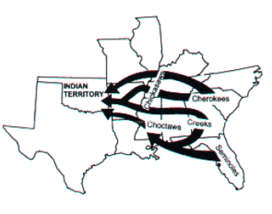 Based on this map, which Native American tribes were relocated from South Carolina and Florida?
Cherokees and Seminoles
300
South Carolina believed that states could leave the _______ if they wanted to, but Andrew Jackson did not agree.
union
300
In the early 1800s, what group of people was most impacted by the expansion of the United States into the western territories?
Native Americans
400
Before he was elected president, Andrew Jackson was a Senator for which state?
Tennessee
400
Why did Native Americans come into conflict with white settlers after the Indian Removal Act?
A. White settlers moved into lands controlled by Native Americans.
B. White settlers refused to trade with Native Americans.
C. White settlers taught Native Americans new farming techniques.
D. White settlers brought Native Americans new technologies.
A. White settlers moved into lands controlled by Native Americans.
400
Where did Native American tribes relocate to on the Trail of Tears?
Oklahoma
400
Andrew Jackson believed the federal union should be preserved. He threatened to use ______ if South Carolina did not follow federal law.
force
400
The United States government made many treaties (agreements) with Native American tribes. What is true about these treaties?
A. The government never broke one of these treaties.
B. The government did not honor many of these treaties.
C. The treaties resulted in Native Americans gaining more land.
D. They treaties were meant to preserve the Native American culture.
B. The government did not honor many of these treaties.
500
What happened to Andrew Jackson when he was 14?
He was captured by the British during the American Revolution.
500
How did the American government react to Native American resistance to the Indian Removal Act?
A. The government protected the traditional lands of the Native Americans.
B. The government provided displaced Native Americans with jobs.
C. The government legalized slavery in Native American reservations.
D. The government used military force to push Native Americans out of their lands.
D. The government used military force to push Native Americans out of their lands.
500
What is the meaning of forced relocation?
the movement of people against their will from one place to another
500
Finally, Congress passed a ________ law that satisfied South Carolina leaders.
compromise
500
Which statement describes the government's treatment of Native Americans?
A. The government broke treaties when it benefited the United States.
B. The government always kept its promises and never broke treaties.
C. The government always did what was best for the Native Americans.
D. The government avoided conflicts with the Native Americans.
A. The government broke treaties when it benefited the United States.