Cell Structure and Function (I)
Cell Structure & Function (II)
Cell Membrane and Permeability
Cell Transport (I)
Cell Size & Osmoregulation
100
What term/phrase best describes the following statement?
'The membrane is held together by weak hydrophobic interactions, allowing lipids and proteins to move.'
Fluid Mosaic Model
100
What are the four structures ALL cells have in common?
Plasma membrane, cytosol (cytoplasm), chromosomes (genetic material), ribosomes
100
Describe the composition of the phospholipid bilayer.
2 layers of phospholipids - hydrophilic heads and hydrophobic tails
100
Describe water movement of cells placed in the following solutions: hypotonic, hypertonic, and isotonic.
Hypotonic - water goes in the cell
Hypertonic - water leaves the cell
Isotonic - water enters and leaves the cell
100
Explain how does the efficiency of cellular processes differ between small and large cells.
Small cells have a higher surface area to volume ratio so they optimize the exchange of materials at the plasma membrane much more effectively! The cell functions at a more efficient rate too!
Large cells have a lower surface area to volume ratio so they lose efficiency exchanging materials and better at storage. The cellular demand for resources increases since the cell is larger.
200
Which organelle contains hydrolytic enzymes, which are important in intracellular digestion?
Lysosomes
200
Which organelle is responsible for detoxification and lipid synthesis?
Smooth ER
200
What type of molecules can pass freely across the plasma membrane?
Small, uncharged, nonpolar, or hydrophobic molecules.
- Ex: Oxygen (O2), Carbon Dioxide (CO2), or Nitrogen gas (N2).
Why? - Because of their size and polarity, it allows them to diffuse through the hydrophobic core of the phospholipid bilayer without the need for transport proteins.
200
Aquaporins are proteins that act as water channels in cell membranes, allowing water to pass through cells. Which type of transport would they be a part of?
Osmosis or Facilitated diffusion.
Aquaporins in general are used when larger portions of water need to be transported quickly! Example: Situations where maintaining proper water balance is crucial, like in the kidneys for urine concentration.
200
Which cell would be the most efficient at exchanging material across its plasma membrane and which would be best for storage?
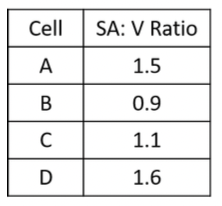
Exchanging - Cell D because 1.6 is the highest SA/V ratio.
Storage - Cell B because 0.9 is the lowest SA/V ratio, which is optimal for storing material.
300
When a cell is exporting a folded protein in mass quantities, what 3 organelles or structures are involved? (they don't have to be in order)
Rough ER, Golgi Body, Vesicle
300
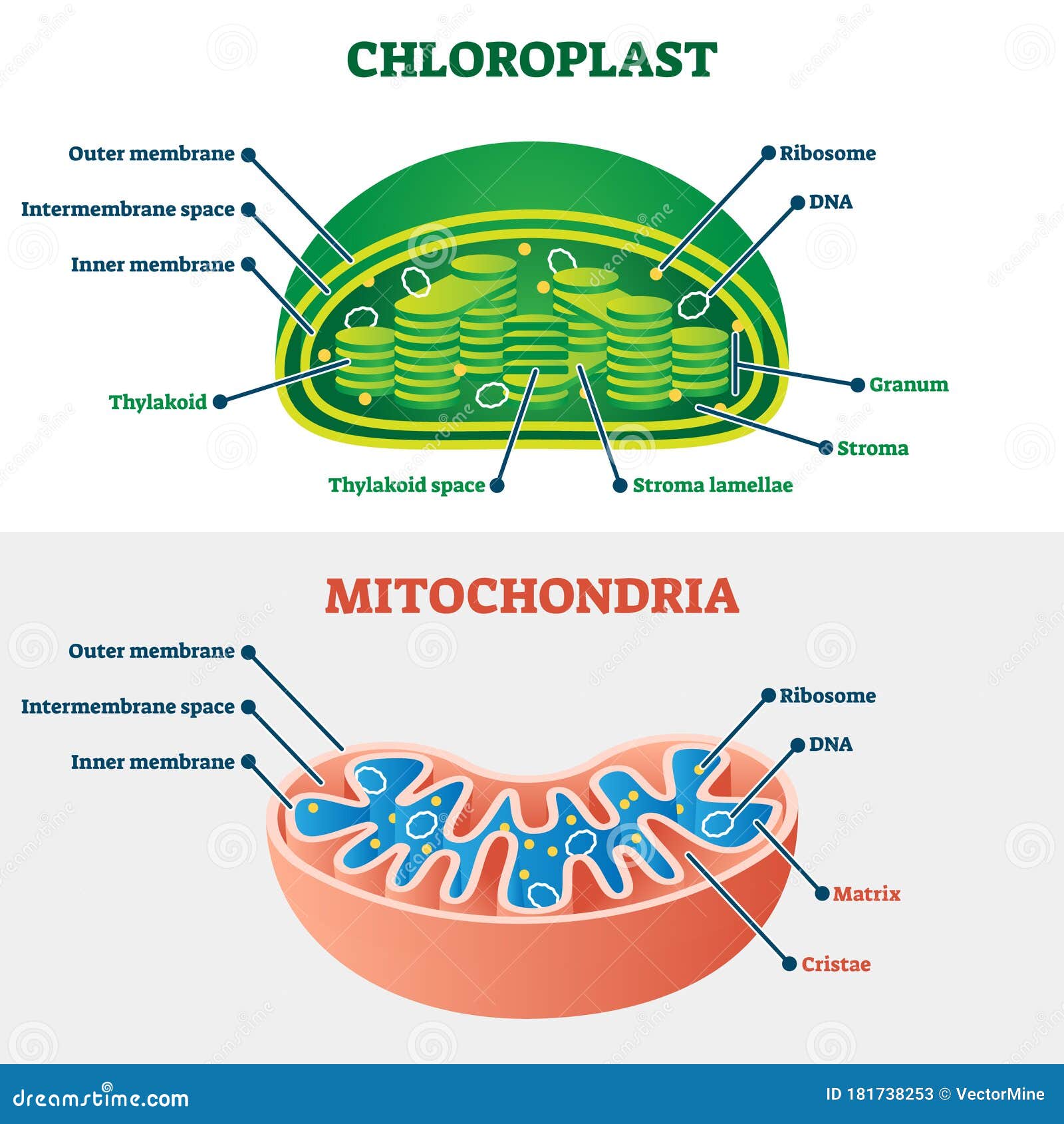
Based on the Endosymbiotic theory, what 2 organelles have double-membranes?
Chloroplasts and mitochondria
300
Identify the structure that represents:
(1) An integral protein, (2) Glycoprotein, (3) Hydrophilic Head, (4) Peripheral Protein
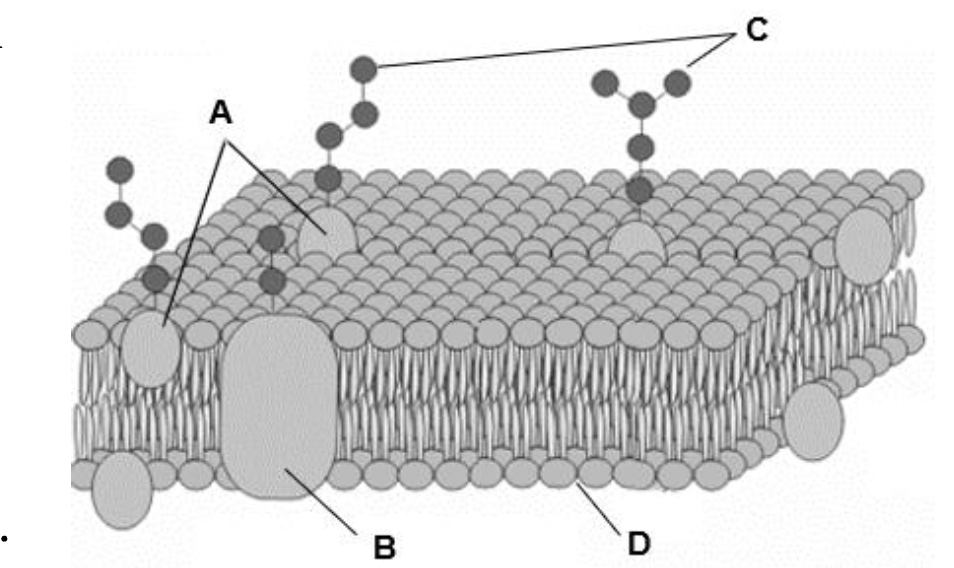
(1) B
(2) C
(3) D
(4) A
300
Which specific type of cell transport is shown below?
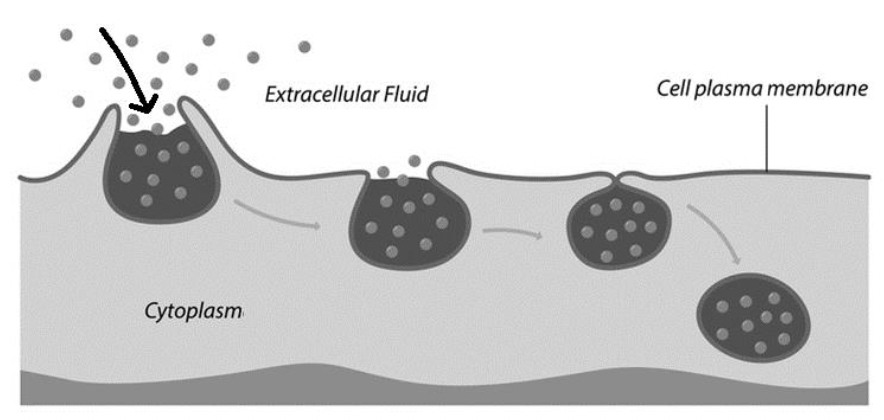
Endocytosis - materials are moving into the cell.
Pinocytosis because it's engulfing a liquid!
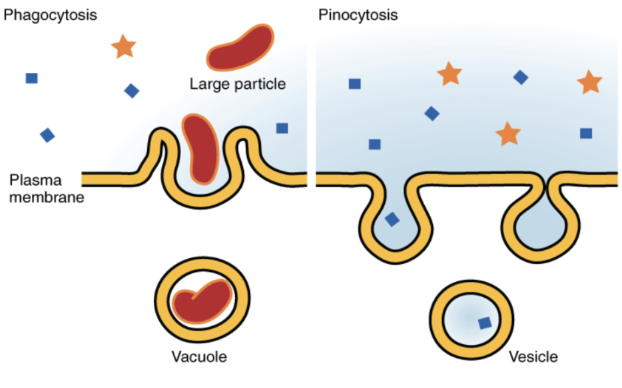
300
A dialysis bag containing a 0.1 M NaCl solution is placed in a beaker containing a 0.4 M NaCl solution. The dialysis bag acts as a semipermeable membrane, allowing water to pass but not NaCl. Which way will the water move?
Water will move out of the dialysis bag, causing it to shrink.
400
Which of the following does not provide evidence of the endosymbiotic theory AND why?
a. Prokaryotes and eukaryotes are both surrounded by a phospholipid bilayer.
b. Mitochondria and chloroplasts have their own circular DNA, similar to bacterial genomes
c. Energy organelles both have ribosomes similar to those found in prokaryotic cells.
d. Organelles are capable of functioning and reproducing on their own.
A - Prokaryotes and eukaryotes are both surrounded by a phospholipid bilayer.
Why? - The Endosymbiotic theory explains how mitochondria and chloroplasts (energy organelles) came to be. It specifically proposes that these organelles were originally free-living prokaryotes (bacteria) that were engulfed by an ancestral eukaryotic cell.
The phospholipid bilayer (aka the cell membrane) already exists in ALL types of cells. Therefore it's not evidence of the endosymbiotic theory.
400
The inner mitochondrial membrane contains a unique, double-phospholipid called cardiolipin, which is virtually absent in other eukaryotic membranes but constitutes about 20% of the total lipid composition in the inner membrane. This exact lipid is also highly abundant in the plasma membranes of modern structural bacteria. Explain how this biochemical finding supports the Endosymbiotic Theory.
It provides biochemical/lipid homology showing that the inner mitochondrial membrane is structurally derived from the original plasma membrane of an ancient engulfed prokaryote, whereas the outer membrane was derived from the host cell's invaginating vesicle.
400
Describe the amphipathic nature of phospholipids in the plasma membrane and explain how this property.
Description - Phospholipids have a hydrophilic/polar head and two hydrophobic/nonpolar tails.
Explanation - The hydrophilic heads face outward toward the aqueous environment, and the hydrophobic tails face inward, creating a bilayer that restricts the passage of polar and large molecules while allowing small nonpolar molecules to diffuse freely.
400
During endocytosis, cells can take in nutrients from their surroundings and then store them using these organelles.
Vacuoles (central vacuole specifically in plants)
400
Which statement(s) below is false?
Water will flow:
(1) Low water potential to areas of high water potential
(2) Low solute to areas of high solute
(3) Low areas of pressure to high areas of pressure.
#1 & #3
500
A cell is treated with a drug that destroys the nucleolus. Which specific cellular process will immediately grind to a halt, and what downstream organelle will it fail to produce?
Ribosome biogenesis (synthesis of rRNA) will stop, meaning the cell will fail to produce functional ribosomes.
500
Describe the sequential pathway a synthesized insulin protein takes through the endomembrane system, starting from its translation to its release outside the cell.
Bound ribosome \(\\) Rough ER lumen (folding) \(\\) Transport vesicle \(\\) Golgi apparatus (modification/sorting) \(\\) Secretory vesicle \(\\) Plasma membrane (exocytosis).
500
If a plant cell is shifted from a warm summer environment to a freezing winter environment, how must it alter its phospholipid composition to maintain membrane fluidity?
It must increase the percentage of unsaturated fatty acids (which introduce kinks that prevent tight packing) and alter structural sterols to keep the membrane fluid.
500
A plant cell with a solute potential of -4.0 bars and a pressure potential of 1.0 bar is placed in an open beaker of 0.2 M sucrose solution = -4.9 bars. Calculate the total water potential of the cell, and state the net direction of water movement.
The cell's water potential is -3.0 bars( -4.0 + 1.0). Since water moves from high to low water potential (less negative to more negative), water will net flow out of the cell into the beaker.
500
The inner membrane of a mitochondrion is highly folded into cristae, and the root hairs of a plant cell are drastically elongated. What specific evolutionary advantage do these structural modifications provide?
They maximize surface area without significantly increasing internal volume, optimizing the rate of exchange for ATP synthesis and nutrient absorption, respectively.