Natural Selection
Natural Selection
Evidence of Evolution
Hardy-Weinberg
Taxonomy
100
Selection that favors BOTH of the extremes (or both homozygotes). Ex: Black rabbits could hide in black rocks and white rabbits could hide in white rocks. The gray rabbits would have a hard time hiding anywhere.
What is disruptive selection?
100
Selection in which humans choose desirable traits and breed organisms accordingly.
What is artificial selection?
100
Evidence that provides a visual record of species evolution through time.
What is the fossil record?
100
Fill in the blank: If a population is said to be in Hardy-Weinberg Equilibrium, it is __________.
What is not evolving?
100
What are the 3 domains of life?
What is Bacteria, Archaea, and Eukarya?
200
Mechanism of evolution in which allele frequencies in a small population are drastically effected due to a random event/occurrence.
What is bottleneck effect?
200
A trait or behavior that helps one survive and reproduce in its environment.
What is an adaptation?
200
Similar anatomical structures found across species that serve as evidence of a common ancestor.
What are homologous structures?
200
What values are used in the Hardy Weinberg Equilibrium model?
What are p and q?
What are dominant and recessive allele frequencies?
200
A picture representation of evolutionary relationships between organisms, including their common ancestors is called:
What is a cladogram/phylogenetic tree?
300
Selection that causes one extreme allele frequency to increase. EX: The increase of beak size in finches over time due to a high proportion of large seeds in an ecosystem could be considered an example of this.
What is directional selection?
300
The definition of this word means the ability to breed and produce viable and fertile offspring.
What is a species?
300
Structures no longer used by a species but remain due to a past need by common ancestry.
What are vestigial structures?
300
One equation for Hardy-Weinberg is, p + q = 1. What is the other equation in the model?
What is p2 + 2pq + q2 = 1?
300
The intersection of two organisms represents their shared common ancestor, this intersection is known as:
What is a node?
400
Selection that leads to a high proportion of heterozygotes or the middle phenotype. EX: Pink flowers are least favored by predators, where red and white flowers are eating most.
What is stabilizing selection?
400
The transfer of alleles to different populations through fertile, reproducing individuals is known as.
What is gene flow?
400
Organisms that do not share a common ancestor, but have evolved to have similar features due to similarities in habitat, niche, etc.
What is convergent evolution?
What are analogous structures?
400
In corn, yellow kernel color is governed by a dominant allele; and white is a recessive allele. A random sample of 1,000 kernels from a population that is in equilibrium reveals that 910 are yellow and 90 are white. What are the frequencies of the yellow and white alleles in this population?
What is p=0.7, q=0.3?
400
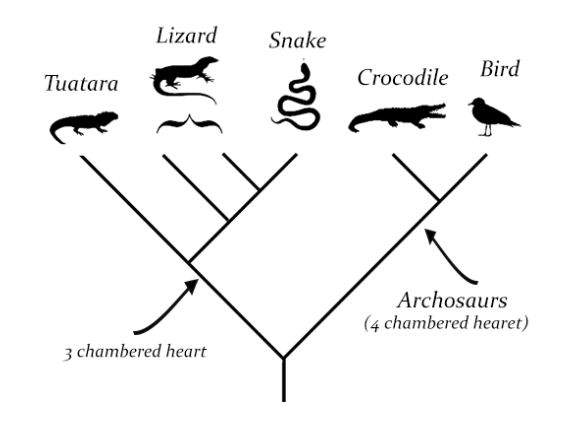
What is the closest relative of the crocodile according to this cladogram?
What is the bird?
500
An organism/species from which two or more species evolved.
What is a common ancestor?
500
This model assesses whether evolution is occurring in a population through natural selection or other mechanisms, typically through a comparison of allele frequencies over time.
What is the Hardy Weinberg equilibrium?
500
Which evidence serves as the most conclusive means to assessing relations/ancestry/evolution?
What is molecular/DNA evidence?
500
Within a population of butterflies, the color brown (B) is dominant over the color white (b). And, 40% of all butterflies are white. Calculate the frequency of homozygous dominant individuals.
What is 0.135 - 0.137?
500

What trait separates the lamprey from the tuna?
A) Evolution is a gradual process that occurs over long periods of time.