Derivatives
Integrals
Limits
Differential Equations
Hodge Podge
100
Find the slope of the tangent line to the graph
f(x)=3x^2-sinpix
at the point
x=2.
12-pi?
100
An object has a velocity given by the equation
v(t)=4t+e^(t-2).
At t=2, the object's position, s(t), is given by s(2)=3.
Find a function that describes the object's position.
s(t)=2t^2+e^(t-2)-6?
100
lim_(x->5)((x^2+2x-35)/(x^2-25)).
6/5
100
Let
y'=1/3y
be the differential equation that models the population growth of rabbits. At time t=0, there are 50 rabbits. How many rabbits are there after 9 years.
50e^3
100
What are the three conditions for a function f to be continuous at the point
x=4?
lim_(x->4)f(x)=f(4)
200
Find the derivative of
f(x)=(x^3sinx)/(x^2+3).
f'(x)=(x^3cosx+3x^2sinx)/(x^2+3)-(2x^4sinx)/(x^2+3)^2?
200
Find the derivative of
f(x)=sinx+4x-e^-x.
f'(x)=-cosx+2x^2+e^-x?
200
lim_(x->1)((2x^2+x-3)/(1-x^2)).
-5/2
200
Find the solution to the differential equation
dy/dx=x^2/y^3,
where y(3)=3.
y=root(4)(4/3x^3+45)
200
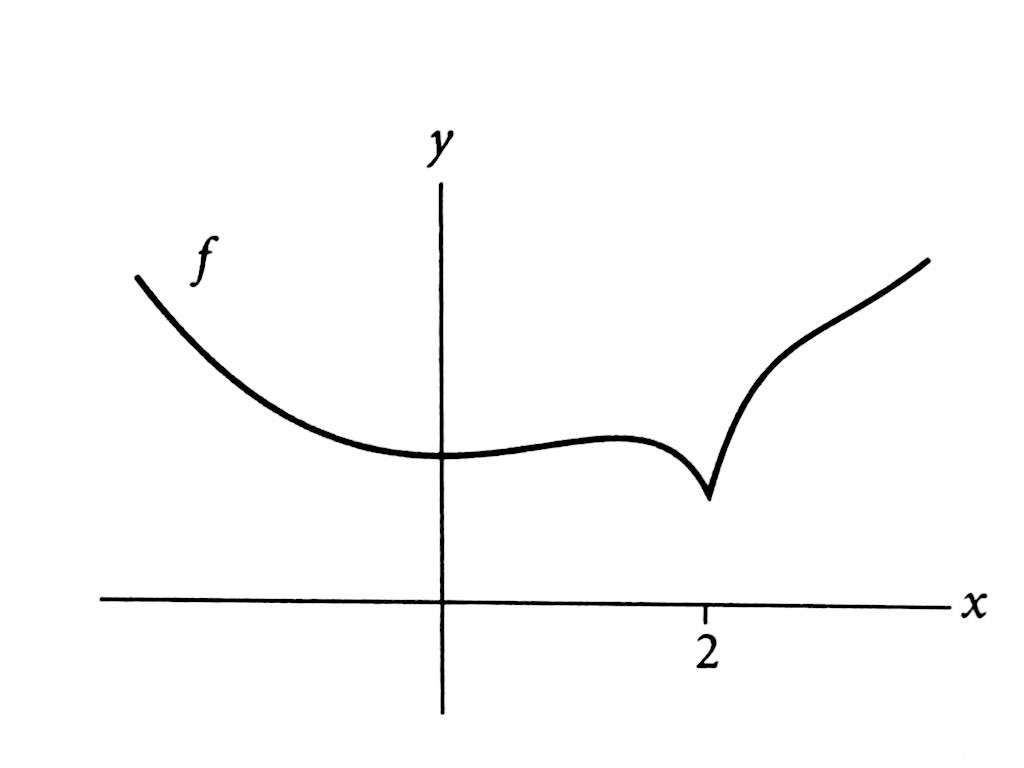 What is true about the point x=2?
f is continuous and differentiable everywhere except at the point where x=2
300
Find the derivative of
x^2-xy+y^3=8.
(y-2x)/(3y^2-x)?
300
int_-1^2(3x^2-4x+2)dx.
9
300
lim_(x->oo)((x^2-3x+7)/sqrt(4x^4-3x^3+2x^2)).
1/2
300
What is the differential equation for the following slope field? 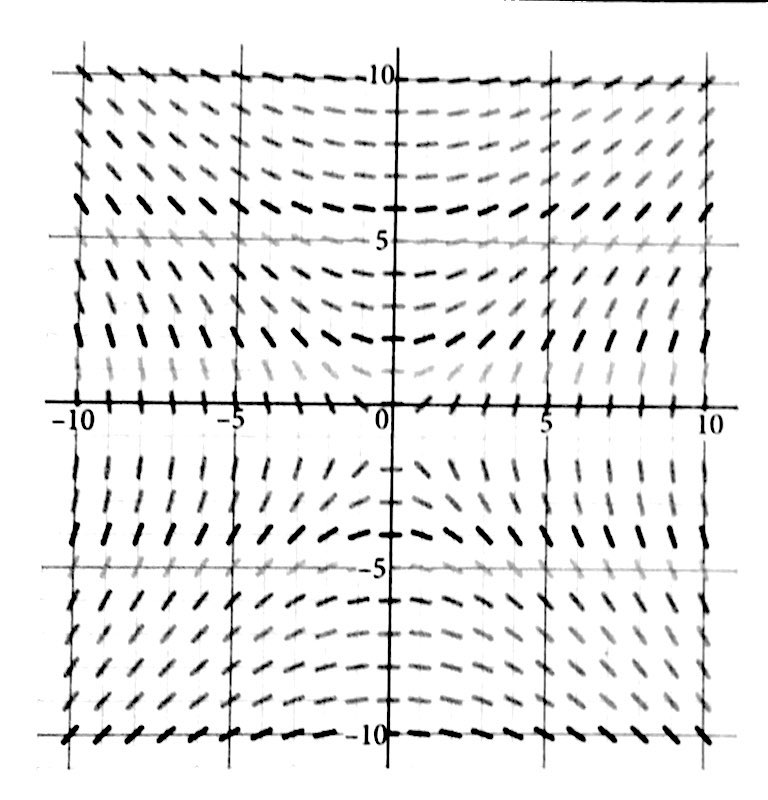
dx/dy=x/(y-1)
300
Given the function
f(x)=xsin(pi/2sqrt(x)),
what is the conclusion of the Mean Value Theorem for a value c in (1,4)?
f'(c)=-1/3
400
Find the slope of the tangent line of
f(x)=x^2sinpix-3x
at x=1.
-pi-3?
400
If the rate of change of a quantity over the closed interval [-1,5] is given by
f'(x)=xe^(x^2),
then the net change of the quantity over the interval is this.
1/2e^25-1/2e?
400
lim_(h->0)((4+h)^3-4^3)/h
48
400
What is the solution to the differential equation
dy/dx=(x^2-1)/y ?
y=sqrt(2/3x^3-2x+C.
400
Find the relative minimum of the function calculator allowed
f'(x)=(-x^3+4x-2)/sqrt(x^2+1).
x=0.539
500
Find the derivative of
f(x)=ln((2x-3)/(x+8)).
f'(x)=2/(2x-3)-1/(x+8)?
500
f(x)=intx*sqrt(1/6x^2+5)dx.
f(x)=2(1/6x^2+5)^(3/2)+C?
500
lim_(h->0)((x+h)^9sin(x+h)^2-x^9sinx^2)/h.
x^8(9sinx^2+2x^2cosx^2)
500
Find the solution to the differential equation
dy/dx=-x/(y*e^(x^2/2).
sqrt(2e^(-x^2/2)+C).
500
Let R be the region in the first quadrant bounded by the graphs of
f(x)=5x-x^2
and
g(x)=2^x-1.
Find the area of the region R. Round answers to minimum three decimal places.
What is 6.481 square units?