AP Chem Unit 5
AP Chem Unit 7
AP Chem Unit 4
100
The factor that the rate of reaction increases by when [NO] is doubled and [Cl2] is tripled for the rate law: Rate = k[NO]2[Cl2]
What is 12?
100
The effect of increasing temperature on K for the reaction: N₂O₄(g) ⇌ 2NO₂(g) when ΔH > 0
What is K increases?
100
This balanced net ionic equation represents when aqueous solutions of silver nitrate and sodium chloride are mixed to form a white precipitate.
What is Ag⁺(aq) + Cl⁻(aq) → AgCl(s)?
200
The two parts of a potential energy diagram that remain the same when a catalyst is added.
(Go to Slide 1 for image)
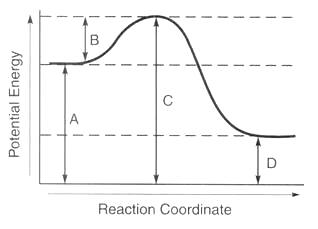
What are the Change in Enthalpy and the Energy of Reactants and Products?
200
The direction the system shifts when the volume is decreased if the product side contains fewer moles of gas.
(Go to Slide 2 for image)
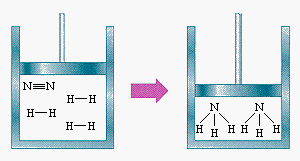
What is towards the products?
200
When the solution of HCl being titrated with NaOH reaches this point the indicator, phenolphthalein, changes color indicating that the HCl has been neutralized by NaOH.
(Go to Slide 3 for image)

What is the endpoint?
300
The half life of a first order reaction with a rate constant of 0.025 s-1
What is 27.7 s?
300
The equilibrium constant for N₂ + 3H₂ ⇌ 2NH₃ when [NH₃] = 0.250 M, [N₂] = 0.100 M, and [H₂] = 0.300 M.
What is Kc = 23.1?
300
The volume in mL of H2 gas produced at STP when 50 mL of 0.150 M HCl reacts with excess Mg metal.
What is 84.0 mL?
400
the equivalent variable for the slope of a first order graph of time vs the natural log of concentration.
(Go to Slide 4 for image)

What is -k?
400
The response to the shift in the reactants seen in the graph below:
(Go to Slide 5 for image)
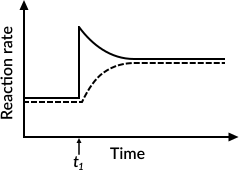
What is the reaction shifting towards the products?
400
The balanced chemical equation for the particle diagram represented below.
(Go to Slide 6 for image)
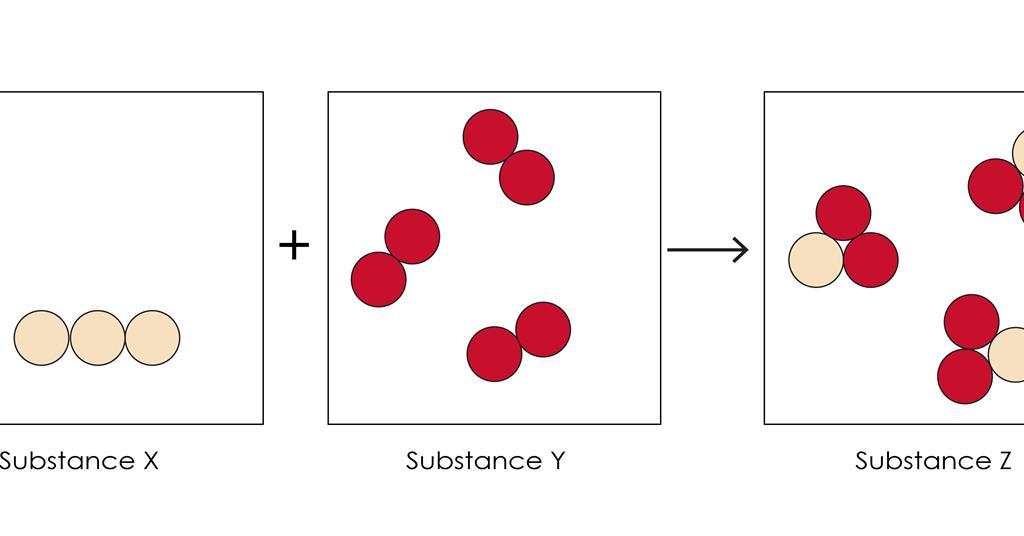
What is X + Y2 -> XY2?
500
The overall reaction's rate law for the steps:
Step 1 (Fast Equilibrium)
NO(g) + Br₂(g) ⇌ NOBr₂(g)
Step 2 (slow):
NOBr₂(g) + NO(g) → 2NOBr(g)
What is Rate = k[NO]²[Br₂]?
500
The direction the system shifts when the reaction
2SO₂(g) + O₂(g) ⇌ 2SO₃(g) with the equilibrium constant of 150 has initial concentrations, [SO₂] = 0.200 M, [O₂] = 0.100 M, and [SO₃] = 0.050 M
What is towards the products?
500
The element that is reduced in the chemical reaction: 2Ag+ + Cu -> 2Ag + Cu2+
What is silver?