Kinematics
Energy & SHM
Forces
Circular & Rotation
Momentum
100
A ball with a mass of 10kg is tossed in the air at the same time a ball of 5kg is tossed in the air. Both objects are tossed with the same initial velocity. Which object will experience the greatest magnitude in acceleration?
Neither
the horizontal component for both objects is 0
the vertical component for both objects is constant at -9.81m/s/s
100
What two quantities are measured in the same units, and what is that unit
Work & Energy
measured in Joules (J)
100
This quantity is directly proportional to the objects net force and inversely proportional to the mass.
acceleration
100
All these objects have the same potential energy at the top, but the time it takes them to get down the incline depends on how much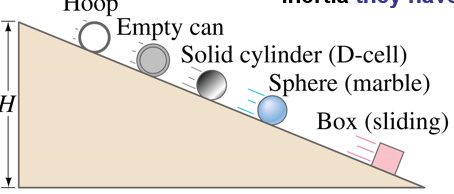
rotational inertia they have
100
Momentum is conserved
Kinetic energy is not conserved
Inelastic collision
200
A car initially at rest accelerates at 10m/s/s. The car’s speed after it has traveled 25 meters is most nearly?
22m/s
200
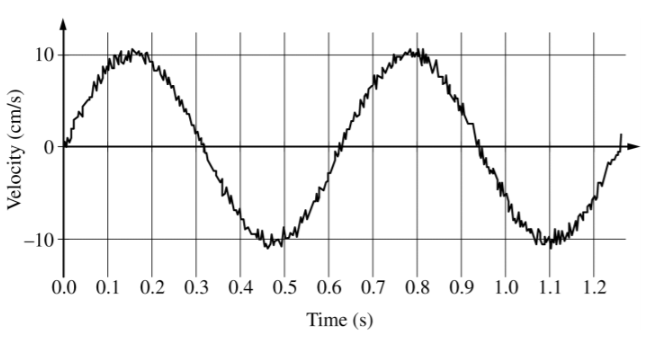
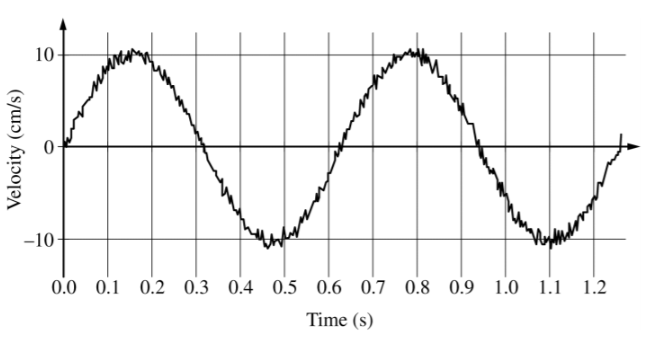
A student sets an object attached to a spring into oscillatory motion and uses a motion detector to record the velocity of the object as a function of time. A portion of the recorded data is shown in the figure above.
The frequency of oscillation is most nearly
1.6Hz
200
If an object is speeding up what is the direction of the objects velocity related to its acceleration?
v + & a+
OR
v- & a-
200
A student swings a ball on a light rod at a constant speed in a vertical circle, as shown in the figure. Which of the following correctly ranks the magnitudes of the forces exerted by the rod on the ball F1, F2, F3, F4 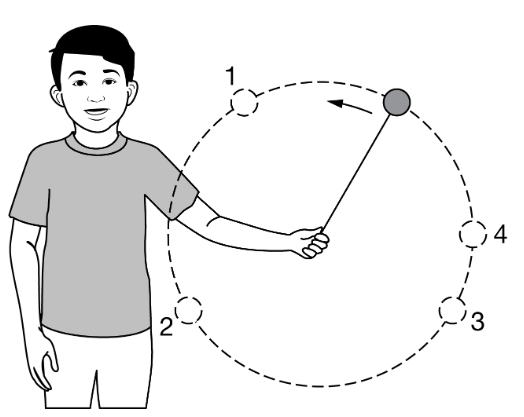 when the ball is at locations 1, 2, 3, and 4, respectively?
(F3=F2) >F4>F1
200
Derive two equations to determine the change in momentum.
Δp =F Δt
Δp=m (vf-v0)
300
Which of the following pairs of graphs shows the distance traveled versus time and the speed versus time for an object uniformly accelerated from rest?
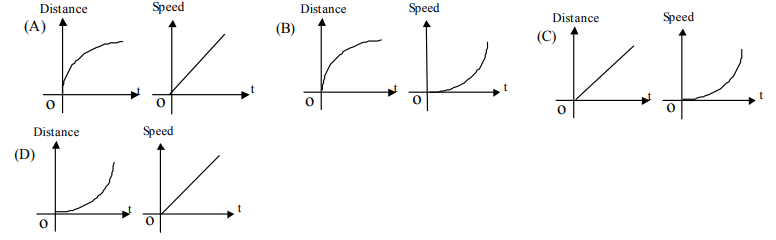
Graph D
300
A student sets an object attached to a spring into oscillatory motion and uses a motion detector to record the velocity of the object as a function of time. A portion of the recorded data is shown in the figure above.
The total change in the object’s speed between 1.0 s and 1.1 s is most nearly
5 cm/s
300
A student predicts that a block sliding down a ramp inclined at 45 degrees should have an acceleration of approximately 7 m/s2 The block is released from rest, and the student measures the distance the block travels and the time it takes to travel that distance. The student determines that the block’s acceleration is only 5.5 m/s2. What is the most likely reason for the difference between the predicted and calculated accelerations?
The student’s model used to make the prediction did not account for all of the forces that are exerted on the block.
300
The figure above shows the paths of two stars of equal mass as they orbit their common center of mass. The positions of the stars at four different times are labeled in the figure. At which of the positions do the stars have their greatest speed? 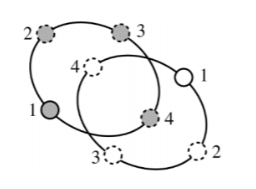
Position 4
300
Two blocks are on a horizontal, frictionless surface. Block A is moving with an initial velocity of v0 toward block B, which is stationary. The two blocks collide, stick together, and move off with a velocity of v0/3 . Which block, if either, has the greater mass?
Block B
400
After 2s object 1 & 2 have the same speed. What other information can be obtained from the graph from 0-2s.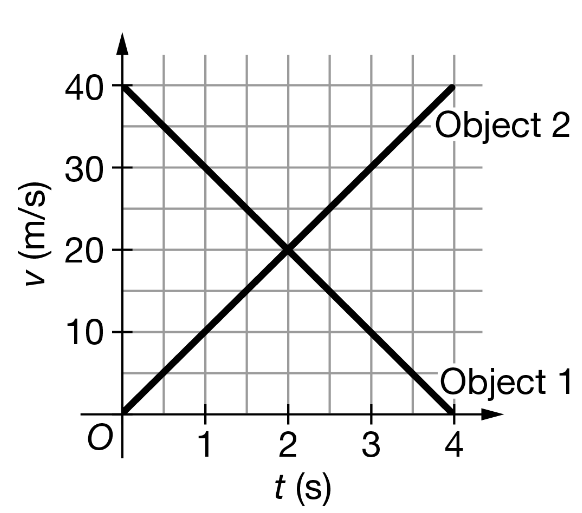
after 2s object 1 travels a greater distance than object 1.
400
A 0.5 kg pendulum bob is raised to 1.0 m above the floor, as shown in the figure above. The bob is then released from rest. When the bob is 0.8 m above the floor, its speed is most nearly 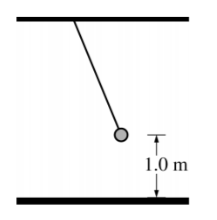
2 m/s
400
A 0.5kg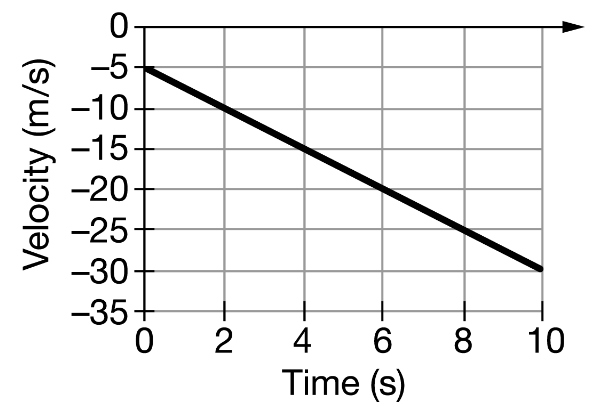 object is in free fall as it falls downward near the surface of a planet. A graph of the object’s velocity as a function of time is shown. What is the force due to gravity exerted on the object by the planet?
1.25N
400
The figure above represents a stick of uniform density that is attached to a pivot at the right end and has equally spaced marks along its length. Any one of the four forces shown can be exerted on the stick as indicated. Which force will create the largest rate of change in the stick’s angular momentum? 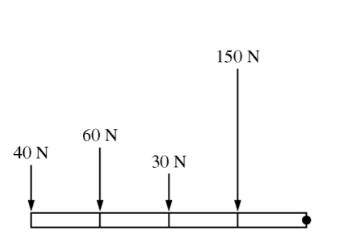
60N
400
A 2kg object travels in the positive direction across a horizontal surface with a constant speed of 10m/s . A force is exerted on the object for 4s, and the force increases linearly with respect to time. The table shows data about the magnitude of the applied force exerted on the object at different times. The force is exerted on the object in the opposite direction of the object’s displacement. What is the change in momentum of the object? 
Impulse=Ft
Impulse=(2N)(4s)= 8Ns
*you must find the average force 1st*
500
What are 3 methods to obtain information from graphs
Direct reading
slope
area
500
A brachiosaur can vomit approximately 49.5kg of regurgitant. Assuming the dinosaur stands 14 m above your head, if the dinosaur vomits directly on you what will the impact velocity of the regurgitant be?
16.6m/s
500
Derive an equation to determine the acceleration of the hanging mass. Consider the hanging mass to be labeled as mass 2 and the mass on the table to be mass 1.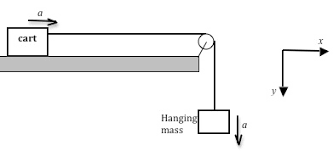
a=(m2g)/(m1 +m2)
500
On a rotating carousel or merry-go-round, one child sits on a horse near the outer edge and another child sits on a lion halfway out from the center.
(a) Which child has the greater linear velocity?
(b) Which child has the greater angular velocity?
The child on the horse has a greater linear velocity ( objects further from the axis of rotation will have greater linear velocities)
They both will have the same angular velocities
500
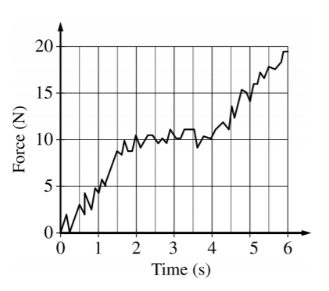 During an experiment a student records the net horizontal force exerted on an object moving in a straight line along a horizontal frictionless track. The graph above shows the force as a function of time. Of the following, which is the best approximation of the magnitude of the change in momentum of the object between 0 s and 4 s?
30 m/s*kg