Period 1 and 9 (-1607; 1980-)
Period 2: (1607-1754)
Period 3 and 5 (1754-1800; 1844-1877)
Period 4: (1800-1848)
Period 6: (1865-1900)
Period 7: (1898-1945)
Period 8: 1945-Present)
100
Most archaeologists and historians believe that the first peoples who colonized the Americas came from:
A). Asia
B). Africa
C). western Europe
D). Australia
E). the Mediterranean
A).
100
The introduction of tobacco during the early
1600s in the Virginia colony led to the
(A) devastating period of disease called the
starving time
(B) use of indentured servants, and later enslaved
Africans, for agricultural labor
(C) concentration of settlers and farms into small
village communities
(D) emergence of peaceful and cooperative
relationships with neighboring American
Indian peoples
(E) development of a diversified economy
B).
100
During the American Revolution, many women contributed to the cause of independence by
A). serving in Continental Army as soldiers
B). forming Committees of Correspondence
C). collecting money, medicine, and food to supply the Continental Army
D). petitioning the Continental Congress to give women the vote
E). protecting Loyalists from mob violence
C).
100
Andrew Jackson vetoed the recharter of the Bank of the United States partly because he believed that the bank
A). concentrated too much power in the hands of a few people
B). gave too many loans to assist unstable state and local banks
C). was secretly funding the abolitionist movement
D). was overly subsidized by state tax monies
E). planned to create new paper money unsupported by gold or silver
A).
100
7. The method of mass production that developed
during the nineteenth century was a process that
(A) relied on the use of power-driven machinery
(B) utilized wireless communications to improve
efficiency
(C) gave workers greater autonomy, less
supervision, and the chance to be creative
(D) relied on guilds to train artisans
(E) promoted more cooperation between labor
unions and factory owners
A).
100
The term "muckrakers" was used in the early twentieth century to refer to
A). laborers who worked in the meatpacking industry
B). baseball players who lost important games on purpose to collect large bribes
C). writers who wrote articles sympathetic to big business
D). captains of industry who defended the accumulation of wealth in lectures and pamphlets
E). journalists who wrote articles exposing political corruption and urban poverty
E).
100
The unanimous Supreme Court decision in
Brown v. Board of Education of Topeka stated
that segregated schools were unconstitutional
because
(A) parallel school systems for White and Black
children resulted in wasteful duplication of
government services
(B) the Soviet Sputnik satellite made it clear
that the segregated public school system
had contributed to the decline of scientific
skills in the United States
(C) separation of students based solely on race
constituted inherently unequal treatment
(D) racial injustice made it difficult for the
United States to appeal to peoples of
recently decolonized countries in Africa
and Asia during the Cold War
(E) the Court could no longer tolerate southern
senators’ filibustering of civil rights
legislation
C).
200
 Which of the following statements about the population of
North America at the time of Christopher Columbus’ voyages
is supported by the map above?
(A) The American Indian population was distributed
uniformly throughout North America.
(B) The most densely populated regions of North America
would eventually become part of New Spain.
(C) The most densely populated regions of North America
would eventually become part of New France.
(D) Compared with other areas of North America, relatively
few American Indians lived in the Southeast.
(E) The American Indian population was concentrated on
the Great Plains.
B).
200
All of the following groups of nonEnglish
colonists migrated into the
British North American colonies
in large numbers throughout the
eighteenth century EXCEPT
(A) Germans
(B) Russians
(C) Scots
(D) Irish
(E) Dutch
B).
200
Which of the following was true of the South
in the post–Civil War period?
(A) A large immigrant population moved to
the region.
(B) Big business and railroads came to dominate
the Southern economy just as they did in
the North.
(C) Landowners widely adopted sharecropping
and tenant farming.
(D) The cotton market experienced a twenty-year
boom.
(E) A strong labor movement emerged in the
textile industry.
C).
200
The United States went to war in 1812 for
all of the following reasons EXCEPT to
(A) end British claims for repayment
of Loyalist debt
(B) prevent France from recapturing the
Louisiana Territory
(C) stop the British from searching and
seizing American ships
(D) appease members of Congress who
advocated war
(E) deal with conflicts between settlers and
American Indians in the Northwest
Territory
B).
200
In the late nineteenth century, state governments
in the South were largely successful in restricting
(A) African Americans’ voting rights guaranteed
by the Fifteenth Amendment
(B) the power of the Democratic Party
in the region
(C) state laws allowing married women
to own property
(D) corruption in the federal government
(E) antitrust laws regarding textile
manufacturing
A).
200
Gwendolyn Brooks, Langston Hughes, and James Weldon Johnson were all similar in that they
A). followed a style of painting called Cubism
B). organized labor unions during the Gilded Age
C). were persecuted by Senator Joseph McCarthy
D). protested Untied States involvement in the Vietnam War
E). contributed to the Harlem Renaissance
E).
200
The decade of the 1970s was marked by all
of the following economic conditions in the
United States EXCEPT
(A) rising oil prices for businesses and consumers
(B) greater participation by women in the paid
workforce
(C) increased competition from Western Europe
and Japan
(D) simultaneous inflation and recession, known
as stagflation
(E) increased labor union membership among
autoworkers
E).
300
The Reagan Revolution of the early 1980s
entailed
(A) tax cuts for low-income Americans and
expansion of social welfare programs
(B) tax cuts for the wealthiest Americans and
increases in defense spending
(C) a free-trade policy with European nations
(D) national health insurance
(E) a balanced federal budget
B).
300
The early success of the Pennsylvania colony
was due in large part to which of the following?
(A) Wars that forced American Indians out
of the area
(B) William Penn’s careful planning and
his policy of selling land to settlers
(C) The ease of producing cotton and rice
in the climate of Pennsylvania
(D) William Penn’s policy of allowing only
selected Quakers to settle there
(E) Restrictions on religious liberty that
reduced controversy and conflict
B)
300
“We do not know whether free laborers ever
sleep. . . . The free laborer must work or starve.
He is more of a slave than the negro, because he
works longer and harder for less allowance than
the slave, and has no holiday, because the cares of
life with him begin when its labors end. He has no
liberty, and not a single right.”
George Fitzhugh, Cannibals All! or, Slaves
Without Masters, 1857
The excerpt above reflects the common argument
in the antebellum South that
(A) slavery was immoral
(B) capitalism was the economic system most
likely to generate wealth and happiness
for the most people
(C) the South needed to change to survive
(D) slaves lived better than northern factory
workers
(E) industrialists took care of their workers’
welfare
D).
300
The Louisiana Purchase proved politically
troubling for Thomas Jefferson because of his
(A) previous support for a strict interpretation
of the Constitution
(B) veto of funding for Meriwether Lewis
and William Clark’s expedition
(C) admiration of France’s military power
(D) devotion to new methods of cartography
(E) disdain for involvement in a foreign
country’s affairs
A).
300
In Horatio Alger’s books, the hero is successful
primarily as a result of his
(A) religious piety
(B) formal education
(C) hard work and luck
(D) influential relatives
(E) inherited wealth
C).
300
Which of the following is a major change in the
status of women that occurred in the 1920s?
(A) They began to vote in national elections.
(B) They achieved income equality with men.
(C) They gained the right to initiate divorce
proceedings.
(D) They began to serve in the armed forces.
(E) They were elected to federal office in large
numbers.
A).
300
Richard Nixon’s diplomatic overtures to the
People’s Republic of China were motivated
in part by his belief that China
(A) was ready to embrace a capitalist economy
and democratic government
(B) was a more legitimate representative of the
Chinese people than was Taiwan
(C) had become an important global power that
could not be ignored
(D) might form an alliance with South Korea and
Japan against the United States
(E) was likely to shun cultural and educational
exchanges with Western European natio
C).
400
During the 1970s and 1980s, the New Right
appealed strongly to all of the following groups
EXCEPT those who were
(A) concentrated in suburbs in the South and
Southwest
(B) evangelical Protestants
(C) urban African Americans
(D) afraid that the Soviet Union represented a
growing menace
(E) opposed to government intervention in
the economy
C)
400
“[God’s] wrath towards you burns like fire; He
looks upon you as worthy of nothing else, but
to be cast into the fire . . . you are ten thousand
times more abominable in His eyes, as the most
hateful and venomous serpent is in ours. You
have offended Him infinitely more than ever
a stubborn rebel did his prince. And yet, it is
nothing but His hand that holds you from falling
into the fire every moment.”
The quote above is an example of the rhetoric
from the
(A) Puritan migration of the 1630s
(B) Salem witch trials of the 1690s
(C) Great Awakening of the 1730s
(D) American Revolution of the 1770s
(E) Mormon migration of the 1840s
C).
400
Which of the following is true of the Virginia
and the New Jersey plans that were presented
at the Constitutional Convention?
(A) They illustrated the struggle between states
for representation and power in the creation
of the new government.
(B) They were attempts to settle the status
of slaves in the southern states.
(C) They advocated different ways in which
federal taxes would be collected by the
new government.
(D) They illustrated the conflicts between states
with primarily agricultural and commercial
economies.
(E) They were alternative plans to admit new
territories to the Union.
A).
400
During the 1800s the most common form of
resistance to slavery by slaves themselves was
(A) rebelling openly, using weapons,
and planning confrontations
(B) organizing petitions and demonstrations
against slavery
(C) escaping to Canada via the
Underground Railroad
(D) working slowly and breaking tools
(E) cooperating with the abolitionist movement
to advocate laws to end slavery
D).
400
Andrew Carnegie’s Gospel of Wealth was
based on the belief that wealthy industrialists
should use their wealth to
(A) acquire additional landholdings in the West
(B) create new businesses
(C) finance philanthropic endeavors
(D) pay workers better wages and benefits
(E) live in luxury
C).
400
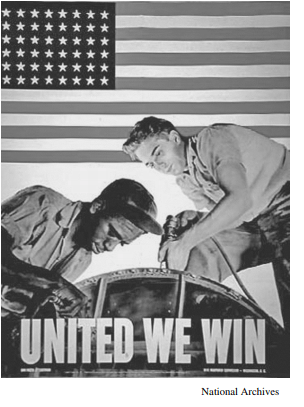
Which of the following messages did the
United States government most likely intend
to impart in the Second World War poster
pictured above?
(A) Promotion of union membership for workers
in war industries
(B) Encouragement of greater acceptance of
African American workers in wartime
industrial jobs
(C) Celebration of the United States policy
of racial integration in the armed forces
(D) Response to criticism that corporate
profiteering undermined United States
war efforts
(E) Counterpoint to the Rosie the Riveter image
by showing that men, as well as women,
worked in war industries
B).
400
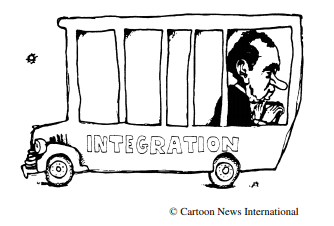
Which of the following statements would best
describe the point being made in the cartoon
above about Richard Nixon’s administration?
(A) In order for integration policies to work,
Nixon needed to pick up the support of the
silent majority.
(B) The Nixon administration was arguing that
integration was no longer a relevant policy.
(C) Nixon was reversing progress toward
integration made in the 1960s.
(D) Nixon needed to attract more Black votes in
order to move forward in civil rights.
(E) Nixon supported busing as a means to
integration.
C).
500
The Pueblo revolt of 1680 was caused by
A). the Spanish Mission System
B). the Spanish Encomienda System
C). the establishment of trading post forts by the Jesuits
D). the policy of the English covenant chain
E). battles of native hegemony with the Iroquois
B).
500
In the period 1650–1750, all of the following
contributed to British North American colonists’
sense of identity as British subjects EXCEPT the
(A) growth of commerce across the Atlantic
Ocean
(B) increased circulation of London newspaper
articles reprinted in the colonies
(C) expansion of the colonies into western
frontier regions
(D) availability of British manufactured goods
in the colonies
(E) warfare against the French and their
American Indian allies
C).
500
Historians have argued that all of the following
were causes of the Civil War EXCEPT
(A) the clash of economic interests between
agrarian and industrializing regions
(B) the actions of irresponsible politicians and
agitators in the North and the South
(C) differences over the morality and future of
slavery
(D) the growing power of poor Southern Whites
who resisted planter dominance and sought
to abolish slavery
(E) a constitutional crisis pitting states’ rights
against federal power
D).
500
“Build, therefore, your own world. As fast as
you conform your life to the pure idea in your
mind, that will unfold its great proportions. A
correspondent revolution in things will attend
the influx of the spirit.”
The 1836 passage above exemplifies which
of the following intellectual trends?
(A) Evangelicalism
(B) Transcendentalism
(C) Abolitionism
(D) Mormon theology
(E) Pragmatist philosophy
B).
500
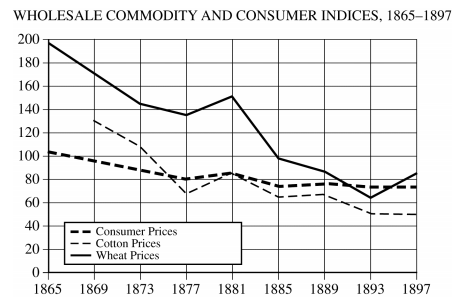
The chart above supports which of the following conclusions regarding economic conditions in the United States
during the last third of the nineteenth century?
(A) Americans with relatively stable incomes found it increasingly difficult to make ends meet.
(B) Wheat farming became more lucrative.
(C) Many American farmers struggled financially.
(D) Cheap foreign goods were the primary cause for the decline in prices.
(E) Industrial workers refused to demand higher wages due to declining prices.
C).
500
The years 1930–1980 have been described by
one historian as a period that saw the “rise and
fall of the New Deal Order.” What is meant here
by the phrase “New Deal Order”?
(A) An arrangement in which the United States
government took an active role in regulating
the economy and in mediating disputes
between labor and management
(B) A plan to allow increased free trade between
the United States and Europe
(C) An agenda pushed by congressional
Republicans intent on encouraging family
values and moral behavior
(D) A program intended by congressional
Democrats to promote the growth of small
businesses at the expense of major
corporations
(E) A scheme designed to pave the way for a
single, worldwide governing body
A).
500
Betty Friedan’s best-selling book of the 1960s
observed that
(A) racism blocked the Civil Rights movement
(B) environmental problems plagued the country
(C) immigrants had access to few social services
(D) conflicts increased between supporters of
Black separatism and supporters of
integration
(E) many middle-class housewives and mothers
felt frustration and a lack of fulfillment
E).
600
Spanish and French colonization efforts most differed from British colonization
A). in that they formed interracial societies
B). in that they were less harsh than the British
C). in that they conquered and controlled less land
D). in that they only converted natives to protestant Christianity
E). in that they refused to encourage native assimilation to European culture
A).
600
Which of the following characterizes the
relationship between church and state for the
Puritans who settled the Massachusetts Bay
Colony in the seventeenth century?
(A) The colonial government officially supported
religious toleration.
(B) Colonial officials strictly separated church
and state.
(C) Colonial officials encouraged churches to
incorporate Catholic elements of worship.
(D) Ministers held most elected offices.
(E) Church membership was required for voting
and holding public office.
E).
600
Which of the following most profoundly
transformed the lives of slaves in the South in
the mid-1700s?
(A) The reluctance of White slaveholders to
move west and settle in the Ohio River
valley
(B) The growing popularity of antislavery
sentiment among White Americans
(C) The growth of a native-born
African American population
(D) The prevalence of slave rebellions on large
plantations
(E) The passage of gradual emancipation laws
in the upper South
C).
600
Politics in the antebellum United States changed
dramatically because
(A) expanded White male suffrage broadened
participation in elections
(B) female suffrage became a topic of debate in
the House of Representatives
(C) widespread electoral reform resulted in direct
election of senators
(D) the power of the federal government
expanded to ensure the equal protection of
all citizens
(E) the government sought to assimilate
American Indians in the West
A).
600
Frederick Jackson Turner’s theory emphasized the
significance of the frontier for all of the following
reasons EXCEPT:
(A) An open frontier led to the development of
the unique American character.
(B) Free land promoted freedom of opportunity
on the frontier.
(C) The frontier helped establish democratic
institutions.
(D) The western frontier had land that could be
distributed to former slaves.
(E) The frontier was a safety valve for the excess
population of eastern cities.
D).
600
Which of the following correctly describes
the Committee on Public Information?
(A) It was the first organization to
oppose legalizing abortion.
(B) It was a business lobby against
Franklin Roosevelt’s New Deal.
(C) It was established to mobilize domestic
support for the war effort during the First
World War.
(D) It was the effort led by Samuel Adams to
rally colonists against British taxes.
(E) It was an antislavery group that formed after
the Compromise of 1850.
C).
600
In her influential 1962 work Silent Spring,
Rachel Carson warned
(A) that discrimination against deaf Americans
violated civil rights laws
(B) that many cars built in the United States
were unsafe
(C) about the dangerous impact of pesticides
(D) that poverty in the United States threatened
the overall economy
(E) about noise pollution
C).
700
What do the convincing election victories by FDR, LBJ, Nixon, and Reagan all have in common?
A). they all suffered scandals in their second terms
B). they were all impeached
C). they all became involved in a war
D). they all emphasized strong economic regulation of the economy
E). they all enjoyed more successful second terms than first terms
700
Someone who favored George Washington’s
approach to foreign policy would be most likely
to object to which of the following United States
policies?
(A) Declaration of neutrality at the beginning
of the First World War
(B) Selling surplus wheat to the Soviet Union
in the 1970s
(C) Membership in the North Atlantic Treaty
Organization
(D) Participation in international scientific
conferences
(E) Trade with the European Common Market
nations
C).
700
Thomas Jefferson disagreed with Alexander
Hamilton’s economic plan primarily because he
feared that it would
(A) make the new nation dependent on foreign
markets for its exports
(B) prevent the expansion of slavery to new states
(C) lead to a military alliance with Great Britain
against revolutionary France
(D) lead to heavy taxes on whiskey producers
in Pennsylvania
(E) promote urban mercantile interests at the
expense of agricultural interests
E).
700
William Lloyd Garrison and the American
Anti-Slavery Society were known for
(A) advocating immediate and uncompensated
emancipation
(B) advocating colonization by former slaves in
West Africa
(C) advocating the use of tariff revenues to
purchase slaves from slaveholders
(D) opposing women’s participation in public
abolitionist meetings
(E) supporting the Kansas-Nebraska Act’s
provisions regarding slavery
A).
700
Although the Sherman Antitrust Act was
originally intended to inhibit the growth of
business monopolies, courts initially used its
provisions successfully against
(A) urban political machines
(B) banks
(C) public schools
(D) labor unions
(E) immigrants
D).
700
Which of the following was Harry Truman’s
stated reason for authorizing the use of the
atomic bomb against Japan?
(A) Using the atomic bomb would prevent
the need for a costly invasion of Japan.
(B) Dropping the atomic bomb would
demonstrate United States military
capability to the Soviets.
(C) An earlier United States land assault against
Japan had been unsuccessful.
(D) The development of the atomic bomb
had been expensive.
(E) The United States should retaliate in response
to Japan’s attack on Pearl Harbor.
A).
700
From 1984 to 1986, Reagan administration
officials secretly sold arms to Iran to illegally
finance
(A) a rebellion against the Sandinista government
in Nicaragua
(B) a coup against the Castro regime in Cuba
(C) the invasion of Grenada
(D) Great Britain’s pursuit of the Falkland
Islands War
(E) a leftist revolt in El Salvador
A).
800
Which of the following best characterizes rural
women in the New England colonies?
(A) Many left their farms in order to work in
textile mills.
(B) They used their influence over the domestic
sphere as a basis for promoting social
reform.
(C) They had legal rights equal to those of men.
(D) They performed a large amount of farm labor
and produced goods for their families.
(E) A large number of them were teachers in oneroom
schoolhouses.
D).
800
Five of the thirteen states voted for ratification of
the Constitution only after
(A) slavery was allowed to continue without
federal interference
(B) several slave revolts rocked the Carolinas
and Virginia
(C) they were assured that the Supreme Court
would have the power of judicial review
(D) they were assured that a Bill of Rights would
be added shortly after ratification
(E) the other states threatened to organize the
government without them
D).
800
One distinguishing feature of the new middle
class that emerged in the 1830s and 1840s was
(A) its members’ tendency to be tolerant of
religious diversity
(B) the separation of economic production from
the home and family life
(C) the fact that almost all middle-class men
attended graduate and professional schools
(D) its members’ support for ending legal
immigration from eastern Europe
(E) the fact that most married women worked
outside the home to provide income for
their families
B).
800
“If they dare to come out in the open field and
defend the gold standard as a good thing, we will
fight them to the uttermost. Having behind us the
producing masses of this nation and the world,
supported by the commercial interests, the
laboring interests, and the toilers everywhere, we
will answer their demand for a gold standard by
saying to them: You shall not press down upon
the brow of labor this crown of thorns; you shall
not crucify mankind upon a cross of gold.”
William Jennings Bryan, 1896
Which of the following groups would most likely
agree with the quote above?
(A) Urban workers
(B) Railroad executives
(C) New York City financiers
(D) Midwestern farmers
(E) White-collar and professional workers
D).
800
Many anti-imperialists opposed the annexation of
the Philippines in 1898 because they believed that
(A) the Philippines should be returned to Spain
(B) United States colonialism in the Philippines
was incompatible with the American belief
in self-determination
(C) Philippine agriculture would be competing
with United States agriculture
(D) the Philippine government was planning
an alliance with Mexico
(E) the United States would be drawn into a war
with Japan over Pacific territories
B).
800
In the early 1960s, Malcolm X challenged the
leadership of Martin Luther King, Jr., in the
Civil Rights movement by arguing that
(A) African Americans must defend themselves
against racism by using violence if
necessary
(B) nonviolent protest could succeed only when
African American and White activists
cooperated
(C) African Americans should develop economic
and cultural ties with African nations
(D) African Americans could move toward
political equality by first developing
stronger vocational skills
(E) court litigation was a more effective strategy
to gain civil rights than were sit-ins or mass
protest rallies
A).
900
The Virginia Slave Codes of 1705 were passed in correlation to
A). increasing western migration
B). increasing gradual emancipation by states
C). increasing slave rebellions
D). increasing trans-Atlantic slave trade
E). increasing evangelism of the First Great Awakening
D).
900
Shays’ Rebellion is significant because it
(A) inspired southern states to tighten slave codes
to prevent future uprisings
(B) strengthened the movement for a new
constitution
(C) led to the expulsion of Lord Baltimore’s
officials from Maryland
(D) led to the establishment of the Anglican
church as the official church in the colonies
(E) led to the establishment of a new government
in New York
B).
900
The role of women expressed in the cult
of domesticity had its roots in
(A) Progressive Era urban reform
(B) mid-nineteenth-century nativism
(C) the early twentieth-century suffrage
movement
(D) republican motherhood
(E) the reaction against feminism after
the Second World War
D).
900
From the 1880s to the New Deal, the dominant
United States government policy toward
American Indians was to try to
(A) strengthen tribal authority
(B) relocate all tribes to Oklahoma
(C) encourage migration to Canada
(D) preserve native languages and customs
(E) assimilate them into White culture
E).
900
During the late nineteenth century, members of
which of the following groups were most likely
to advocate settlement houses as a means of
social reform?
(A) African Americans leaders
(B) Educated middle-class women
(C) Scandinavian immigrants
(D) Labor leaders
(E) Democratic politicians
B).
900
The “Declaration of Constitutional Principles”
(Southern Manifesto) of 1956 and
George Wallace’s campaigns for the
presidency in 1968 and 1972 all endorsed
(A) tax cuts for middle-income Americans
(B) civil rights for Black people
(C) keeping the federal government out of state
matters
(D) a constitutional amendment requiring an
annual balanced federal budget
(E) allowing display of the Confederate battle
flag on state capitol grounds
C).
1000
Members of the American (Know-Nothing)
Party of the 1850s typically supported
(A) universal manhood suffrage
(B) restoration of a national bank
(C) immediate abolition of slavery
(D) homesteads in the western territories
(E) restrictions on Catholics’ holding
public office
E).
1000
The United States gained which of the following
from the Treaty of Guadalupe Hidalgo in 1848 ?
(A) An undisputed claim to Oregon
(B) Control of the sugar trade with Cuba
(C) Possession of California and most of the
Southwest
(D) Possession of the Philippines
(E) The right to construct a canal across the
Isthmus of Panama
C).
1000
After the Civil War, some businesspeople and
newspaper editors—such as the Atlanta
Constitution’s Henry Grady—promoted the idea
of a New South. Which of the following best
describes their vision for the southern states?
(A) An agricultural region consisting of small
farms focused on growing food crops
(B) An industrial region whose economic
mainstays would be the mining and
smelting of minerals and metals
(C) An agricultural region of large plantations
growing cotton, tobacco, and rice, worked
by sharecroppers
(D) A mixed economy no longer primarily
dependent on cash crops
(E) A postindustrial region whose economy
revolved around health care, insurance, and
financial services
D).
1000
“The Department of Justice will pursue the attack
of these ‘Reds’ upon the Government of the
United States with vigilance, and no alien,
advocating the overthrow of existing law and
order in this country, shall escape arrest and
prompt deportation.”
The declaration above was made by
(A) Louis D. Brandeis
(B) William Howard Taft
(C) A. Mitchell Palmer
(D) Theodore Roosevelt
(E) Robert M. La Follette
C).
1000
Which of the following migration patterns had
the greatest impact on United States society in
the 1950s?
(A) Immigration of eastern and southern
Europeans to the United States
(B) Migration of Mexican Americans to
midwestern cities
(C) Immigration of East Asians to the West Coast
(D) Migration of Americans from urban centers
to the suburbs
(E) Migration of American Indians from the
Dakotas to California
D).
1100
79. Which of the following did NOT contribute to
the perception of many White Southerners that
antislavery sentiment was spreading in the 1850s?
(A) Uncle Tom’s Cabin drew enthusiastic
audiences of Northern readers and
theatergoers.
(B) Groups like the New England Emigrant Aid
Company worked to make Kansas a free
state.
(C) Some prominent Northern intellectuals like
Henry David Thoreau praised John Brown’s
raid on Harpers Ferry.
(D) The Republican Party attracted an increasing
number of supporters.
(E) Congress voted to end the interstate slave
trade.
E)
1100
W. E. B. Du Bois differed in philosophy from
Booker T. Washington in that Du Bois believed
(A) African Americans should pursue immediate
and full equality
(B) economic success would lead to political
equality
(C) job training was ultimately more important
than formal education
(D) civil rights would come through local efforts
rather than national organization
(E) segregation was a southern problem more
than a national one
A).
1100
President Calvin Coolidge and his secretary of the
Treasury, Andrew Mellon, pursued an economic
policy that featured
(A) a sustained downward revision of the tariff
(B) tax cuts for the wealthy and corporations
(C) innovative programs to help beleaguered
farmers
(D) a bimetallic monetary standard
(E) effective regulation of the stock market and
Wall Street
C).
1100
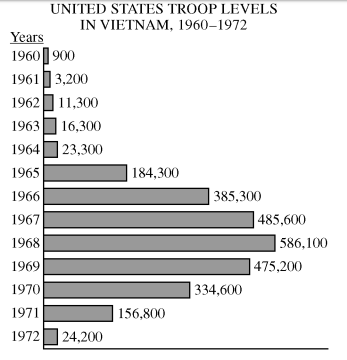
The chart above illustrates the effect of President Richard
Nixon’s policy of
(A) Vietnamization
(B) escalation
(C) détente
(D) containment
(E) appeasement
A).
1200
The Federalist papers were written in order to
(A) mobilize popular support for keeping the
Articles of Confederation
(B) persuade voters to support Thomas Jefferson
in the election of 1800
(C) frustrate Spanish efforts to sway the political
loyalty of the Southwest
(D) persuade the Continental Congress to declare
independence
(E) attain ratification of the Constitution
E)
1200
Although Progressive Era reformers held different (YES I KNOW THIS IS PERIOD 7)
opinions about many issues of the day, they
shared a belief in
(A) the creation of a classless society
(B) the capacity of trained professionals to find
rational, scientific solutions to society’s
problems
(C) an ideal society based on shared ownership
through voluntary organizations rather than
increasing government power
(D) the expanding role of the United States as an
imperial power
(E) the creation of an organization to promote
international peace
B)
1200
“Chronic wrongdoing, or an impotence which
results in a general loosening of the ties of
civilized society, may in America, as elsewhere,
ultimately require intervention by some civilized
nation, and in the Western Hemisphere the
adherence of the United States to the Monroe
Doctrine may force the United States, however
reluctantly, in flagrant cases of such wrongdoing
or impotence, to the exercise of an international
police power.”
The foreign policy statement above came to be
known as
(A) dollar diplomacy
(B) the Roosevelt Corollary
(C) the Truman Doctrine
(D) the Good Neighbor policy
(E) the Alliance for Progress
B).
1200
When the Soviet Union successfully launched
the first artificial satellite Sputnik in 1957,
Congress responded by
(A) ending diplomatic relations with the
Soviet Union
(B) opening talks with China
(C) passing the National Defense Education Act
(D) passing Title IX of the Federal Education
Amendments
(E) proposing the Strategic Arms Limitation
Treaty
C).
1300
Which of the following would most likely have
opposed the Kansas-Nebraska Act?
(A) A Missouri slaveholder
(B) Stephen Douglas
(C) A midwestern investor in a
Pacific-to-Chicago railroad line
(D) A Southern supporter of popular sovereignty
(E) A New England abolitionist
E).
1300
One stated objective of Woodrow Wilson’s plan
for peace after the First World War was to
(A) ensure the military dominance of the
United States over the European powers
(B) ensure that the Central Powers paid the
Allied nations for war damages
(C) destroy the Central Powers’ military strength
(D) promote the right of national selfdetermination
(E) provide monetary assistance to rebuild
Europe
D).
1300
Which of the following is most characteristic of
President Eisenhower’s Cold War strategy?
(A) It caused him to restrict covert operations
of the Central Intelligence Agency.
(B) It relied on a massive buildup of conventional
troops.
(C) It relied on the principle of massive
retaliation.
(D) It utilized counterinsurgency tactics to control
communist-influenced rebellions in the
developing world.
(E) It drastically restricted any further
development of the United States nuclear
arsenal.
A).
1400
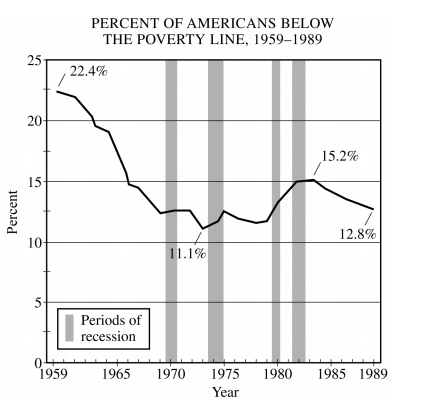
According to the graph above, the largest decrease in the
percent of Americans living below the poverty line
accompanied which of the following federal policy
initiatives?
(A) The New Deal
(B) The Fair Deal
(C) The Great Society
(D) Supply-side economics
(E) Welfare to Work
C).