Epithelial Cells
Neurology
Ear/Eye Anatomy
Integument
Connective Tissue
Miscellaneous
100
What is the function of cilia in the respiratory tract?
Cilia exist to trap pathogens in the coating mucus layer. The beat in synchronized sweeps to move microbes and particulates embedded in mucus.
100
What is the resting membrane potential and threshold potential?
Resting Membrane Potential = -70mV
Threshold Potential = -55mV
100
What is the specialized reflective layer in the choroid of some animals? (It is what you see when animals are caught in your car’s headlights at night)
Tapetum
100
What is damaging inflammation of laminar tissue called?
Laminitis
100
What are the two main types of connective tissue proper?
Loose and Dense Connective Tissue
100
What are the medical terms for eye and ear exam?
Eye = Ophthalmic exam (Ophthalmoscopy)
Ear = Otoscopic exam
200
What epithelium type is seen here?
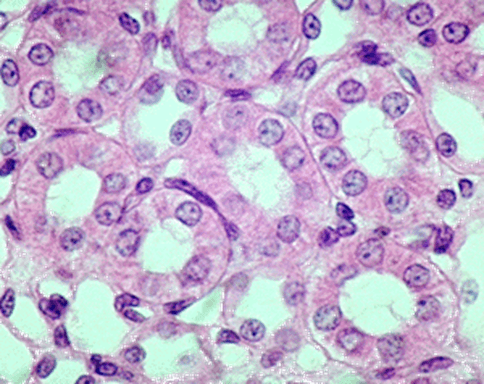
Simple Cubodial Epithelium
200
What is a ganglion?
A ganglion is a cluster of cell bodies located outside the central nervous system
200
What are the 3 major layers of the eye? (Not looking for outer, middle and inner)
From anterior to posterior:
1) Fibrous
2) Vascular
3) Nervous
200
True or False:
Antlers are specialized epidermal derivative arises from skull bone, grows throughout an animals life, and is never shed
False, this describes horns
200
What type of connective tissue is seen here?

Dense Regular Connective Tissue
200
What are the 4 main components of the brain?
1) Cerebrum (Cerebral Cortex)
2) Diancephelon
3) Cerebellum
4) Brainstem
300
What are the three major types of cellular attachments?
Tight Junctions, Desmosomes, and Gap Junctions
300
How many cranial nerves are related to sensory or movement of the eye?
4 cranial nerves:
#2 = Optic
#3 = Oculomotor
#4 = Trochlear
#6 = Abducent
300
What are the two components of the inner ear and their functions?
Cochlea = hearing
Semicircular canals = balance
300
What is the difference between apocrine and eccrine sweat glands?
Apocrine glands open into the hair follicle
Eccrine glands open directly onto the surface of your skin
300
What are the 3 types of specialized connective tissue?
Cartilage, Bone, and Blood
300
What are the 3 layers/cells of the retina?
Photoreceptor, Bipolar, and Ganglion cells/layers
400
What are the 3 types of secretory mechanisms used by glands and explain one of there excretion styles?
Apocrine = a portion of the cell membrane that contains the excretion buds off
Merocrine = cells excrete their substances by exocytosis
Holocrine = the entire cell disintegrates to excrete its substance
400
What are 3 of the 4 ways the body protects the central nervous system?
1) Encased by bone
2) The Meninges
3) Cerebrospinal Fluid
4) Blood-brain barrier
400
What typically causes Glaucoma?
Impaired outflow in drainage canals, which are called canals of Schlemm
400
What are the 3 hair growth stages seen here (from left to right)?
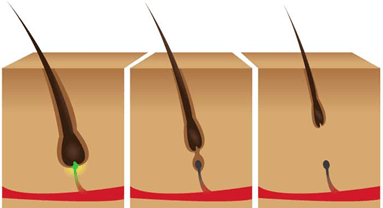
Anagen, Catagen, and Telogen
400
What connective tissue is seen here and what is one function of it?
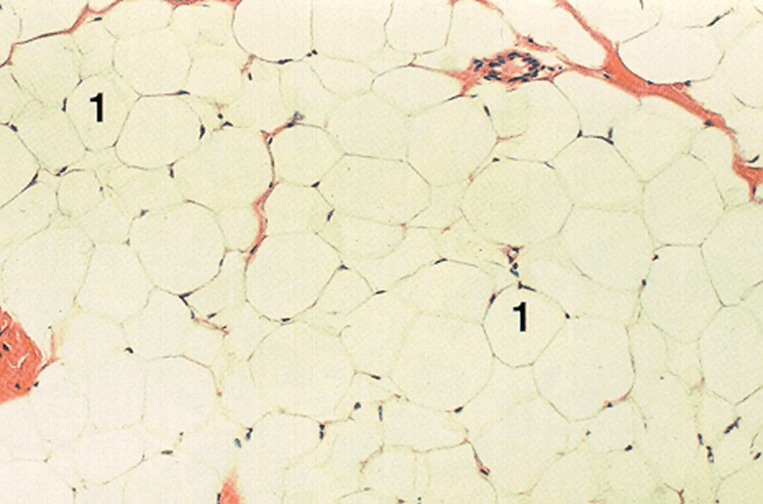
Adipose Tissue
Functions = storage, cushioning, insulation
400
What are the 4 stages of cutaneous wound repair?
1) Hemorrhage and inflammation
2) Organization
3) Proliferation of granulation tissue
4) Regeneration or fibrosis
500
Name 3 of the 5 characteristics common to all epithelial cells
1) Cellularity
2) Held together by specialized attachments called junctions
3) Polarity
4) Avascular
5) Regeneration
500
What is one excitatory and inhibitory neurotransmitter?
Excitatory = Acetylcholine (at neuromuscular synapses and parasympathetic synapses) OR Catecholamines (at sympathetic nervous system synapses)
Inhibitory = GABA or glycine
500
What are the 3 tiny bones known as the ossicles of the middle ear?
1) Hammer (Malleus)
2) Anvil (Incus)
3) Stirrup (Stapes)
500
What connective tissue does the dermis mostly contain? And the hypodermis?
Dermis contains mostly dense irregular CT
Hypodermis contains mostly areolar CT and Adipose tissue
500
What are the 3 types of cartilage and where might one of these be found in the body?
Hyaline = found in trachea
Elastic = found in epiglottis and pinnae (external ear flaps)
Fibrocartilage = found near inter-vertebral discs and at the insertions of tendons and ligaments
500
What are the two major anatomical differences between
the sympathetic and parasympathetic nervous system?
Sympathetic: Nerves emerge from spinal cord in the thoracolumbar segments AND Preganglionic neuron is short, postganglionic neuron to target organ is long
Parasympathetic: Nerves emerge from the craniosacral segments AND Preganglionic neuron is long, postganglionic neuron to target organ is short