Atom History
Atomic Structure
Isotopes
Ions
Grab Bag
100
They studies many materials and used mysterious symbols to represent these materials.
ALCHEMISTS
100
Protons, nuetrons and electrons
3 subatomic particles.
100
A different version of the same atom.
isotope
100
an atom that has lost or gained electrons
ions
100
The study of matter and the changes it undergoes
chemistry
200
He came up with the four part atomic theory.
JOHN DALTON
200
This subatomic particle has a postive charge.
protons
200
This is the reason the mass is different in an isotope.
the number of neutrons
200
The charge when Magnesium becomes an ion.
+2
200
Must have mass and volume.
matter
300
person associated with discovering electrons
John Dalton.
300
This subatomic particle is neutral and located in the nucleus.
nuetrons
300
In Carbon-14, what the 14 represents.
the mass of carbon
300
The charge when Bromine becomes an ion?
-1
300
December 25th
Christmas
400
His gold foil experiment proved there was a small, dense positively charged center of an atom called the nucleus.
Ernest Rutherford
400
Calculated by adding your protons plus neutrons.
atomic mass
400
How you calculate neutrons.
4 neutron
400
Another name for a positive ion.
cation
400
Two Catagories: Physical Science and Biological Science
the two categories that the sciences were previously divided into
500
This model represents electrons circling the nucleus like planets orbiting the sun.
Bohr Model
500
This tells you the number of energy level an atom has.
the period (row)
500
How many electron, protons and neutrons would
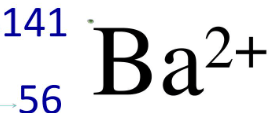
56 protons, 54 electrons and 85 neutrons
500
The pattern of ionic charges across the top of the periodic table.
+1, +2, +3, +or-4, -3, -2, -1, 0
500
The college that Mr. Mico John A. Andres attended
University of Southeastern Philippines
Obrero Campus