HYPOXIA
GAS
LAWS
LAWS
DCS
TRAPPED GASES
ATMOSPHERE
RANDOM!
100
This kind of hypoxia is caused by a lower partial pressure of O2 as altitude increases.
What is hypoxic hypoxia?
100
This law states that the total pressure of a mixture of gases equals the sum of partial pressures of each gas in the mixture?
What is Dalton's Law of Partial Pressure?
PT = P1 + P2 + P3+ …
100
This is the element that builds up to cause decompression sickness.
What is Nitrogen (N)?
*Why? Nitrogen left in the tissues & body fluids need somewhere to go during rapid decompression, which leads to N expansion and build up in the body*
100
All the places trapped gases can occur.
What is: middle ear, sinuses, teeth, GI tract, and the lungs?
100
This is the composition of the atmosphere.
What is 78% Nitrogen, 21% Oxygen, and 1% other gases?
100
This is the recommended time between ingesting alcohol and acting as a crew member?
What is 8 hours or a blood alcohol content below .04?
200
This type of hypoxia occurs because the blood's oxygen carrying capacity is reduced.
What is hypemic hypoxia?
200
At this level, the partial pressure of oxygen drops from 760 mmHg to approximately 380 mmHg.
What is FL 180?
*Remember: hypoxia symptoms can start as low as 5,000 ft and become more rapidly onset at 10,000 ft, but partial pressures are halved at FL180*
200
This is the type of DCS that is more severe, potentially leading to the death of the effected individual.
What is Type 2 DCS?
*What are the conditions under Type 1? Type 2?*
200
A feeling of fullness in the ear, pain, and muffled hearing are symptoms of this condition.
What is an ear block?
200
This is the layer in which most weather occurs.
What is the Troposphere?
200
This kind of trapped gas disorder is the most uncommon.
What is pulmonary barotrauma?
300
This type of hypoxia occurs in the utilization phase of the respiratory cycle.
What is histotoxic hypoxia?
300
This law is commonly associated with DCS, as it explains why Nitrogen leaves bodily tissues to form bubbles.
What is Henry's Law?
(P1 / P2) = (A1 / A2)
*The amount of gas in a solutions varies directly with the partial pressure of gas over the solution*
300
These forms of DCS occur when:
1. Nitrogen builds up in the joints, causing pain that may worsen with movement.
2. Nitrogen builds up under the skin, causing a purple-red rash.
What are The Bends (Arthropathy) and Skin manifestations (Cutaneous) DCS?
300
A sharp feeling of pain in one tooth is a common symptom of this condition.
What is Barodontalgia (trapped gas in a tooth)?
300
This region of the atmosphere is the barrier between the stratosphere and the troposphere, and offers temperature stability.
What is the tropopause?
300
This is the kind of sugar that is stored in the muscles that the body uses for energy.
What is Glycogen?
400
The presence of CO (carbon monoxide), such as in a cabin fire, commonly leads to this kind of hypoxia.
What is hypemic hypoxia?
400
This law is the basis of which bodily activities operate (ex: respiration and oxygen transfer, circulatory waste removal, etc.)
What is the Law of Gaseous Diffusion?
*In what direction does gaseous concentration flow?*
400
Symptoms, such as tingling or weakening, on one side of the body, commonly points to this condition as the cause.
What is Central Nervous System (CNS) DCS?
*N bubble formation in the brain, spinal cord, or the peripheral nerves. What are some symptoms of each of these subcategories?*
400
Consuming a large amount of foods with this nutrient can increase your chances of experiencing in-flight GI pain and discomfort.
What is fiber?
400
These are the functions of the atmosphere.
What is UV ray protection, temperature variation mitigation, and CO2 insulation?
400
These are the building blocks of proteins.
What are amino acids?
500
This phenomenon occurs when supplemental oxygen is applied to a hypoxic individual, often causing the affected aviator's symptoms to worsen temporarily.
What is Oxygen Paradox?
500
This law is commonly related to trapped gases and states that at constant temperature, the volume of gas varies inversely to its pressure.
What is Boyle's Law?
(P1)(V1) = (P2)(V2)
500
Symptoms such as chest pain, shortness of breath, and a non productive cough (dry hacking) are all symptoms of this condition.
What is The Chokes (cardiopulmonary) DCS?
500
Pneumothorax, pneumomediastinum, and arterial gas embolism are all possible bodily effects when one develops this condition.
What is Pulmonary Barotrauma (trapped gas in the lungs)?
500
These are the three physiological divisions of the atmosphere.
What are the Physiological, Physiological Deficient, and Space equivalent zones?
500
These are the main differences in trapped gases and evolved gases.
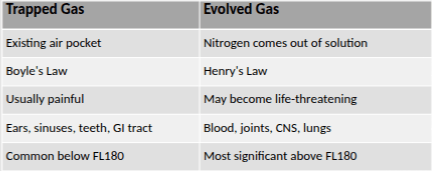
600
This condition is caused by excessive CO2 loss.
What is HYPOcapnia?
*Hypocapnia is commonly caused by improper pressure breathing, anxiety/stress, and hypoxia (air hunger and faster rate of breathing)*
600
This gas law explains gas behavior in cold aircraft.
What is Charles Law?
(V1 / T1) = (V2 / T2)
*Volume varies proportional to temperature; gases expand when heated, and contract when cooled.*
600
Vertigo, confusion, vision changes and a headache are common symptoms of this kind of DCS.
What is CNS DCS in the brain?
600
This is the last resort remedy for in-flight ear blocks.
What is vasoconstrictor spray?
600
These are symptoms of acclimatization.
What is hyperventilation, shortness of breath, sleep disruption, and increased urination?
600
Cyanosis, belligerence, and an increased rate of respiration are this kind of hypoxia symptoms.
What are objective symptoms?