Graph ME
Solve ME
Change ME
What about ME
Miscellaneous ME
100
Write an absolute or compound inequality for the graph. 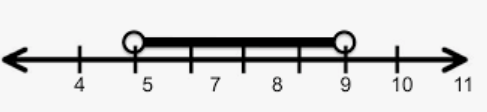
|x - 7| < 2
5<x< 9
x >5 ; x < 9
100
Solve the multistep problem.
3(7x - 4) + 10 = 10x + 7 + 8x
x =3
100
Simplify the expression and write your final answer in standard form.
5x^2+3x-2(x - 6)+3x^2
8x^2+ x+12
100
What is the following expression equal to?
i^31
-i
100
What would be the end behavior of the following polynomial?
f(x) = -2x^5 + 3x^4 - 7x^2 - 11
Up/Down
200
Write the equation of the line graphed in slope-intercept form.
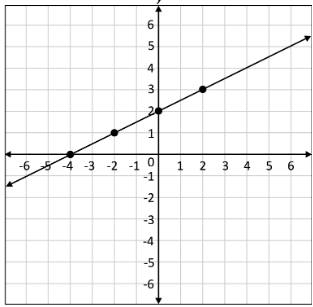
y = 1/2x + 2
200
Solve the absolute value. Remember there are two answers.
|x - 4| + 3 = 8
x = 9 " & " x = -1
200
Simplify the expression. Write your final answer as
a + bi
2i(6 + 8i)
-16 + 12i
200
The following are examples of what type of numbers?
pi, sqrt5, 6.37926...
Irrational numbers
200
What are the roots of the polynomial?
f(x) = x(x - 4)(x + 6)(x - 1)^2
x = 0, " " x = 4, " " x = -6, " " x = 1
300
What is the vertex of the quadratic when graphed?
y = -3(x + 7)^2 - 11
( -7, -11)
300
Solve the inequality.
6 - 3y >=2y + 1
y <= 1
300
Write the equation in slope-intercept form.
5x - 2y = 12
y = 5/2x-6
300
Name the parent function for the given equation.
f(x) = sqrt(x + 3)
Square Root Function
300
Describe the transformation of the parent function.
f(x) = -|x - 3| + 6
Absolute Value that is 1st Reflected down, 2nd shifted right 3, 3rd shifted up 6.
400
What is the solution of the systems given in the graph?
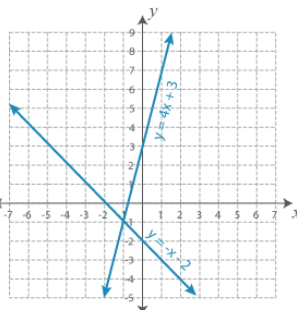
y = 4x + 3 ; y = -x - 2
(-1, -1) or x = -1; y = -1
400
Solve the linear system algebraically.
y = 3x
2x + 4y = -28
x = -2; " "y = -6; " "(-2, -6)
400
Multiply the binomials. Write your answer in Standard Form.
(2x + 3)(x - 7)
2x^2 - 11x - 21
400
What is the Quadratic Formula?
x = (-b +- sqrt(b^2 - 4ac)) / (2a)
400
Given:
f(x) = x + 3
g(x) = 5x - 7
Find:
(f+ g)(2) =
(f+ g)(2) = 8
500
Graph a sketch of the following graph using its degree and leading coefficient.
f(x) = -4x^5+3x^2 + 11
Answers vary. One example:
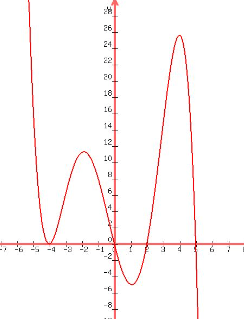
500
Solve the quadratic equation.
x^2- 2x-15 = 0
x = 5," " x = -3
500
Factor the Trinomial.
x^2+14x+33
(x + 11)(x + 3)
500
Are the following lines Parallel, Perpendicular, or Neither?
y = 3x - 5
y = 1/3x - 5
Neither
500
x and y have an inverse variation, if when x = 1, y = 10 find y when x = 2?
y = 10/x
y = 10/ 2 = 5