Elements
Isotopes
Acids/Bases/Solutions
pH
Bonds
100
Which 4 elements make up approximately 96% of living matter?
Carbon, Hydrogen, Oxygen, and Nitrogen
100
One difference between carbon-12 and carbon-14 is that carbon-14 has...
two more neutrons than carbon-12
100
A strong acid like HCl ionizes (completely/incompletely) in an aqueous solution.
completely
100
Which of the following solutions would require the greatest amount of base to be added to bring the solution to neutral pH?
a. gastric juice at pH 2
b. vinegar at pH 3
c. tomato juice at pH 4
d. black coffee at pH 5
a. gastric juice at pH 2
100
A covalent chemical bond is one in which
outer-shell electrons of two atoms are shared so as to satisfactorily fill the outer electron shells of both atoms.
200
Why makes each element unique and different from other elements?
Each has a specific number of protons (its own number of protons that no other element contains)
200
The atomic number of nitrogen is 7. Nitrogen-15 is heavier than nitrogen-14 because the atomic nucleus of nitrogen-15 contains how many neutrons?
8
200
Name a strong base (alkali) that ionizes completely in solution.
(KOH)
(NaOH)
(Ba(OH)2)(CsOH) (Sr(OH)2) (Ca(OH)2)(LiOH)(RbOH)
200
How do buffer solutions function? What is their job?
They maintain a relatively constant pH when either acids or bases are added to them.
200
What results from an unequal sharing of electrons between atoms?
a polar covalent bond
300
The atomic mass is...
the number of protons plus neutrons
300
Which of the following best describes the relationship between these atoms?
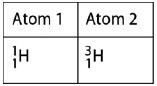
isotopes
300
A 0.01 M solution of a substance has a pH of 2. What can you conclude about the strength of this substance, whether it is an acid or base, and how it will ionize in water?
It is a strong acid that ionizes completely in water.
300
Carbon dioxide (CO2) is readily soluble in water, according to the equation CO2 + H2O ↔ H2CO3. Carbonic acid (H2CO3) is a weak acid.
If CO2 is bubbled into a beaker containing pure, freshly distilled water, what happens to the pH?
It lowers
300
What is the difference between covalent bonds and ionic bonds?
Covalent bonds involve the sharing of electrons between atoms; ionic bonds involve the electrical attraction (giving/receiving electrons) between atoms.
400
In what way are elements in the same column of the periodic table the same?
Same number of valence electrons
400
The molar mass of glucose (C6H12O6) is 180 g/mol. What procedure should you carry out to make a 0.5 M solution of glucose?
Dissolve 90 g of glucose in a small volume of water, and then add more water until the total volume of the solution is 1 L.
400
Carbon dioxide (CO2) is readily soluble in water, according to the equation CO2 + H2O ↔ H2CO3. H2CO3 is a weak acid. Respiring cells release CO2 into the bloodstream. What will be the effect on the pH of blood as that blood first comes in contact with respiring cells?
Blood pH will decrease slightly.
400
The slight negative charge at one end of one water molecule is attracted to the slight positive charge of another water molecule. What is this attraction called?
hydrogen bond
500
The nucleus of a nitrogen atom contains 7 neutrons and 7 protons. What is the atomic number and mass number?
7; 14
500
The molar mass of glucose is 180 g/mol. What procedure should you carry out to make a 1 M solution of glucose?
Dissolve 180 g of glucose in 0.8 L of water, and then add more water until the total volume of the solution is 1 L.
500
One of the buffers that contributes to pH stability in human blood is carbonic acid (H2CO3). Carbonic acid dissociates into a bicarbonate ion (HCO3-) and a hydrogen ion (H+).
H2CO3 ↔ HCO3- + H+
If the pH of the blood increases, one would expect the levels of H2CO3 and HCO3- to change how?
a decrease in the concentration of H2CO3 and an increase in the concentration of HCO3-.
500
In a single molecule of water, two hydrogen atoms are bonded to a single oxygen atom by
polar covalent bonds or just covalent bonds