Limits
Derivatives
Integral
Pictures
Hodge Podge
100
lim_(x->2)x^2+3
7
100
d/dx(x^3+x^2-x+sqrtx)
3x^2+2x-1+1/(2sqrtx)
100
int (3x^2+8x-1) \ dx
x^3+4x^2-x+C
100
Where does f(x) have a relative maximum given the graph of f'(x) below?
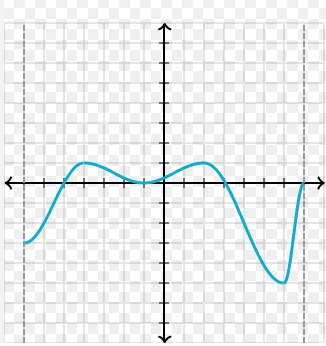
x = 3
100
If v(t) = 3t^2+2t, find s(t) if s(1)=4
s(t)=t^3+t^2+2
200
lim_(x->oo)(x^3+7x-1)/(6x^3-17x+2
1/6
200
d/dxLn(10x^2+1)
(20x)/(10x^2+1)
200
d/dxint_5^(x^2)lntdt
2xlnx^2
200
Given the graph of f'(x) below, where is f(x) increasing? Why?
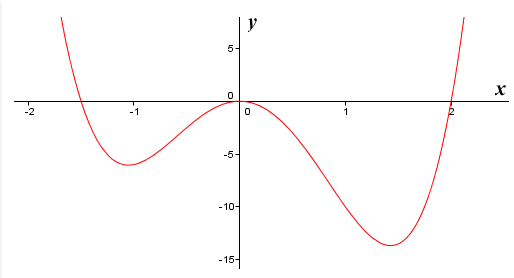
(-infinity, -1.5) and (2, infinity) because f'(x) is positive
200
If f is continuous and f(1)=8 and f(6)=-1, there is a value x = c that is between 1 and 6 where f(c)=2. What theorem is this referring too?
IVT (intermediate value theorem)
300
lim_(x->0)(4sinx)/(5x)
4/5
300
d/dx(e^xsinx)
e^xsinx+e^xcosx
300
int_1^2e^(4x)dx
1/4e^8-1/4e^4
300
Where is f(x) decreasing and concave up? Why?
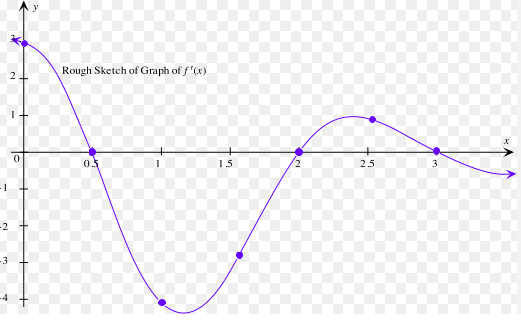
~(1.2, 2) since f' is negative and increasing
300
A sphere's radius is increasing at a rate of 3in/min. What is the rate of change of the volume of the sphere when radius =2in?
48pi or 150.796 in^3/min
400
lim_(x->-oo)(9x^3+2x-1)/sqrt(4x^6+6x-1
-9/2
400
d/dx(x^2/tanx)
(2xtanx-x^2sec^2x)/(tan^2x
400
int2x^4sin(x^5)dx
-2/5cos(x^5)+C
400
Given the following rule, find g(-2)
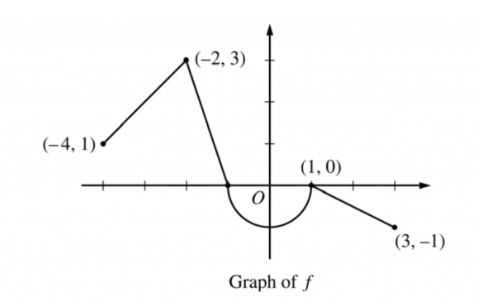
g(x)=int_1^xf(x)dx
pi/2-3/2
400
If f is a continuous and differentiable function and f(5) =10 and f(15)=7 what value of slope is guaranteed to occur somewhere between x=5 and x=15?
-3/10 (MVT)
500
lim_(x->0)(e^x-x-1)/(x^2)
1/2
500
d/dxcos^4(x^5)
-20x^4cos^3(x^5)sin(x^5)
500
intx^2e^xdx
x^2e^x-2xe^x+2e^x+C
500
Given the graph below, where does F(x) have an absolute max? Why?
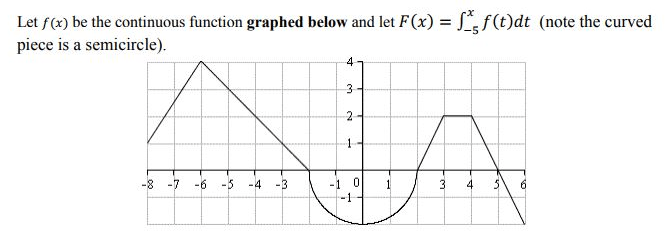
x=-2 since it has the large y-value (9/2)
500
int(-3x)/(x^2+3x+2)dx
3ln|x+1|-6ln|x+2|+c