Proteins
Carbohydrates
Nucleic Acids
Lipids
Chemistry
100
How do enzymes speed up activation energy?
They lower the activation energy needed for chemical reactions.
100
What is the atomic ratio for carbohydrates? (C, H, O)
1:2:1 ration
for every 1 carbon, 2 hydrogen, and 1 oxygen
Think about glucose! (C6H12O6)
100
What are the components of a nucleotide?
A pentose (5 carbon sugar), a phosphate group, and a nitrogenous base.
:max_bytes(150000):strip_icc()/what-are-the-parts-of-nucleotide-606385-FINAL-5b76fa94c9e77c0025543061.png)
100
What is monomer and polymer of lipids?
Trick question! Lipids don't have true monomers and polymers. Fatty acids are the building blocks, and they are linked to glycerol through ester linkages.
100
Is a hydrocarbon generally hydrophilic or hydrophobic and why?
It is hydrophobic because of weak electronegativity that creates nonpolar covalent bonds.
200
What is a prion?
Prions are proteins that cause disease. Prions are an abnormally folded protein that can promote abnormal folding in other proteins.
200
What is a glycoprotein and why is it labeled as a carbohydrate?
A glycoprotein is a protein with a sugar attached to it. It is labeled as a carbohydrate because it has a carbohydrate portion.
200
State which of these molecules is DNA and which is RNA, and explain why.
The molecule on the left is DNA (deoxyribonucleic acid) because it only contains 4 oxygen; it is deoxygenated. The molecule on the right is RNA (ribonucleic acid) because it contains 5 oxygen; it is fully oxygenated.
200
Why do fatty acids have more free energy than carbohydrates?
fatty acids contain more C-H bonds than carbohydrates
200

Would this molecule be considered hydrophilic or hydrophobic and why?
This molecule is hydrophobic because it contains a sulfhydryl group.
300
A protein contains many hydrophobic amino acids on one surface and many hydrophilic amino acids on the other. This protein is __________.
Amphipathic
300
What are the different types of carbohydrates?
Monosaccharides, disaccharides, and polysaccharides
300
Describe the direction that DNA strands run.
DNA strands run in opposite directions from 5' to 3' or 3' to 5'
300
What is the difference between a saturated and unsaturated fatty acid?
Saturated fats have no double bonds and are fully saturated with hydrogens. Unsaturated fats have double bonds and do not contain the maximum amount of hydrogens. 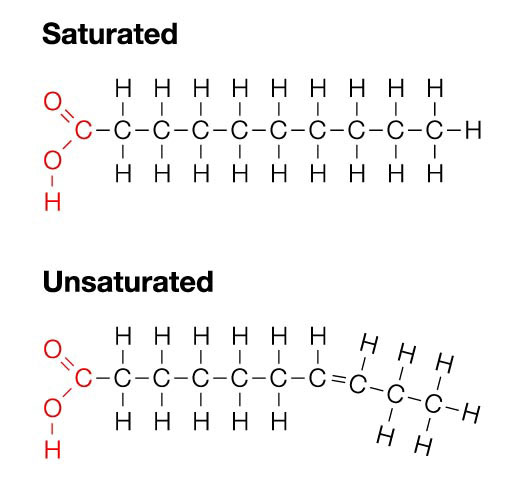
300
What does it mean to be hydrophilic vs hydrophobic?
Hydrophilic molecules are water loving and hydrophobic molecules are water hating
400
An enzyme contains A>B>C>D
D binds to the enzyme near the beginning of the pathway (NOT the active site) and reduces its activity. What is this mechanism called?
Allosteric inhibition
400
Where do you find alpha glycosidic linkages?
Starch and glycogen
400
What are the similarities and differences between DNA and RNA?
Both are nucleotides with a sugar phosphate backbone. DNA is double stranded, while RNA is single stranded. DNA has the base T, while RNA has the base U.
400
What is a trans fat?
Trans fats are unsaturated and have at least one trans configuration
400
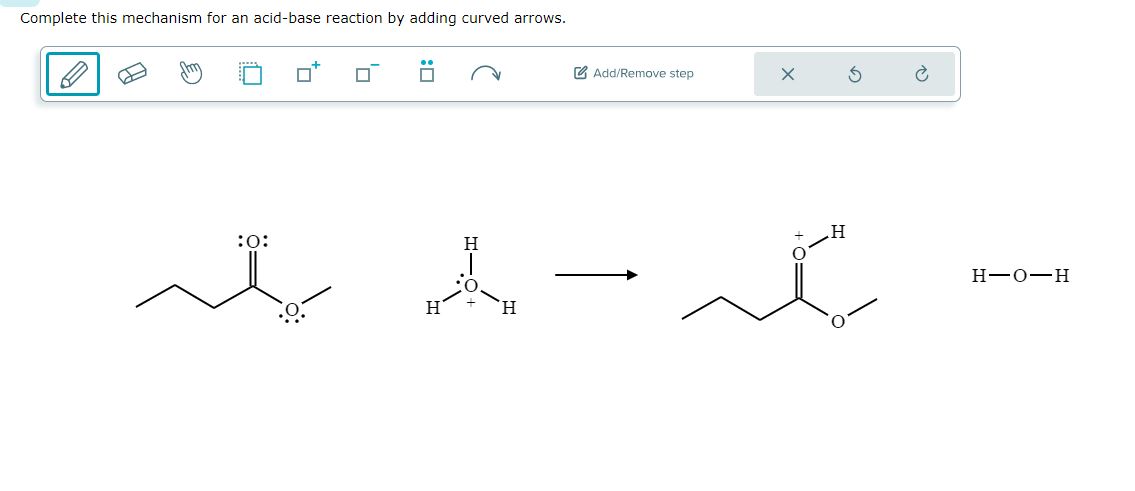 Which molecule in this reaction is the acid and which is the base?
Acid - H3O+
Base - C5H10O2
500
Write on the whiteboard the four parts of an amino acid.

500
Compare starch, glycogen, and cellulose. For each, state where it is found, whether it is used for structure/storage, the significance of the glycosidic linkages, and how branching affects its function.
Starch: found in plants, used for storage, alpha linked glucose, compact structures
Glycogen: found in animals, used for storage, alpha linked glucose (rapid release because it is highly branched)
Cellulose: found in plants, used for structure, beta linked glucose, produces strong, strait fibers
500
You are given a DNA strand: 5' ATGCCGTA 3'
What is the complementary strand? Then, identify the purines, pyrimidines, # of G-C hydrogen bonds, and # of A-T hydrogen bonds.
Complement strand: 3' TACGGCAT 5'
Purines: A and G
Pyrimidines: T and C
12 G-C H bonds, 8 A-T H bonds
500
What are the four types of lipids and what are their characteristics?
Triglycerides (energy), phospholipids (membranes), steroids (hormones), and waxes (waterproofing)
500
Draw an example of each of the 6 functional groups on the white board
Carboxyl
Sulfhydryl
Amino
Carbonyl
Hydroxyl
Phosphate