Proteins
More proteins :)
Nucleic Acids
Carbs/Lipids
MISC
100
Draw the basic structure of an amino acid. Also, how many common amino acids exist?
*20 common amino acids that differ by R-group*
Amino Acid = 1 carboxyl group (COOH), 1 amino group (NH2), R group, Hydrogen, & alpha carbon
100
Name the 3 components of a nucleotide
1) a sugar (ribose = RNA, deoxyribose = DNA)
2) a phosphate group
3) A nitrogenous base (A,G,U,C in RNA ; A,G,T,C in DNA)
100
What is the basic formula for a carbohydrate? What types of bonds hold polysaccharides together?
1) (CH2O)n
2) glycosidic bond
100
Name the monomer & polymer for the 4 basic macromolecules
1) Proteins: amino acids ---> proteins (aka polypeptides)
2) Nucleic Acids: nucleotides --> nucleic acids (DNA or RNA)
3) Carbohydrates: monosaccharides ---> polysaccharides
4) Lipids (saturated vs unsaturated)... NO true monomer/polymer relationship
200
Name 4 of 6 crucial tasks performed by proteins that allow cells to exist
1) CATALYSIS: enzymes speed up chemical rxns
2) DEFENSE: antibodies & complement proteins attack pathogens
3: MOVEMENT: motor & contractile proteins move the cell or molecules within the cell
4) SIGNALING: proteins convey signals between cells
5) STRUCTURE: structural proteins define cell shape & comprise body structures
6: TRANSPORT: transport proteins carry materials; membrane proteins control molecular movement into/of out the cell
200
There are 2 types of REVERSIBLE enzyme inhibitors: Competitive inhibitors and NON-competitive inhibitors. What is the difference between them?
1) COMPETITIVE inhibitors:
-look similar to substrate
-compete with substrate for active site
-adding substrate CAN overcome inhibition
2) NON-competitive inhibitors:
-NO similarity to substrate
-do NOT bind at active site, but still change shape of active site
-adding substrate CANNOT overcome inhibition
200
Which nitrogenous bases are pyrimidine bases, which are purine bases? Why is this differentiation important (what binds with what)?
1) Pyrimidine bases: Thymine, Cytosine, Uracil
2) Purine bases: Adenine, Guanine
3) Purine bases bind to pyrimidine bases (C-G; A-T/A-U); important because only Purine-Pyrimidine pairs fit inside double helix (maximizes H-bonding)
200
What are 2 important functions of polysaccharides?
1) FUEL STORAGE: sugar is stored as starch in plants & as glycogen in animals
2) STRUCTURAL INTEGRITY:
-cellulose component of plant cell walls
-chitin component of insect exoskeletons and fungal cell walls
-peptidoglycan component of bacterial cell walls
200
Which bond is stronger? Adenine to Thymine, or Cytosine to Guanine? Why?
C-G because it is composed of 3 hydrogen bonds; more H-bonds = more stability (A-T only has 2 H-bonds)
300
FILL IN THE BLANK:
1) ______ R-groups: ______, do NOT form hydrogen bonds; ______ in water
2) _____ R-groups: hydrophilic, ______ hydrogen bonds; readily _____ in water
3) Amino acids with hydroxyl, amino, carboxyl, or sulfhydryl functional groups in their side chains are ______ chemically _______ than those with side chains composed of only carbon + hydrogen atoms.
1) NONPOLAR R-groups: HYDROPHOBIC, do NOT form hydrogen bonds; coalesce (do NOT mix) in water
2) POLAR R-groups: hydrophilic, FORM hydrogen bonds; readily DISSOLVE in water
3) Amino acids with hydroxyl, amino, carboxyl, or sulfhydryl functional groups in their side chains are MORE chemically REACTIVE than those with side chains composed of only carbon + hydrogen atoms.
300
Describe the 3 determinants of protein structure
1) PRIMARY STRUCTURE (sequence of amino acids)
--> certain amino acids promote/disrupt secondary, tertiary, & quaternary structure
2) CELL ENVIRONMENT:
a) temperature b) salts (ions) c) pH
3) CHAPERONE FOLDING AIDS: assist in folding other proteins by creating a sheltered environment to allow protein to adopt specific configuration
300
A DNA molecule is composed of 30% Thymine nitrogenous bases. What percentage of Guanine is the molecule comprised of?
Chargaff's Rules: [A] = [T] ; [C] = [G]
[T] = 30% ; [A] = 30%
100%-60% = 40% / (2) = 20% = [C] = [G]
300
Definitions! Define a....
1) Fatty Acid
2) Saturated fat
3) Unsaturated Fat
4) Fat (aka "triglyceride molecule")
1) Fatty Acid: "a hydrocarbon chain bonded to a carboxyl (COOH) group; the building blocks of lipid synthesis"
**the LENGTH of the fatty acid determines its melting point**
2) Saturated fat: "NO double bonds; SOLID at room temperature"
3) Unsaturated Fat: "HAS double bonds; LIQUID at room temperature"
4) Fat (aka "triglyceride molecule"): glycerol + 3 fatty acid tails linked together via ESTER LINKAGES
300
The extracellular/intracellular domain of an integral/transmembrane protein must be _______, while its transmembrane domain must be _______.
The extracellular/intracellular domain of an integral/transmembrane protein must be HYDROPHILIC (polar), while its transmembrane domain must be HYDROPHOBIC (nonpolar).
400
I will draw 4 amino acids on the board (Methionine, Histidine, Glycine, Glutamic acid). Are they non polar or polar amino acids? Why?
1) Methionine-- nonpolar
2) Histidine-- polar
3) Glycine-- nonpolar *special case*
4) Glutamic Acid-- polar
400
Draw a graph comparing a noncompetitive inhibitor and competitive inhibitor to a normal enzyme
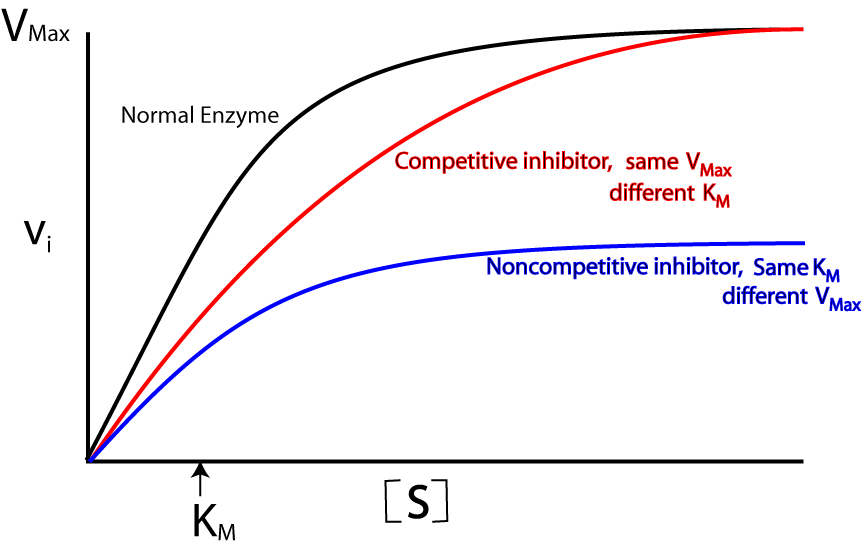
400
The 5' end of a polynucleotide strand has a _____ _____, while the 3' end of a polynucleotide has a _____ ______.
The 5' end of a polynucleotide strand has a PHOSPHATE GROUP, while the 3' end of a polynucleotide has a HYDROXYL GROUP.
400
What is a phospholipid? What kind of characteristics does it have?
Phospholipid: "similar to a triglyceride, but replaces one fatty acid with a phosphate-containing compound; has a POLAR head and NON-polar tail"
-amphipathic (contains both hydrophilic and hydrophobic regions!)
-MAJOR component of MEMBRANES! (phospholipid bilayer)
400
Explain hypertonic vs. hypotonic vs. isotonic environments
Hypertonic: cell shrinks
Hypotonic: cell swells
Isotonic: no change
500
Describe how a condensation reaction and a hydrolysis reaction occur on whiteboard (hint: condensation = "dehydration" ; hydrolysis = "hydration").
What type of bond is being made/destroyed in these reactions (think proteins)?
1) Condensation/dehydration: monomer --> polymer + loss of H2O *MAKING bond*
2) Hydrolysis/hydration: polymer + H2O --> monomer *BREAKING bond*
3) PEPTIDE BONDS (type of covalent bond)
500
Name & describe the 4 types of protein structure :)
(hint: be sure include bond types)
1) primary: linear sequence of amino acids held together by covalent peptide bonds
--> PRIMARY dictates protein FOLDING which determines PROTEIN FUNCTION
2) secondary: generate alpha helices/ beta-pleated sheets; interactions between carbonyl & amide groups in backbone
--> dependent on primary structure
--> HYDROGEN BONDING INCREASES stability & holds secondary structure together
3) tertiary: SINGLE polypeptide chain with 1+ secondary structures; overall 3D shape of polypeptide formed
--> held together by H-bonds, van der waals, covalent, & ionic bonds
--> held together by interactions in atoms in R groups/between R groups and polypeptide backbone
4) quaternary: MORE than 1 polypeptide chain interacting to form a single structure
--> held together by H-bonds, van der waals, covalent, & ionic bonds
500
Random fun facts!
1) A lipid bilayer with ____ unsaturated fatty acids will have a _____ permeability.
2) Cholesterol is __(polar/non-polar/amphipathic)___. Cholesterol is an important component of _______ membranes and is a type of _____. At ___ temperatures, cholesterol ______ fluidity by preventing _____ from packing together tightly.
3) _____ membrane proteins are partially or entirely located within a membrane, while _____ membrane proteins are associated with the internal/external side of the membrane.
1) A lipid bilayer with MANY unsaturated fatty acids will have a HIGHER permeability. (easier to move through)
2) Cholesterol is AMPHIPATHIC. Cholesterol is an important component of ANIMAL membranes and is a type of STEROID. At LOW temperatures, cholesterol INCREASES fluidity by preventing PHOSPHOLIPIDS from packing together tightly.
3) INTEGRAL membrane proteins are partially or entirely located within a membrane, while PERIPHERAL membrane proteins are associated with the internal/external side of the membrane.
500
Describe (movement of molecules, energy required, saturable?)...
1) Simple diffusion
2) Facilitated diffusion
3) Osmosis
4) Active Transport
1) Simple diffusion: "PASSIVE transport; movement of molecules DOWN concentration gradient; NO energy required; NOT saturable"
2) Facilitated diffusion: "PASSIVE transport; movement of molecules DOWN concentration/electrochemical gradient w/ aid of transport proteins; NO energy required; YES, saturable"
3) Osmosis (type of facilitated diffusion): "PASSIVE transport; water moves across membranes via aquaporins; movement of molecules DOWN concentration/electrochemical gradient w/ aid of transport proteins; NO energy required; YES, saturable"
4) Active Transport: "movement of molecules across membrane AGAINST a concentration gradient with the aid of transport proteins; REQUIRES energy; YES saturable"