Enzymes/Chemical Reactions
Macromolecules
Macromolecule Functions
Macromolecule Elements
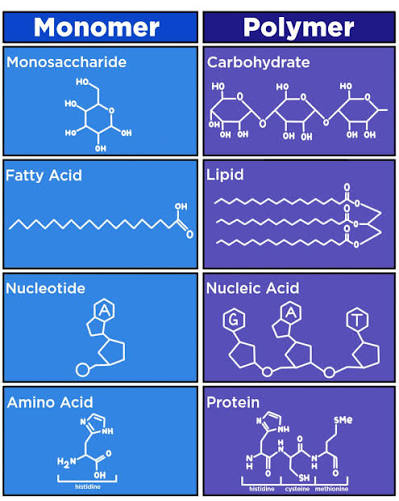
Monomers & Polymers
100
What is it called when an enzyme meets up with its substrate?
Enzyme-substrate complex
100
What are the 4 types of macromolecules?
Lipids, Carbohydrates, Nucleic Acids, and Proteins
100
What is a protein's functions in the body?
Perform functions, structure, transportation
100
Carbohydrates are composed of what elements?
Carbon, Hydrogen, Oxygen (CHO)
100
Lipids
Fatty acids
200
Exothermic reaction
Releases energy (The reactants have more energy than the products)
200
Examples of proteins
Meats, beans, nuts, enzymes
200
What is a lipid's function in the body?
Energy storage, forms cell membranes, body insulation.
200
Proteins are composed of what elements?
Carbon, Hydrogen, Nitrogen, Oxygen (CHNO)
200
Nucleic Acids
 Nucleotide
300
Endothermic Reaction
Absorbs energy. (The reactants have less energy than the products)
300
Example of lipids
Fats, oils, cheese, butter
300
What is a carbohydrate's function in the body?
It's the primary source of energy for organisms
300
Lipids are composed of what elements?
Carbon, Hydrogen, Oxygen (CHO)
300
Carbohydrates
 Monosaccharide
400
What is activation energy?
The energy needed by the reactants in order to start a reaction.
400
Example of nucleic acid
DNA and RNA
400
What is nucleic acid's function in the body?
Storing and transmitting instructions to make proteins
400
Nucleic acids are composed of what elements?
Carbon, Hydrogen, Nitrogen, Oxygen, Phosphorus (CHNOP)
400
Proteins
 Amino Acid
500
What suffix do enzymes usually have.
ASE
500
Example of carbohydrates
Sugars (glucose), grains, potatoes, fruits
500
Monomer & polymer meaning
Mono- One
Poly- Many
500
Most organisms are composed of what six elements?
Carbon, Hydrogen, Nitrogen, Oxygen, Phosphorus, Sulfur (CHNOPS)
500
POLYMERS: Protein, Lipids, Carbohydrates, Nucleic acid
MONOMERS: Amino acid, Nucleotide, Fatty acid, Monosaccharide