Scientific Reasoning
Atoms and Bonds
Properties of Water
Nucleic Acids
DNA
100
What is the difference between a hypothesis and a prediction?
A hypothesis is a proposed explanation for something. A prediction is a specific outcome that should happen if the hypothesis is correct. In an "if...then..." statement, the hypothesis is the "if" part and the prediction is the "then" part.
100
What is the positively charged particle found in the nucleus of an atom?
A proton.
100
What are the properties of water?
Hint: there's 4 we talked about
Universal solvent, high heat capacity, adhesion, and cohesion.
100
What is a nucleotide?
The monomer that links together to build nucleic acids like DNA and RNA.
100
In DNA, what base does adenine always pair with? How about guanine?
Adenine pairs with thymine, while guanine pairs with cytosine.
200
What are the steps of the scientific method?
1. Observation
2. Research
3. Hypothesis
4. Experiment
5. Conclusion
6. Communicate
200
What do you call it when two or more atoms are held together by chemical bonds?
A molecule.
200
What does it mean for a molecule to be hydrophilic?
It's polar or charged, so it interacts favorably with water (it's "water-loving").
200
What are the three building blocks of a nucleotide?
A sugar, phosphate group, and nitrogenous base.
200
What base replaces thymine in RNA?
Uracil.
300
What is the difference between the treatment/experimental group and the control group?
The treatment group experiences the condition being tested/manipulated. The control group experiences the unmanipulated/standard condition and serves as a baseline, so researchers can tell whether the treatment actually caused a difference.
300
What is electronegativity?
An atom's ability to pull the shared electrons in a covalent bond toward itself.
300
What does the pH scale actually measure?
How acidic or basic a solution is, based on the concentration of hydrogen ions. It runs from 0 to 14, 0 being acidic and 14 being basic/alkaline.
300
What links nucleotides together to form the "backbone" of a nucleic acid strand?
A bond between the phosphate group of one nucleotide and the sugar of the next nucleotide.
300
What does it mean that DNA's two strands are antiparallel?
The two strands run in opposite directions. One runs 5′ to 3′, while the other runs 3′ to 5′.
400
A gardener proposes this hypothesis: "My tomato seeds failed to sprout because the universe wasn't ready for them to grow yet." What is wrong with this hypothesis?
It cannot be tested or falsified. There's no way to measure or observe "the universe being ready".
A more sound version of this hypothesis would be something along the lines of, "My tomato seeds failed to sprout because they did not receive enough water".
400
In a covalent bond between carbon and oxygen, which atom ends up with a partial negative charge, and why?
Oxygen, because it's more electronegative than carbon, so it pulls the shared electrons closer to itself.
400
Why do coastal areas tend to have milder climates than places further inland?
Water has a high heat capacity, meaning it takes a lot of energy before its temperature can rise. Land absorbs heat quickly, making it hotter, but water stays relatively cool.
400
Which sugar is found in DNA nucleotides, and how does it differ from the sugar in RNA nucleotides?
DNA contains deoxyribose. RNA contains ribose, which is very similar but has one extra oxygen atom (hence DNA having the word "deoxy").
400
A sample of DNA is 30% adenine. What percentage is thymine, and what percentage is guanine plus cytosine combined?
Thymine is also 30%, since A pairs with T in equal amounts. That leaves 40% for guanine and cytosine combined.
500
Seedlings are grown under red, blue, green, and white light to test whether light color affects growth rate. If the hypothesis "light color affects growth" is correct, what pattern would you expect in the results? What would the null hypothesis predict instead?
If the hypothesis is correct, growth rate should differ across the light colors. If the null hypothesis is correct, growth rate should be about the same under all four light colors.
500
In a water molecule, do the hydrogen atoms have a partial positive or partial negative charge, and why?
Partial positive, because oxygen pulls the shared electrons away from the hydrogens.
500
How does a hydrogen bond actually form, and how is that different from how a covalent bond forms?
A hydrogen bond forms when a hydrogen atom that's already covalently bonded to an electronegative atom (like oxygen or nitrogen) is attracted to a partially negative atom (often oxygen or nitrogen) on a nearby molecule. It's an attraction between existing partial charges, not a new bond made of shared electrons. On the other hand, a covalent bond forms when two atoms actually share a pair of electrons between them.
500
Is DNA double-stranded or single-stranded? How about RNA?
DNA is double-stranded, while RNA is single-stranded.
500
Given the following DNA strand, what is the sequence of its complementary strand?
5′-A T G C C A-3′
3′-T A C G G T-5′
600
A student wants to test whether a new studying app improves grades. They have their roommate use the app this semester and compare that grade to the roommate's grade from last semester, when they didn't use the app. Is this a convincing experimental design? Why or why not?
It is not convincing. There's only one person and no control group tested at the same time without the app, and many other things could differ between semesters (harder or easier courses, more or less free time, etc.) besides just using the app.
600
A molecule has one C–H bond and one O–H bond. Which bond is polar, and why?
The O–H bond, because oxygen and hydrogen have a much bigger difference in electronegativity than carbon and hydrogen do (C–H is nonpolar).
600
Water molecules stick to each other and also stick to other surfaces, like the walls of a thin glass tube. What property of water is responsible for both of these behaviors?
Water molecules can bond to each other through hydrogen bonding (cohesion) and can also hydrogen bond to other surfaces (adhesion).
600
What overall shape does DNA typically form, and what shape can RNA fold into instead?
DNA forms a double helix. RNA, being single-stranded, can fold back on itself into a stem-loop structure.
600
What are the bonds between two nucleotides called?
Phosphodiester bonds/linkages.
700
 What conclusion does this chart support?
Responses will vary, but the chart supports the idea that Americans and nutritionists generally have similar ideas of what foods are healthy/unhealthy, bar a few outsiders.
700
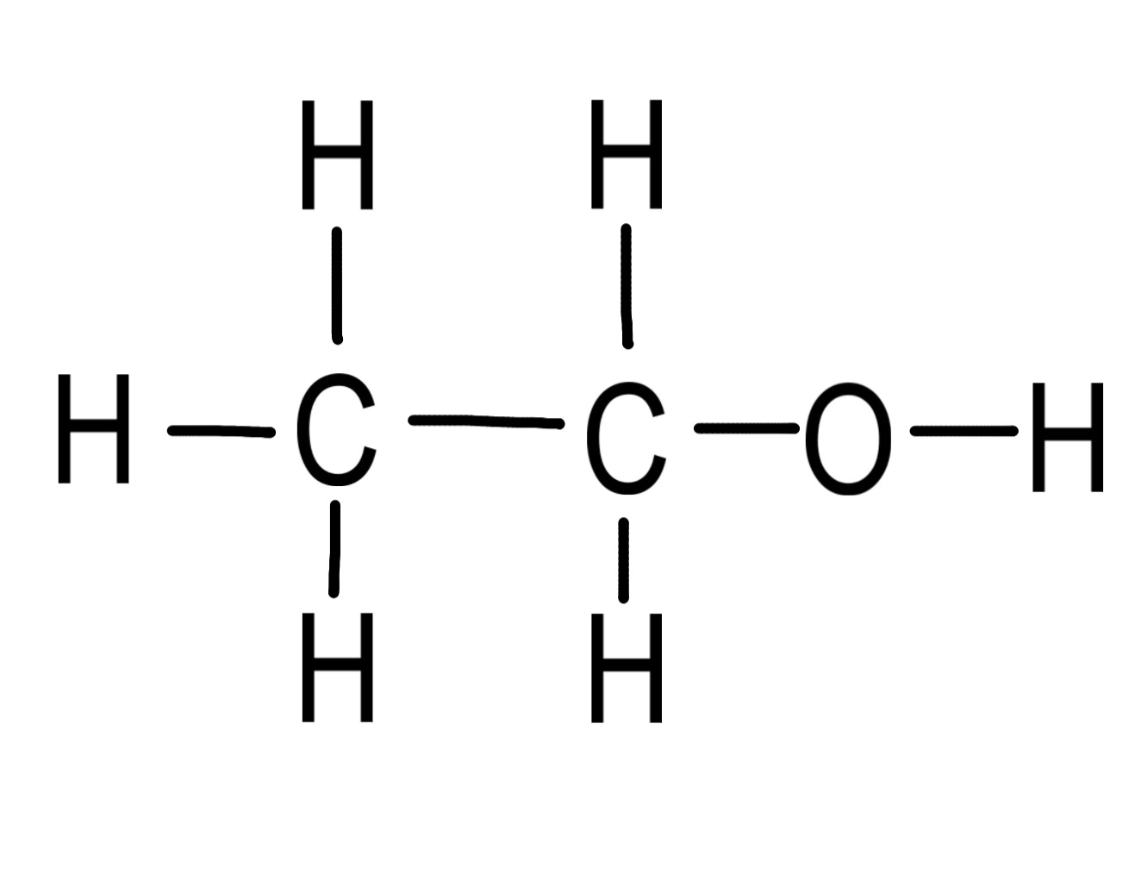 Could this molecule form a hydrogen bond with a nearby water molecule? Why or why not?
Yes. The hydrogen in the O-H bond carry a partial positive charge, so they can be attracted to the partially negative oxygen atom in water.
700
Molecule 1 has an –OH group. Molecule 2 is just a chain of carbon and hydrogen atoms with no charged or highly electronegative atoms. Which one dissolves better in water, and why?
Molecule 1: it is polar, and the OH group can form hydrogen bonds with water, making it hydrophilic. Molecule 2's nonpolar C–H bonds can't interact favorably with water, so it's hydrophobic.
700
Why do we say a nucleic acid strand has "polarity" (meaning its two ends are different from each other)?
Because one end of the strand has a free phosphate group (called the 5′ end) and the other end has a free hydroxyl (–OH) group (called the 3′ end), so the two ends are chemically different.
700
A double-stranded DNA molecule is 24% cytosine. What percentage of the molecule is guanine, adenine, and thymine?
Guanine is also 24%. That leaves 52% split evenly between adenine and thymine, so each is 26%.