Traits
Mitosis or Meiosis
DNA
Evolution
Natural Selection
100
Information held in DNA is used to make this
Protein
100
The division of cells into two identical cells is responsible for what process
Growth, healing, and replacing old cells
100
DNA is held in this part of the cell
Nucleus
100
The same or similar structures
homology
100
Natural selection resulting in both extreme traits
Disruptive selection
200
Transcribed DNA
RNA
200
The number of chromosomes in a mitosis daughter cell if the parent has 8 chromosomes
8 chromosomes
200
Condensed DNA
Chromosomes
200
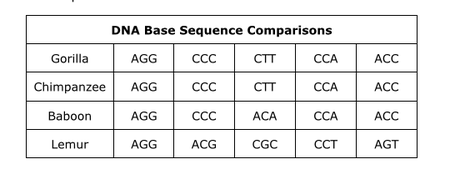
The two animals the most recent common ancestor
Gorilla and Chimpanzee
200
Natural selection resulting in one extreme trait
Directional selection
300
Translated RNA
Amino acid sequence (protein)
300
The result of meiosis
4 different daughter cells
300
The four nitrogenous bases
A, T, G, and C
300
Homology provides evidence for a relationship between organisms called this
Common ancestry
300
Selection resulting in the intermediate trait
Stabilizing selection
400
Proteins determine this
Traits
400
Homologous chromosomes switch DNA during this process
Crossing-over
400
The nitrogenous base not included in DNA
U
400
This is used to study the similarities in different species from long ago and to reveal links between species
Fossil record
400
The result of natural selection after many generations
Evolution
500
The term for proteins regulating which genes within a cell are activated and which are not
Differentiation
500
The number of chromosomes in a meiosis daughter cell if the parent has 8 chromosomes
4 chromosomes
500
The coding section of DNA
Gene
500
Similarities in this can identify common ancestry, such as a notochord, pharyngeal slits, or a postanal tail.
Embryos
500
An inherited characteristic that allows an organism to better survive
Adaptation