Questions 1-5
Questions 6-10
Questions 11 - 15
Questions 16 - 20
Questions 21 - 25
100
Adam is trying to identify a solid. He places a small amount of the substance in an acid solution and observes whether or not a reaction takes place. This test is based on a _______ property.
D. chemical
100
Maddie’s has a stomach ache and wants to take some Alka-Seltzer. What water temperature will help Mattie dissolve the Alka-Seltzer tablets faster so that she can take them as soon as possible?
C Hot water will allow the tablet to dissolve quicker by speeding up the reaction.
100
11. Michael mixes two chemicals together in a beaker. The chemicals change color, and the beaker heats up quickly. What kind of change most likely occurred?
C. A chemical change occurred
100
16. A substance is found to be reactive, flammable, soluble, and explosive. Which of these observations is a physical property?
D. soluble
100
21. Which statement describes a physical change?
C. Lead is heated and becomes more viscous.
200
A change of _________, such as a liquid changing to a gas, is an example of a physical change.
A. state
200
7. Cynthia is holding a sheet of paper that has a mass of 2 grams. She tears the sheet of paper into many small pieces. Which of the following is true?
The sum of the mass of all the pieces of paper is 2 grams.
200
Mrs. Andrews did a science demonstration with dry ice. First, she placed some dry ice inside of a balloon. Then she tied off the balloon and placed it on a triple beam balance. The balance showed that the combined mass of the balloon and dry ice was 22 grams. While the balloon sat on the balance, it began to expand. As the dry ice sublimed, or changed from a solid into a gas, the gas filled the balloon. When the dry ice had sublimated completely, how much mass was sitting on the balance and why?
A.
Exactly 22 grams because mass cannot be created or destroyed by ordinary physical changes.
200
17. The rate of the chemical reaction is almost always affected by temperature. Which of these is most likely to cause a reaction to slow down or take longer to develop?
B. Decreasing the temperature (making it colder)
200
22. Mario places 10 mL of water in a test tube and heats the liquid over a Bunsen burner for 2 minutes. After removing the test tube from the Bunsen burner, there are 6 mL of water left in the test tube. This experiment is a good example of a
B. physical change involving phase changes
300
3. If a solid that has a mass of 25 grams melts, it should result in a _______ with a mass of _______ grams.
C. liquid; 25
300
8. There are times when scientists will have different ideas about a scientific concept. These scientists will need to communicate among each other to resolve their differences. What might scientists do to come up with an acceptable resolution?
D. A group of scientists will attend a conference to debate and confirm their ideas
300
The process that changes a solid directly into a gas is called sublimation. A solid that begins with a mass of 450 g will sublime to give off a gas with a mass of _______ g.
B. 450
300
18. When substances go through chemical changes, which of the following will always happen?
C. One or more substances with different chemical properties will form.
300
23. Twenty-four grams of magnesium metal reacts with sixteen grams of oxygen gas to form magnesium oxide. According to the law of conservation of mass, how much magnesium oxide will there be after the chemical change is complete?
A. 40 g
400
4. If a bucket of ice was left outside on a hot day but brought inside before any evaporation occurred, how would the mass be affected?
A. The mass would not be affected
400
Sally's teacher tells her to find the masses of a sugar cube and a glass of water. Sally finds the masses to be 10 g for the sugar cube and 100 g for the glass of water. Then, the teacher tells her to put the sugar cube into the water. Sally puts the cube into the glass of water and watches as it dissolves. Then, the teacher tells Sally to estimate the new mass of the glass of sugar-water. What should Sally guess as the new mass of the glass of sugar-water?
A. 110 g
400
14. Methane is a colorless, odorless gas. It oxidizes in air and has a boiling point of -161° C. Which property of methane is a chemical property?
Oxidizes in air
400
19. A plant uses the energy from sunlight to create oxygen and glucose from carbon dioxide and water. Which statement is true about the changes that have occurred?
A. A chemical change has occurred because new compounds have been produced.
400
24. When plants and animals die, their bodies are decomposed by organisms such as bacteria or fungi. Which statement is true regarding the decomposition process?
B. Decomposition is a chemical change because the organism is broken down into new substances.
500
5. Eddie has a container of water. The water in the container has a mass of 25 grams. He places the container in the freezer and the water freezes. Which of the following is true?
B. The ice has a mass of 25 grams
500
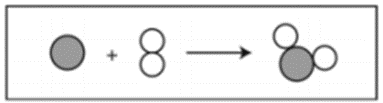
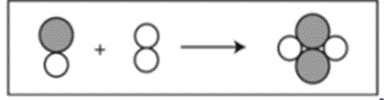
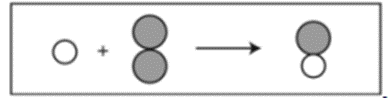
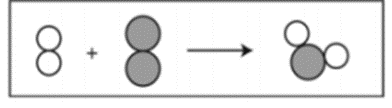
10. The law of conservation of mass can be demonstrated by a chemical reaction. Which of the following models of a chemical reaction best represents the law of conservation of mass?

500
15. Chris found when he added a certain chemical to water, the water would heat up. He then preformed an experiment in which he mixed different amounts of the chemical with water in a test tube and measured the temperature of the water. Which of these is a valid conclusion based on the results of Chris’ experiment
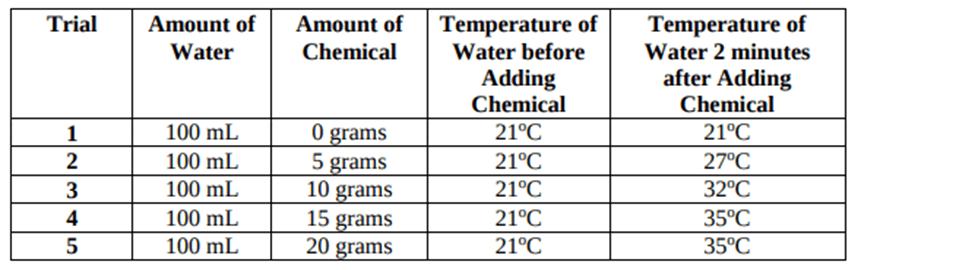
Adding more of the chemical will heat the water but only up to a certain temperature
500
20. Victor pours 100 grams of oil into a beaker filled with 1,000 grams of water. What is the total mass of his mixture?
A. 1,100 grams
500
Vincent combines sodium and chlorine in two different beakers (beaker X and beaker Y). In both beakers, the chemical reaction shown below occurs.
 If beaker X is kept at room temperature and beaker Y is placed in a refrigerator, then
The chemical change will occur faster in beaker X