3.1 Exponential Functions
3.2 Logarithmic Functions
3.3 Properties of Logarithms
3.4 Exponential and Logarithmic Equations
3.5 Exponential Growth & Decay; Modeling Data
100
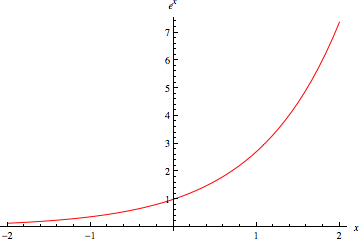
The graph of an exponential function f with base b approaches, but does not touch, the _____-axis. This axis, whose equation is _____, is a/an ________ asymptote.
What is y-axis, y=0, and horizontal asymptote?
100
Write the exponential equation mr = n in its equivalent logarithmic form.
What is logm n = r?
100
Use the properties of logarithms to expand the logarithmic expression as much as possible. When possible, evaluate without a calculator.
log4(64/y)
What is 3 - log4 y?
Because log4(64/y) = log4 64 - log4 y = 3 - log4 y
100
Expressing each side as a power of the same base and then equating exponents, the answer to 9x = 27.
What is 3/2 or 1.5?
9x = 27
(32)x = 33
32x = 33
2x = 3
x = 3/2 or 1.5
100
The formula t=(ln2)/k is used to find how long it will take a country's population to double, where t is the time in years and k is the growth rate. If a certain country's population is growing at a rate of 2.6% per year, the population will double in this many years.
What is about 26.7 years?
t = (ln 2)/k
t = (ln 2)/.026
t = 26.65950694 or about 26.7 years.
200
Describe the transformation of f(x) = 5x to the graph of g(x)= -5(x+3) - 4.
What is a horizontal shift left 3 units, a reflection across the x-axis, and a vertical shift down 4 units?
200
Write the logarithmic equation logz s = v in its equivalent exponential form.
What is zv = s?
200
Use the properties of logarithms to expand the logarithmic expression as much as possible. When possible, evaluate without a calculator.
log(base 5) root(3)((x^2y)/25
What is 
root(3)((x^2y)/25) =((x^2y)/25)^(1/3) = ((x^(2/3)y^(1/3))/25^(1/3)) = ((x^(2/3)y^(1/3))/(5^2)^(1/3))=
((x^(2/3)y^(1/3))/5^(2/3))
log5 x2/3 + log5 y1/3 - log5 52/3
2/3 log5 x + 1/3 log5 y - 2/3
200
Expressing each side as a power of the same base and then equating exponents, the answer to
8x+3 = 16x-1
What is 13?
8x+3 = 16x-1
(23)x+3 = (24)x-1
23x+9 = 24x-4
3x+9 = 4x-4
9=x-4
13 = x
200
The half-life of a certain substance is 500 years. If 22 grams is present now, ________ grams will be present in 40 years?
What is about 20.8 grams?
A = Aoekt *for half-life, the A will be 1/2 of Ao
(1/2)Ao = Aoekt
(1/2)22 = 22ekt
(1/2) = ekt *this will always be the formula for half-life. Now find k.
(1/2) = e (k * 500)
ln (1/2) = ln e 500k
ln 0.5 = 500k
(ln 0.5)/500 = k
k is approximately -0.0013862944
A = Aoekt
A = 22e(-0.0013862944 * 40)
A= 20.81326823 or about 20.8 grams
300
Using a compound interest formula, or
, solve the following problem.
Find the accumulated value of an investment of $8,000 at 2.1% interest compounded quarterly for 5 years.
What is $8,883.24?
A=8000(1+.021/4)^(4*5)=8883.244639
300
Evaluate each expression without using a calculator.
a. log2 64
b. log557
c. 10log 8.3
What is
a. 6 (because 2^6 = 64)
b. 7 (because the logbbx = x)
c. 8.3 (because 10log x = x)
300
Use properties of logarithms to condense each logarithmic expression. Evaluate without using a calculator when possible.
1/3[2 ln (x+5) - ln x - ln (x2-4)]
What is
lnroot(3)((x+5)^2/(x(x^2-4))?
1/3[2 ln (x+5) - ln x - ln (x^2-4)] =
1/3[ln (x+5)^2 - [ln (x) + ln (x^2-4)]] =
(1/3)ln (((x+5)^2)/(x(x^2-4))) = ln (((x+5)^2)/(x(x^2-4)))^(1/3) =
lnroot(3)((x+5)^2/(x(x^2-4))
300
Expressing your solution in exact logarithmic terms, the answer to the following exponential equation is ____.
52x+3 = 3x-1
What is
x = (ln3+3ln5)/(ln 3 -2 ln5)
52x+3 = 3x-1
ln 52x+3 = ln 3x-1
(2x+3) ln 5 = (x-1) ln 3
2xln5 + 3ln5 = xln3 - ln3
*now group all of the x's together on one side
2x ln5 - x ln3 = -ln3 - 3ln5 *factor out x next
x(2 ln5 - ln3) = -ln3 - 3 ln5
x = (-ln3-3ln5)/(2 ln5-ln 3)
x = (ln3+3ln5)/(ln 3 -2 ln5)
300
Use the equation A=1173.1e0.008t for India's population A, in millions, t years after 2010, to find when India's population will be 1377 million people.
What is the year 2030?
A=1173.1e0.008t
1377 = 1173.1e0.008t
1377/1173.1 = e^(0.008t)
ln (1377/1173.1) = ln e^(0.008t)
ln (1377/1173.1) = (0.008t)ln e
ln (1377/1173.1) = 0.008t
(ln (1377/1173.1))/0.008 = t
t =20, so 2010+20 = 2030
400
Using a compound interest formula, or
, solve the following problem.
Suppose that you have $12,000 to invest. Which invest yields the greater return over 3 years: 7% compounded monthly or 6.85% compounded continuously?
What is $12000 invested at 7% compounded monthly?
Monthly: Continuous:
12000(1+.07/12)^(12*3) = 14795.11
12000e^(.0685*3)=14737.67
400
Find the domain of the logarithmic function
f(x) = log(x2 -5x +6)
What is
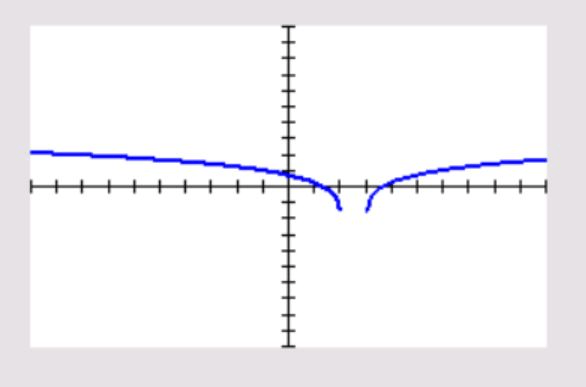 (- infty, 2) uu (3, infty)?
400
Let logb 2 = A and logb 3 = B and logb 5 = C. Write the expression in terms of A, B, and/or C for
logb 75
What is 2C + B?
logb 75 =
logb (25 *3) =
logb 25 + logb 3 =
logb 52 + logb 3 =
2 logb 5 + logb 3 =
2C + B
400
By solving the given logarithmic equation and rejecting any value of x that is not in the domain, the answer to
5 ln(2x) = 20.
What is (1/2)e4?
5 ln(2x) = 20
ln(2x) = 4
eln(2x) = e4
2x = e4
x = (1/2)e4
400
Newton's Law of Cooling: T = C + (To - C)ekt
The temperature of a heated object decreases exponentially over time towards the temperature of the surrounding medium.
T is the current temperature, C is the surrounding temperature, To is the initial temperature of the object, k is a negative constant, and t is the time in minutes.
A casserole, cooking at 400 degrees, was taken out of the oven and left to cool on the counter. The room has a temperature of 72 degrees. After 10 minutes, the casserole had cooled down to 375 degrees. State the model for the temperature of the casserole ,T, after t minutes, using Newton's Law of Cooling formula.
What is T= 72 + 328e-.00793t?
T = C + (To - C)ekt
375 = 72 +(400-72)ek*10
375 = 72 + 328e10k
303 = 328e10k
(303/328) = e10k
ln (303/328) = ln e10k
ln (303/328) =10k
[ln(303/328)]/10 = k
k is approximately -.0079280803, so the model would be T= 72 + 328e-.00793t.
500
India is currently one of the world's fastest-growing countries. The exponential function f(x) = 574(1.026)x models the population of India, f(x) in millions, x years after 1974. Find India's population, to the nearest million, in the year 2028.
What is 2295 million people?
2028 - 1974 = 54 years
f(54) = 574(1.026)54 = 2295.458124
500
The function f(x) = -3.52 ln x +34.5 models a wife's weekly housework hours, f(x), x years after 1964. Use this function to project a wife's weekly housework hours in 2025. Round to the nearest hour.
What is 20 hours?
2025 - 1964 = 61 years
f(61) = -3.52 ln(61) + 34.5 = 20.029724 or about 20 hours.
500
Let logb 2 = A and logb 3 = B and logb 5 = C. Write the expression in terms of A, B, and/or C.
log (base b) sqrt(8/45)
What is
log (base b) sqrt(8/45) =
log (base b)(8/45)^(1/2) =
(1/2) log (base b)(8/45) =
(1/2) [log (base b)(2^3)/(9*5)] =
(1/2)[log (base b)(2^3)/((3)^2*5)] =
(1/2)[log (base b)((2^3) - log (base b)((3)^2*5)] =
(1/2)[3log (base b)(2)-(log (base b)((3)^2 + log (base b)5)]=
(1/2)[3log (base b)(2)-log (base b) 3^2 - log (base b)5]=
(1/2)[3log (base b)(2)-2log (base b) 3 - log (base b)5]=
(3/2)log (base b)2 -log (base b) 3 - (1/2)log (base b)5=
(3/2)A-B-(1/2)C
500
By solving the given logarithmic equation and rejecting any value of x that is not in the domain, the answer to
log(3x-3) = log(x+1) + log 4
What is "no solution"?
log(3x-3) = log(x+1) + log 4
log(3x-3) = log [(x+1)(4)]
log (3x-3) = log(4x+4)
3x-3 = 4x+4
-3 = x+4
-7 = x, but -7 is not in the domain of the original problem so there is no solution.
500
Newton's Law of Cooling: T = C + (To - C)ekt
The temperature of a heated object decreases exponentially over time towards the temperature of the surrounding medium.
T is the current temperature, C is the surrounding temperature, To is the initial temperature of the object, k is a negative constant, and t is the time in minutes.
A casserole, cooking at 400 degrees, was taken out of the oven and left to cool on the counter. The room has a temperature of 72 degrees. After 10 minutes, the casserole had cooled down to 375 degrees. State the number of minutes it would take for the casserole to cool to 170 degrees.
What is 152 minutes?
T = C + (To - C)ekt
375 = 72 +(400-72)ek*10
375 = 72 + 328e10k
303 = 328e10k
(303/328) = e10k
ln (303/328) = ln e10k
ln (303/328) =10k
[ln(303/328)]/10 = k
k is approximately -.0079280803, so the model would be T= 72 + 328e-.00793t.
T= 72 + 328e-.00793t
170= 72 + 328e-.00793t
98 = 328e-.00793t
(98/328) = e-.00793t
ln(98/328) = ln e-.00793t
ln(98/328) = -.00793t
[ln(98/328)]/-.00793 = t
t is approximately 152 minutes.