Diffeq Warmup
Vector Calculus
Integration
Applications of Integration
100
The verification step showing
u(t) = 2 + Ce^(-t/5)
is the solution to the differential equation
u'(t) = 2/5 - 1/5u(t)
u'(t) = -C/5e^(-t/5)
2/5 - 1/5(2 + Ce^(-t/5)) = 2/5-2/5-C/5e^(-t/5)
2/5 - 1/5(2 + Ce^(-t/5)) = -C/5e^(-t/5)=u'(t)
100
The acceleration of a particle, at t=3 seconds, whose velocity at time t is given by
v(t) = langle 8t^3, t-2 rangle (ft)/s
a(1) = langle 216, 1 rangle (ft)/s^2
a(t) =v'(t) = \langle 24t^2, 1 \rangle (ft)/s^2
100
The formula for integration by parts, if
int u dv
uv - int vdu
100
The definite integral representation of the area of the region bounded above by
f(x) = 9 -(x/2)^2
and below by
g(x) = 6-x
int_(-2)^6 [(9 -(x/2)^2) - (6-x)] dx
Find where f(x) and g(x) intersect by setting f(x)=g(x) and solve for x.
200
The equilibrium solutions to the differential equation
(dP)/(dt) = (P+1)(e^(2-P)-1)
P=-1, P =2
(P+1)(e^(2-P)-1)= 0
P+1 = 0 \Rightarrow P = -1
e^(2-P)-1= 0 \Rightarrow P = 2
200
The integration technique used to integrate
int tln(t) dt
Integration by parts
u = ln(t)
dv = t dt
300
Correct labeling of the equilibrium solutions P=5, P=12, and P=102 given that
P'(2)>0
P'(8)>0
P'(14)<0
P'(2000)>0
P=5: semistable
P=12: Stable
P=102: Unstable
300
The speed of a particle, at t=1 seconds, whose velocity at time t is given by
v(t) = langle 8t^3, t-2 rangle (ft)/s
sqrt(65) (ft)/s
v(1) = \langle 8, -1\rangle (ft/s)
||v(1)|| = sqrt(8^2+(-1)^2)=sqrt(65)
300
Using substitution, what is the u and du for
int sin(x)cos(x) dx
u = sin(x), du = cos(x) dx
or
u = cos(x), du = -sin(x) dx
300
The definite integral representation of the mass of a 7 cm long wire where the wire density is represented by
rho(x) = (14x+1) g/(cm)
int_0^7 rho(x) dx = int_0^7 (14x + 1) dx
400
The arclength of a particle, between t=0 s and t=1 s, whose position at time t is given by
r(t) = langle cos(18t), sin(18t) rangle (ft)
18ft
\int_0^1 norm(r'(t))dt = int_0^1 norm(\langle -18sin(t), 18 cos(t) rangle)dt
int_0^1 sqrt(324(sin^2(t) + cos^2(t))) dt
int_0^1 sqrt(324) dt
400
The integration technique used to integrate
int (2t)/(t^2+1) dt
Substitution
u=t^2 + 1
du = 2t dt
400
The definite integral representation of the volume of a cone whose base has a radius of 5m and a height of 12m.
int_0^12 pi (-5/(12)x+5)^2 dx
500
The most accurate approximation of y(10) given that y(4) = 12, using the following table:
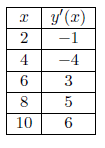
20
y(6) approx y(4) + hy'(4) = 12 + 2(-4) = 4
y(8) approx 4 + 2y'(6) = 10
y(10) approx 20
500
The integration technique used to integrate
int (4)/(4y - y^2) dy
Partial Fraction decomposition
(4)/(4y - y^2) = A/y + B/(4-y)
500
The definite integral representation of the hydrostatic force in the given image.
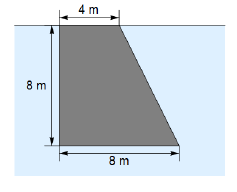
rho = 1000, g=9.8
int_0^8 9800x(4+x/2)dx