Limits
Derivatives
Integrals
Applications
100
lim as x approaches 3 of (x2-10)
What is -1
100
What is the derivative of x2 + x
d(x2+x)/dx = 2x + 1
100
The integral of x3 + 2x
1/4x4+x2+C
100
What is the first and second derivative of displacement?
velocity is the first and acceleration is the second derivative
200
The limit of 1/x as x approaches infinite
What is 0
200
d/dx cos(x2)=-sin(x2)2x
This process demonstrates which derivative rule?
the Chain rule
200
What is the difference between an indefinite integral and a definite integral?
An indefinite integral has no bounds or initial value, so its answer will be an expression with variables that must include the addition of a constant, C. A definite integral has bounds and can be evaluated for an exact number.
200
When do you know the an object is moving to the right and slowing down?
Velocity is positive and acceleration negative
300
Is 1/0 considered as indeterminate?
No
300
What is the derivative of lnx?
1/x
300
What is the integral from 7 to 7 of any function?
0 because there is no area between the same x value.
300
Find the area of the region bounded by y=2x+5, and y=x2+2x+1.
32/3
400
What is the name of the rule where you take the derivative of top and bottom of rational expression to find its limit?
L' Hospitals rule
400
What is the derivative of 2x2+3x+ex?
4x+3+ex
400
What is the integral of sin(x) + ex - 4
-cos(x)+ex-4x+C
400
A particle is moving along an axis. The velocity of a particle is modeled by the equation v(t)=3t2+7. If the particle's position on the x-axis is 3 at t=0, what is it's position at t=4?
At t=4, the particle's position is equal to 95.
500
Find the limit of (x2+7x+10)/(x+2) as x approaches -2.
The limit is 3
500
Fill in the blanks:
Derivatives represent the _______ rate of change, and the _________ of the tangent line at a given point on a function.
instantaneous, slope
500
Integrate the function f(x)=x2+(2/3)x on the interval [1,3]
34/3
500
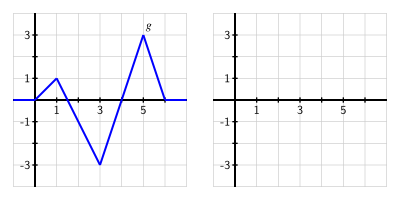
Find the integral of function g from 6 to 3 geometrically using the graph below.
-1/5