Limit Definition/Tangent and Normal Lines/Differentiability
Power Rule/Product Rule/Quotient Rule
Chain Rule/Multiple Rules
Higher Order Derivatives
Miscellaneous
100
Find the derivative using the limit definition!
f(x) = 6x2 + 15
f'(x) = 12x, but they must show the limit definition process!
100
Find the derivative of f(x) = 5/x3.
f(x) = 5x-3 so f'(x) = -15x-4.
100
Find the derivative of f(x) = 35x-cos(x)
f'(x) = 35x-cos(x)*ln(3)*5+sin(x)
100
Find the third derivative of f(x) = 7x2 + 5x - 30000
y' = 14x + 5
y'' = 14
y''' = 0
100
f(x) = 10x4 + x2 - 8. Find f'(2).
f'(x) = 40x3 + 2x
f'(3) = 40(2)3 + 2(2)
f'(3) = 40(8) + 4 = 320 + 4 = 324
200
Find the tangent line equation for f(x) at the point where x = 2.
f(x) = 3x3 - 4x2 + 5x
f'(x) = 9x2 - 8x + 5 and f'(2) = 36-16+5 = 25
f(2) = 24-16+10 = 18 so the slope is 25 at the point 2, 18. y = 25x + b and (18) = 25(2) + b so 18-50 = b and b = -32. Therefore, the final equation for the tangent line would be y = 25x - 32.
200
Find the derivative of f(x) = (-2x3)(ln(x)).
f'(x) = -2x3(1/x) + ln(x)(-6x2)
f'(x) = -2x2 - 6x2ln(x)
200
Find the derivative of f(x) = x2sin(2x)
f'(x) = 2x2cos(2x) + 2xsin(2x)
200
Find the third derivative of f(x) = 3ex
y' = 3ex
y'' = 3ex
y''' = 3ex
200
Find f'(x) if f(x) = 2x2(x2 + 8x) using the product rule, then find f'(x) using the power rule.
Product rule: 2x2 --> 4x and x2 + 8x --> 2x + 8
2x2(2x + 8) + 4x(x2 + 8x) = 4x3 + 16x2 + 4x3 + 32x2 = 8x3 + 48x2
Power rule: 2x2(x2 + 8x) = 2x4 + 16x3 --> 8x3 + 48x2 they are the same!
300
Find the normal line of f(x) where the x value is 0.
f(x) = -sin(x)
f'(x) = -cos(x) and f'(0) = -cos(0) = -1
f(0) = -sin(0) = 0 so the normal line slope is -1/-1 which is 1. So we have y = 1x + b and then 0 = 1(0) + b so b = 0. Therefore, the normal line would be y = x.
300
Prove the derivative of tan(x) using the quotient rule!
tan(x) = sin(x)/cos(x) and using the quotient rule, we have cos(x)*cos(x) + sin(x)*sin(x)/cos2(x) so we have cos2(x) + sin2(x)/cos2(x) and since sin2(x) + cos2(x) = 1, we have 1/cos2(x) = sec2(x)!
300
Find the derivative of f(x) = sin(ln(x2))
f'(x) = cos(ln(x2))*(1/x2)*(2x) = 2cos(ln(x2))/x
300
Find the acceleration function if s(t) = 5t3 + 2t
v(t) = 15t2 + 2t(log(2))
a(t) = 30t + 2t(log(2))(log(2))
300
Find the tangent line equation for f(x) through the point (2, 15) if f'(2) = -3.
y = mx + b
(15) = (-3)(2) + b
15 = -6 + b
21 = b
y = -3x + 21
400
What are the three reasons that a graph could be NOT differentiable and WHY?
Discontinuities: because the limit of the derivatives would be different on both sides and therefore the limit does not exist, so the derivative does not exist.
Sharp Corner or Cusp: Same idea!
Vertical Tangent: If there is a vertical tangent, that means that the slope at that point would be vertical. The slope of a vertical line is undefined, therefore the derivative would be undefined there/not exist!
400
If f(2)=−8, f′(2)=3, g(2)=17, and g′(2)=−4 determine the value of (fg)′(2).
(fg)'(2) = f(2)g'(2) + f'(2)g(2) = -8*-4 + 3*17 = 32 + 51 = 83.
400
Find the derivative of f(x) = (cos2x)/x
f'(x) = x*2cos(x)*-sin(x)-(cos2(x))*1/x2 = -xsin(2x)-cos2(x)/x2
400
If the position of a particle is represented by s(t) = sin(2x), find BOTH the velocity function AND the acceleration function.
v(t) = 2cos(2x)
a(t) = -4sin(2x)
400
Graph the derivative of this graph!

500
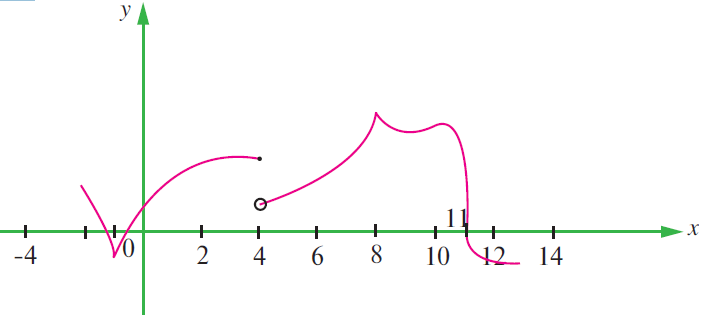 Identify the x values that are not differentiable on this graph and explain the reasoning!
x = -2 --> discontinuity
x = -1 --> sharp cusp
x = 4 --> discontinuity
x = 8 --> sharp cusp
x = 11 --> vertical tangent
x = 13 --> discontinuity
500
Find the derivative of √x/x-2.
x-21/2x-1/2-√x*-2x-3/x-4 = 1/2x-5/2 + 2x-5/2/x-4 = 2.5x-5/2/x-4 = 2.5x4/x5/2 = 2.5x3/2 = 2.5√x3
500
Find the derivative of f(x) = -3tan3(sin(x))
f'(x) = -9tan2(sin(x))*sec2(sin(x))*cos(x)
500
Find the 49th derivative of x50.
f49(x) = 50!x
500
Find f'(𝝅/2) if f(x) = tan(x)
f'(x) = sec2(x) = 1/cos2(x) = 1/cos2(𝝅/2) = 1/02 = 1/0 = UNDEFINED!!