Cardiac Conditions
OUCH I have chest pain
Drugs!? What do I give?!
yes or no
Final Round
100
What does ACS stand for?
ACS+ Acute Coronary Syndrome!
It is the clinical presentation of myocardial ischemia which includes ST-elevation myocardial infarction (STEMI), Non-ST elevation myocardial infarction (NSTEMI) and unstable angina
100
As per the chest pain pathway, Once a patient complains of chest pain, what amount of time does the ECG have to be reviewed within and by who?
10 mins by a senior MO
100
As per the Chest pain pathway, which drug and what strength should be given as an initial intervention?
Aspirin 300mg
100
Can you give opioid analgesia for a patient with chest pain?
Yes!
However, ensure to avoid sedation and respiratory depression
100
List 5 signs and symptoms of an ACS
1. Diaphoresis
2. Cool peripheries
3. Pale or grey in colour
4. N+V
5. Pain
6. Syncope
200
What are troponins and lactate?
Troponin is a protien found in skeletal and cardiac muscle. It is reposible for muscle contraction. This is a cardiac marker used to detect and measure heart muscle damage and severity of ACS.
Lactate or lactic acid is a substance produced by the body to generate energy under low oxygen conditions. HIGH lactate indicates metabolic stress, poor oxygen delivery , sepsis, ischemia or heart failure.
200
What are the first 4 initial nursing actions for a chest pain patient?
1. request and urgent medical review
2. A-E assessment including vital signs
3. Attach to CCM
4. Obtain ECG
200
What is GTN, why do we give it, and what is a side effect of GTN that required monitoring
GTN (Glycerol Trinitrate) is a vasodilator that relieves chest pain by reducing cardiac workload and increasing oxygen rich delivery to relieve ischemic chest pain.
GTN can REDUCE BP, due to its vasodilation properties, so blood pressure has to be monitored
200
Can we administer thrombolytics agents on the ward?
NO
200
What is considered elevated troponin?
High sensitivity test:
female normal= 16 ng/L
Male normal= 26ng/L
Highly abnormal= >40 ng/L
Standard sensitivity PoCT:
Normal= <0.04mcg/L
elevated=>0.04mcg/L
300
Name 4 INTRINSIC and 4 EXTRINSIC cardiac risk factors
INTRINSIC:
-High cholesterol
-smoking and/or vaping
-Physical inactivity
-Poor diet
-high alcohol consumption
-Obesity
-Poorly controlled blood pressure
EXTRINSIC:
-Age
-Gender
-Family history
-Ethnicity
300
What is the observation frequency for a patient what chest pain?
5 minutely until review
300
Why do we give antiplatelets? List 2 examples
Antiplatelets reduce risk of formulation of additional or worsening blood clots, reduce mortality and prevent re-infarction
EXAMPLES: Aspirin, clopidogrel, ticagrelor
300
Limb leads do not have to be used when monitoring the patient with a 12-lead ECG
NO
300
List 3 forms of imaging that can be obtained for a chest pain patient
1. CTPA
2. CXR
3. CT angiogram
400
PQRST is a common pain assessment used, what does each letter stand for?
P- Provocation: Identify what riggers or alleviates the pain. Ask the patient "what makes your pain worse?" or "Is there anything that helps/makes it feel better?"
Q- Quality: Ask the patient to describe what the pain feels like. Is the pain sharp? dull? constant? intermittent?
R- Radiation: determine the location of the pain and whether it spreads to other areas
S- Severity: Pain score out of 10
T- Timing: Examine when the pain started and its duration
400
As per the pathway, When should a troponin be tested?
At 0 and 2 hours
400
What are thrombolytics and when are they used?
Thrombolytics agents dissolve blood clots to restore blood flow to critical vessels.
These are used for: PE, DVT, Ischaemic stroke
400
Is Bilateral BP performed to rule out hypertension diagnosis?
NO!
it is used to assess for aortic dissection
400
Name the interval and polarisation complex of each coloured box 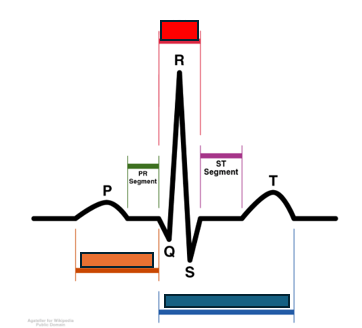
Orange= PR interval: ARIAL DEPOLARIZATION of atria and delay of AV node to allow for filling of the ventricles
Red= QRS complex: VENTRICULAR DEPOLARIZATION which triggers the main pumping contraction
Blue= ST Interval: VENTIRUCLAR REPOLARIZATION where ventricular muscles restore their resting state energy
500
List 3 Indications for CCM
1. Potassium infusion at a rate faster than 10mmol/hour
2. Unprovoked tachycardia
3. Irregular heart rate/rhythm
4. Complaints of chest pain
5. Bradycardia
500
What bloods should be collected for a chest pain patient?
1 Troponin
2 VBG
3 FBC
4. UEC
5. Lactate
6. LFTs
7. D-Dimer (not always indicated)
500
Why is Heparin given to a chest pain patient instead of enoxaparin?
Heparin has a shorter half-life, rapid affect and rapid anticoagulation reversal effects which is crucial in emergency situations
500
Do you remove the CCM after the chest pain patient has been reviewed by the MO?
Not unless requested by the MO. CCM should remain insitu for continued monitoring
500
The Acronym MONA can be used to help management a chest pain patient. What does each letter stand for?
M: Morphine/ opiod analgesia
O: Oxygen, apply if SPO2<93%
N: Nitrates
A: Aspirin